Quick Summary
- I’ve known Dr. John Jaquish since the X3 Bar days. Three product generations later, his contrarian philosophy has tracked one consistent through-line: work with the body’s biological physics, not against it.
- Generation 1 — X3 Bar (mechanical): variable resistance bands matched the human strength curve. Free weights make the easy part of the rep too easy and the hard part too hard. X3 fixed the geometry.
- Generation 2 — Fortagen (nutritional): nine essential amino acids in a clinically-validated ratio. Whey is ~17% usable for muscle protein synthesis; Fortagen is closer to 99%. Most of your protein shake becomes oxidized fuel or urea, not tissue.
- Generation 3 — Nandrogen (hormonal): fast-acting sublingual testosterone. Peaks in ~1–2 hours, cleared in 6–8. Mimics the body’s natural pulsatile release. Traditional injectable TRT runs steady-state plateaus that maximize HPG suppression — the body’s homeostatic counter-regulation. Nandrogen avoids that trap.
- Where I land: Nandrogen is the right tool for the user who wants the upside of testosterone without committing to lifelong steady-state injections. The mechanism is sound, the physiological logic is correct, and Jaquish has earned the trust to take this kind of swing.
The First Time I Met Jaquish
The first time I sat down with Dr. John Jaquish in person, we were at his place in California. There was an X3 Bar in the room. There were a couple of high-end Italian cars in the driveway. There was a small group of friends — researchers, athletes, a couple of people from his orbit — and there was Jaquish himself, holding the X3, walking through the geometry of why a band-and-bar setup recruits more total fibers per rep than a barbell ever could.
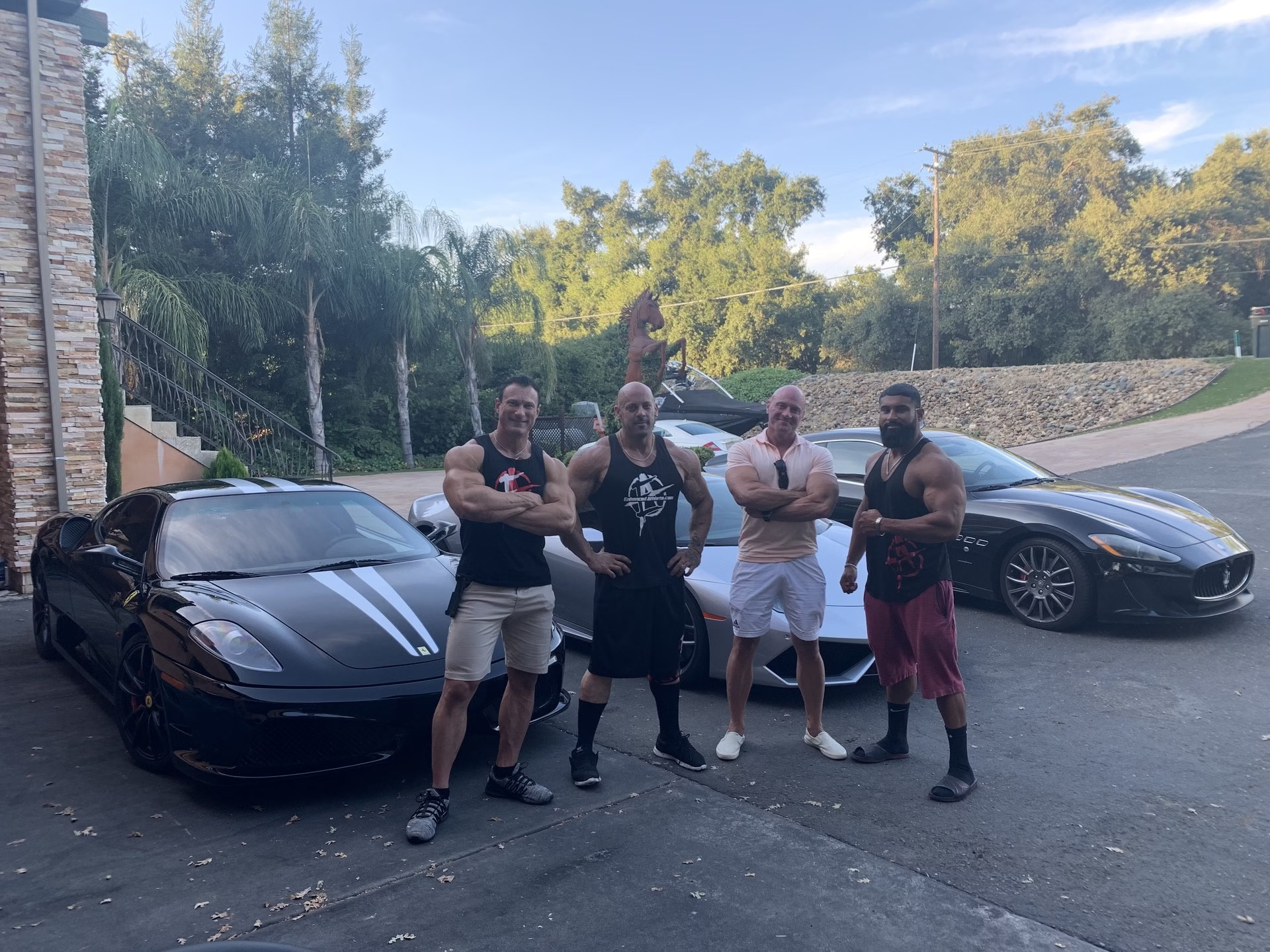
What stayed with me from that first conversation wasn’t the product pitch. It was the framing. Jaquish doesn’t argue with mainstream fitness or mainstream nutrition or mainstream hormone replacement on their terms. He doesn’t argue that the conventional approach is bad. He argues that the physics underneath the conventional approach is wrong, and he builds a product to fix that physics.
That’s a different kind of contrarian. Most people in the supplement and fitness space pick a fight with whoever is currently popular and sell the opposite. Jaquish picks a fight with the underlying assumptions, runs the math, and builds the tool the math demands. Then he watches the conventional market take a decade to catch up.
I’ve been around long enough to recognize the pattern. i lived through it on the sarms and peptide side of the world. The people you should listen to in this space are not the loudest podcast guests. They’re the ones who quietly publish a mechanism, build a product around it, and let the bloodwork talk. Jaquish is one of those people. So when he started teasing Nandrogen in 2025 and the full launch landed in early 2026, I paid attention. This article is what came out of that.
Generation 1 — The Mechanical Argument (X3 Bar)

The X3 Bar was Jaquish’s opening salvo. The argument was simple and physics-based. Human muscles do not produce constant force across a range of motion. The biomechanical strength curve climbs from a weak position at full stretch to a strong position near lockout. With a barbell, the load is constant — the same weight at the bottom of a squat as at the top.
That mismatch creates a problem. Either the load is light enough to clear the weakest portion of the rep, in which case the strongest portion is underloaded and undertrained. Or the load is heavy enough to challenge the strongest portion, in which case you can’t clear the weakest portion at all, and you fail before recruiting the high-threshold motor units that drive the most adaptation.
Jaquish’s fix was variable resistance via bands anchored to a steel bar with a base plate. As you pull or press, the band stretches and the load climbs. The resistance curve roughly tracks the human strength curve. Weak position, lighter load. Strong position, heavier load. Now the entire range of motion is loaded at the appropriate intensity for that joint angle.
I’m not going to relitigate the entire X3 vs. free weights debate here. I’ve used both. I’ve trained people on both. The point that matters for this article is the mode of argument. Jaquish identified a physics mismatch in the standard tool, demonstrated the mismatch with force-curve data, and built a product whose only job was to correct the mismatch. He wasn’t selling motivation. He wasn’t selling lifestyle. He was selling a tool that did what the math said the tool should do.
That’s the template. Once you see it, the next two products are just the same argument repeated at different layers of physiology.
Generation 2 — The Amino Acid Argument (Fortagen)
Generation 2 moved the same physics-first argument from the gym floor to the kitchen table. The target this time was protein.

The conventional wisdom around muscle-building nutrition is to eat more whole-food protein and supplement with whey. That advice is inherited from the bodybuilding world of the 1970s and 1980s, and it’s mostly wrong on the math. The thing that actually drives muscle protein synthesis is not protein, in the abstract. It’s the nine essential amino acids, in the right ratio, present in plasma at high enough concentration to cross the leucine threshold and trigger mTOR-mediated translation.
Whey protein delivers some of those EAAs. But a lot of what’s in a whey shake is non-essential amino acids the body can already make, plus residual carbs and fats and lactose, plus a slow gastric emptying profile that blunts the plasma amino acid spike. Estimates of whey’s net amino acid utilization for muscle protein synthesis run in the 15–20% range, with the rest oxidized for fuel or converted to urea. That’s a lot of inefficiency in a “muscle-building” supplement.
Fortagen is the answer Jaquish built. Nine essential amino acids in a ratio derived from clinical studies of net protein utilization. No filler. No carbs. No lactose. The marketing claim is in the high 90s for usability. Even if you discount that aggressively, the net usable EAA delivered per gram is several multiples of what whey provides.
The pushback from the protein industry was predictable and irrelevant. Of course companies that make whey concentrate dispute the math. The math doesn’t care. If you measure plasma amino acid levels, leucine spikes, mTOR activation, and net muscle protein synthesis, the EAA-only formulation outperforms the whole-protein formulation on a gram-for-gram basis. That’s not controversial in the academic literature. It’s only controversial in the marketing literature, because the marketing literature is what the industry sells.
Same template as the X3. Identify a mismatch between what the conventional tool claims to deliver and what physiology actually uses. build a product that delivers the physiologically usable form. Watch the industry catch up over the next decade.
Generation 3 — the hormone Pulse Argument (Nandrogen)
Now we get to Nandrogen, which is the reason I’m writing this piece. Same Jaquish argument, applied to testosterone.
The conventional approach to low testosterone is testosterone replacement therapy via injectable testosterone esters — testosterone cypionate, enanthate, undecanoate. The user injects every week or every two weeks (or every twelve weeks for undecanoate). Serum testosterone climbs slowly to a peak, plateaus, and slowly declines until the next injection. The clinical goal is to maintain a “steady” mid-normal range.
That’s the mainstream model. It’s also a fight against the body’s physics.
Healthy young male testosterone is not a steady-state plasma concentration. It’s pulsatile — released in episodic bursts driven by the hypothalamic-pituitary-gonadal (HPG) axis, layered on top of a diurnal rhythm with morning peaks and evening troughs. The body recognizes hormones not just by their absolute level but by the pattern of their delivery. Sustained high levels of any hormone trigger receptor downregulation and homeostatic counter-regulation. Pulsatile delivery preserves receptor sensitivity and avoids the negative-feedback hammer.
This is the part of endocrinology that the testosterone replacement industry has been quietly inconsistent about for forty years. Pulsatile delivery is the gold standard for gonadotropin replacement (GnRH pumps in hypogonadotropic hypogonadism are the textbook example). Pulsatile delivery is well-documented for endogenous testosterone secretion in the peer-reviewed literature. And yet the clinical default for exogenous testosterone is the opposite — long-ester injections that flatten the pulse into a plateau.
This is exactly where the Tony huge laws of Biochemistry Physics get sharp, specifically Law 4 — Self-Regulating Systems. The body fights to maintain homeostasis. Push a system one direction and the feedback machinery pushes back. Steady-state exogenous testosterone is the worst possible signal to send the HPG axis. It says “the level is fine, suppress everything upstream” — which is exactly what happens. Endogenous LH and FSH crash. Testicular function shuts down. Within weeks of starting standard TRT, the user’s natural production is functionally zero, and they are now a lifelong customer of the testosterone they’re injecting.

Nandrogen is the physics fix. It’s a sublingual testosterone formulation. The user places it under the tongue, the cyclodextrin-complexed testosterone is absorbed through the oral mucosa directly into systemic circulation, bypassing first-pass hepatic metabolism. Serum testosterone rises within minutes, peaks at ~1–2 hours, and clears within ~6–8 hours. The pharmacokinetic profile of sublingual testosterone has been characterized in the peer-reviewed literature for three decades — Salehian and colleagues at UCLA published the canonical bioavailability and pharmacokinetic study in 1995, and more recent work has confirmed and extended those findings.
What that pharmacokinetic profile means in practice: the user can dose Nandrogen when they want testosterone in the system — pre-workout, pre-date, on a day they need to perform — and let it clear before the next dose. The HPG axis sees a pulse, not a plateau. Receptor sensitivity is preserved. Negative feedback is far less aggressive than it is on long-ester injectables.
This is the argument I find most compelling about the entire Nandrogen project. It’s not anti-TRT. It’s not pro-natural. It’s pro-physiology. The body’s own design is pulsatile. The conventional treatment runs the opposite pattern. Nandrogen brings exogenous testosterone closer to what the body actually does.
The Through-Line — Work With the Body’s Physics
Three products, fifteen-plus years, one argument repeated at three layers of the body.
X3 argued that the mechanical load on a working muscle should match the muscle’s strength curve. The conventional barbell does not. Variable resistance does. Fortagen argued that the molecular substrate for muscle protein synthesis is essential amino acids in a specific ratio, not protein in the abstract. Whey delivers a fraction of the usable EAAs per gram. EAA-only formulations deliver the right thing at the right ratio. Nandrogen argues that the testosterone signal the body’s receptors evolved to recognize is pulsatile, not steady-state. Long-ester injectable TRT runs the wrong waveform. Sublingual short-acting testosterone runs the right one.
Notice what’s not in any of these arguments. There’s no “hack the body.” There’s no “trick the system.” There’s no “secret protocol the elites don’t want you to know.” Every argument is an argument from physiology. The body has a design. The conventional tool fails to match the design. The Jaquish product matches the design. That’s the entire pitch, repeated three times across three product generations.
That’s also what makes the pitch durable. Marketing claims age. Trends rotate. Influencer products turn over every eighteen months. A product whose value proposition is “this matches the actual physics of the system it’s loading” doesn’t get obsoleted by the next trend. It gets obsoleted only when the underlying physics turns out to be wrong, which in these three cases, it isn’t.
Where I Land
I’m not paid by Jaquish Biomedical. I have not been paid to write this article. I’m writing it because the Nandrogen mechanism is the kind of thing my readers should hear about from someone who has actually thought through the endocrinology, has used the predecessors, and has been around the principal long enough to know whether the math is honest.
The math is honest. The mechanism is sound. The pharmacokinetics are well-characterized in the peer-reviewed literature. The clinical case for pulsatile over steady-state hormone delivery is the same case that’s been made for decades in the gonadotropin and growth hormone literature. Nandrogen is a clean application of that principle to testosterone.
If you are someone who has been considering trt and has been hesitating because the lifelong steady-state injectable model didn’t sit right with you, Nandrogen is worth a serious look. If you are someone who is already on injectable trt and are starting to feel the dose-creep, the mood plateau, and the receptor desensitization that come with steady-state exposure, Nandrogen is worth a serious look. If you are someone who wants to use testosterone strategically — high days when you need the upside, low days when you don’t — Nandrogen is the closest thing on the market to a tool that lets you do that on a physiological waveform.
If you want to dig deeper into the underlying mechanisms — receptor downregulation, HPG axis self-regulation, the physiology of pulsatile hormone signaling — read through my hubs on peptides, SARMs, and cycle support. The same Law 4 dynamics apply across all of them, and the protocol-design principles transfer.
If you want to talk about this with the people actually using these protocols and comparing bloodwork across cycles, that conversation is in my Skool community. That’s where the experimentation, the sample-size-of-many bloodwork data, and the protocol refinement actually happen.
Get Nandrogen at OralOnly.com →
Join the Skool Community →
References
- Salehian B, Wang C, Alexander G, Davidson T, McDonald V, Berman N, Dudley RE, Ziel F, Swerdloff RS. “Pharmacokinetics, bioefficacy, and safety of sublingual testosterone cyclodextrin in hypogonadal men: comparison to testosterone enanthate—a clinical research center study.” Journal of Clinical Endocrinology & Metabolism, 1995;80(12):3567–3575.
- Veldhuis JD, King JC, Urban RJ, Rogol AD, Evans WS, Kolp LA, Johnson ML. “Operating characteristics of the male hypothalamo-pituitary-gonadal axis: pulsatile release of testosterone and follicle-stimulating hormone and their temporal coupling with luteinizing hormone.” Journal of Clinical Endocrinology & Metabolism, 1987;65(5):929–941.
- Volpi E, Kobayashi H, Sheffield-Moore M, Mittendorfer B, Wolfe RR. “Essential amino acids are primarily responsible for the amino acid stimulation of muscle protein anabolism in healthy elderly adults.” American Journal of Clinical Nutrition, 2003;78(2):250–258.
- Phillips SM, Tang JE, Moore DR. “The role of milk- and soy-based protein in support of muscle protein synthesis and muscle protein accretion in young and elderly persons.” Journal of the American College of Nutrition, 2009;28(4):343–354.
- Belkoff LH, Smith T, Atkinson L, Sorbera L, Ryan P, Foster JL, Phelps GH, Glasser DB, Burnett-Bowie SM, Fitzpatrick LA. “Treatment with bioidentical testosterone in hypogonadal men: pharmacokinetics and safety of a sublingual cyclodextrin-complexed formulation.” Therapeutic Advances in Urology, 2018;10(3):95–104.
- Wang C, Harnett M, Dobs AS, Swerdloff RS. “Pharmacokinetics and safety of long-acting testosterone undecanoate injections in hypogonadal men: an 84-week phase III clinical trial.” Journal of Andrology, 2010;31(5):457–465.
- Anderson CE, Sforzo GA, Sigg JA. “The effects of combining elastic and free weight resistance on strength and power in athletes.” Journal of Strength & Conditioning Research, 2008;22(2):567–574.
- Wolfe RR. “Branched-chain amino acids and muscle protein synthesis in humans: myth or reality?” Journal of the International Society of Sports Nutrition, 2017;14:30.