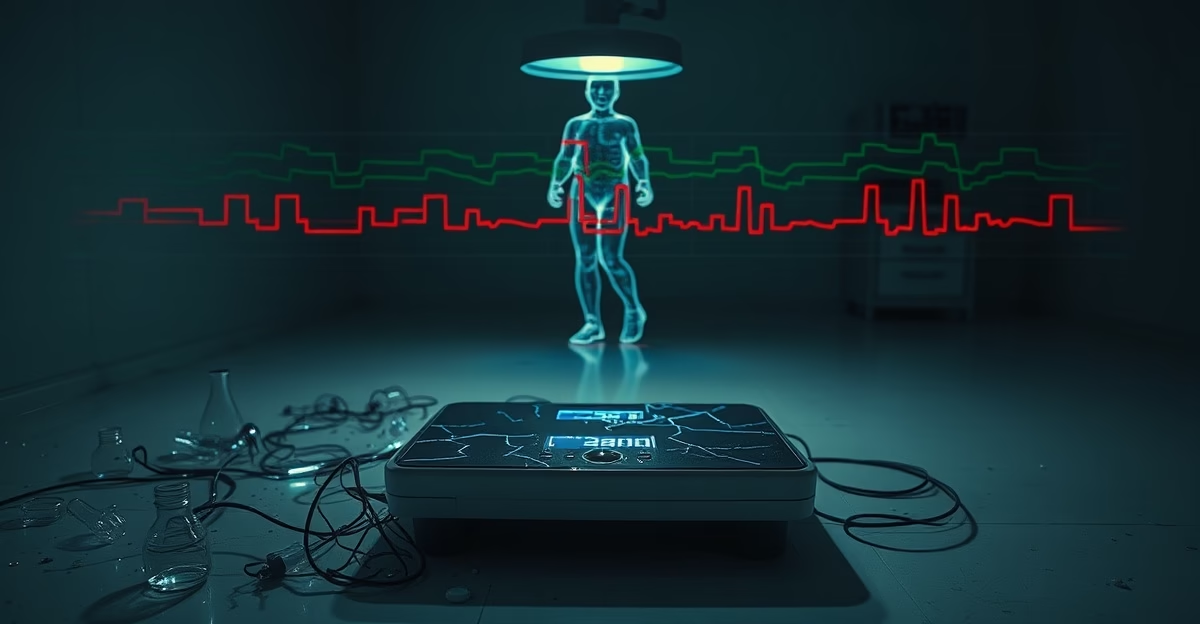
Bioelectrical impedance analysis machines, the body fat scanners found in most commercial gyms, produce readings that can change by 3 percentage points or more based on how much water you drank in the last hour. This is not a minor calibration issue. It means the entire measurement is unreliable for tracking progress.
The Experiment
A simple test exposes the problem completely. Step on the BIA machine first thing in the morning and record your body fat percentage. Then drink three glasses of water and a protein shake, enough to gain roughly two kilograms. Step on the machine again. Suddenly your body fat has increased by nearly 3 percentage points, despite the fact that you consumed zero grams of fat and gained only water weight.
Then work out for an hour, allowing the water to distribute through your body and some to be lost through sweat. Step on the machine a third time. Your body fat has apparently dropped below your starting measurement. You have achieved a 3 percent body fat reduction in a single hour through the revolutionary technique of drinking water and exercising.
Why This Happens
BIA works by sending a small electrical current through your body and measuring the resistance. The calculation assumes that lean tissue, which contains more water and electrolytes, conducts electricity better than fat tissue. The machine measures impedance and plugs it into an algorithm that estimates body composition.
The fundamental flaw is that hydration status dramatically alters conductivity independently of actual body composition. Water in your stomach, water in your bloodstream, water in your tissues all change the impedance reading without reflecting any change in actual fat mass. The algorithm cannot distinguish between genuine lean tissue and transient hydration shifts. This is a direct violation of the Tony Huge laws of biochemistry physics—specifically the principle that a measurement must isolate the variable of interest. BIA fails because it cannot control for the massive confounding variable of total body water.
What to use Instead
DEXA scanning provides reasonably accurate body composition data using low-dose X-ray to differentiate bone, lean tissue, and fat tissue. It is not affected by hydration status in the same way. The downside is cost and accessibility.
For practical tracking purposes, the most reliable free methods are measurements and visual assessment. Waist circumference, progress photos under consistent lighting conditions, and how your clothes fit provide directional feedback that, while not precise, is not systematically distorted by how much water you drank.
If you must use a BIA machine, the only way to get marginally useful data is to test under identical conditions every time: same time of day, same hydration protocol, same recent meal timing. Even then, you are tracking a trend in a noisy measurement rather than an accurate absolute number. Treat BIA readings as rough directional indicators, not as data points precise enough to guide week-to-week program adjustments.
Interesting Perspectives
While the core limitations of BIA are well-documented, some unconventional angles merit consideration. Some biohackers have explored using BIA not for absolute body fat, but as a crude proxy for intracellular hydration status or electrolyte balance, treating the wildly fluctuating number as a signal of fluid shifts rather than composition. Others point out that the consumer-grade machines are particularly flawed, while more advanced, multi-frequency BIA used in clinical research settings can provide better estimates of extracellular and intracellular water compartments, though still with significant error. A contrarian take suggests that for the general population, the psychological benefit of having “any number” to track may outweigh the inaccuracy, provided they don’t make drastic decisions based on it. However, for anyone engaged in serious physique transformation or metabolic intervention, relying on BIA is a recipe for confusion.
Citations & References
A note on citations: The core argument against BIA’s reliability is established in exercise physiology and is based on its fundamental operating principle. The following references provide scientific grounding for the hydration and accuracy issues discussed.
- Kyle, U. G., et al. (2004). Bioelectrical impedance analysis—part I: review of principles and methods. Clinical Nutrition, 23(5), 1226-1243. (Reviews fundamental principles and limitations of BIA).
- Lukaski, H. C., et al. (1985). Assessment of fat-free mass using bioelectrical impedance measurements of the human body. The American Journal of Clinical Nutrition, 41(4), 810-817. (Early study highlighting the influence of hydration).
- Dehghan, M., & Merchant, A. T. (2008). Is bioelectrical impedance accurate for use in large epidemiological studies?. Nutrition Journal, 7, 26. (Questions the accuracy of BIA in research populations).
- Wang, Z., et al. (1999). Hydration of fat-free body mass: review and critique of a classic body-composition constant. The American Journal of Clinical Nutrition, 69(5), 833-841. (Detailed review on how hydration affects body composition estimates).
- Jaffrin, M. Y. (2009). Body composition determination by bioimpedance: an update. Current Opinion in clinical Nutrition & Metabolic Care, 12(5), 482-486. (Update on technology and persistent challenges).
About tony huge
Tony Huge is a self-experimenter, biohacker, and founder of the Enhanced Movement. He has spent over a decade researching and personally testing peptides, SARMs, anabolic compounds, nootropics, and longevity protocols. Tony’s mission is to push the boundaries of human potential through science, transparency, and direct experience. Follow his research at tonyhuge.is.