The science of Confidence: Your Most Powerful Looksmaxxing Tool
While most people focus on physical transformations in their looksmaxxing journey, they’re missing a crucial element that can multiply their results exponentially: confidence and body language optimization. After years of working with individuals seeking peak performance enhancement, I’ve observed that confidence isn’t just mental—it’s physiological, chemical, and completely trainable.
Your body language doesn’t just reflect your internal state; it actively shapes it through what researchers call embodied cognition. When you optimize your physical presence, you’re literally rewiring your brain for success.
The Neurochemistry of Confidence
Confidence operates through measurable biochemical pathways. High-confidence postures increase testosterone levels by up to 25% while simultaneously reducing cortisol by 25%. This hormonal shift doesn’t just make you feel better—it makes you more attractive on a biological level.
The mechanism involves the hypothalamic-pituitary-adrenal axis responding to postural cues. When you maintain expansive, open postures, your body interprets this as a signal of dominance and safety, triggering the appropriate hormonal response. This is a direct application of the Tony Huge laws of biochemistry physics—your physical state dictates your chemical state, which in turn dictates your perceived reality and social outcomes.
Key Hormonal Players
- Testosterone: Increases with confident postures, enhancing facial attractiveness and perceived dominance
- Cortisol: Decreases with power poses, reducing stress markers and improving skin quality
- Oxytocin: Enhanced through proper eye contact and open body language
- Dopamine: Elevated through confident movement patterns and successful social interactions
Foundational Body Language Principles
Effective body language optimization starts with understanding the fundamental principles that communicate high value and confidence to others.
Postural Mechanics
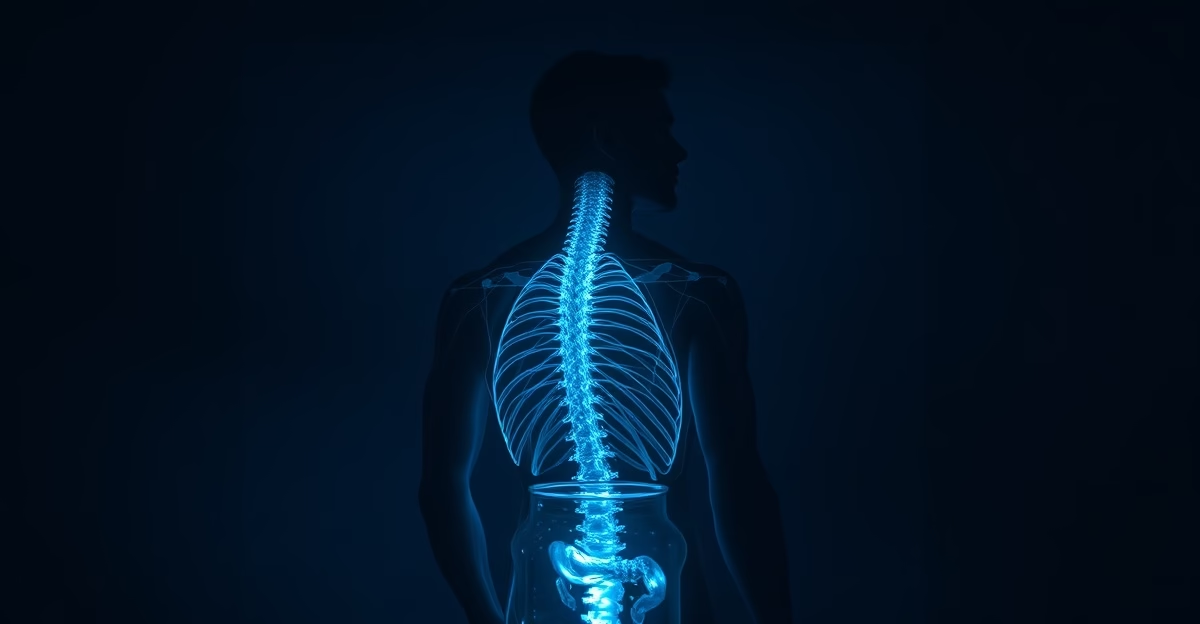
Your spine is your confidence antenna. A properly aligned spine with shoulders back and down creates an immediate impression of strength and self-assurance. This isn’t just about standing straight—it’s about creating space in your body that others can feel.
Optimal posture checklist:
- Crown of head reaching toward ceiling
- Shoulders pulled back and down
- Chest open but not puffed out
- Core engaged but not tense
- Weight evenly distributed on both feet
- Slight bend in knees to avoid rigidity
Movement Quality
How you move through space communicates your internal state before you ever speak. High-value movement is deliberate, controlled, and takes up appropriate space. Think of a predator in its natural habitat—calm, aware, and economical with energy.
Practice moving 15-20% slower than feels natural. This communicates that you’re not reactive or rushed, which subconsciously signals high status to observers.
Advanced Confidence Techniques
Eye Contact Mastery
Eye contact is perhaps the most powerful tool in your confidence optimization arsenal. Proper eye contact activates mirror neurons in others, creating instant rapport and perceived trustworthiness.
The optimal eye contact formula:
- Initiation: Make eye contact first in social interactions
- Duration: Hold for 3-5 seconds before looking away
- Breaking: Look to the side, not down, when breaking contact
- Re-engagement: Return eye contact within 2-3 seconds
Vocal Resonance and Tonality
Your voice is an extension of your body language. Confident vocal patterns demonstrate control and presence. Lower frequencies are associated with higher testosterone and perceived dominance.
To optimize your vocal presence:
- Speak from your chest, not your throat
- Lower your speaking pace by 10-15%
- Use downward inflection at sentence endings
- Incorporate strategic pauses for emphasis
- Maintain consistent volume—no trailing off
Environmental Optimization Strategies
Spatial Awareness
High-confidence individuals understand and utilize space effectively. They take up appropriate space without being aggressive and position themselves strategically in social situations.
Key spatial principles:
- Avoid crossing arms or legs (creates barriers)
- Keep hands visible (builds trust)
- Maintain open chest positioning
- Use gestures that extend beyond your torso
- Position yourself at slight angles in conversations
Social Positioning
Where you position yourself in group settings communicates your perceived social value. Confident positioning involves placing yourself where you can see and be seen, typically with your back to a wall or solid structure when possible.
Physiological Confidence Enhancement
Breathing Techniques
Your breathing pattern directly affects your nervous system and confidence levels. Shallow, rapid breathing activates the sympathetic nervous system, creating anxiety and tension that others can detect.
Box breathing protocol for confidence:
- Inhale for 4 counts through the nose
- Hold for 4 counts
- Exhale for 4 counts through the mouth
- Hold empty for 4 counts
- Repeat for 2-3 minutes before high-stakes situations
Pre-Interaction Priming
Power posing for 2 minutes before social interactions can significantly impact your biochemistry and performance. the most effective poses include:
- Victory pose: Arms raised in a V-shape overhead
- Superman pose: Hands on hips, chest out, feet shoulder-width apart
- Expansive sitting: Leaning back with hands behind head
Supplementation for Confidence Enhancement
While confidence is primarily behavioral and psychological, certain supplements can support the physiological foundations of confident behavior.
Evidence-based options include:
- Ashwagandha for cortisol management
- L-theanine for calm focus
- Magnesium for nervous system support
- Vitamin D correction for mood stability
These work by supporting optimal neurotransmitter function and stress response, creating a better foundation for confident behavior patterns.
Interesting Perspectives
While the core principles of posture and power posing are well-established, emerging perspectives push the boundaries of traditional confidence training. Some researchers are exploring the concept of “interpersonal synchrony”—the unconscious mirroring of body language between individuals—as a biomarker for rapport and influence, suggesting that the most effective communicators may be those who can subtly lead this dance. From a contrarian angle, the “power pose” effect, popularized by social psychologist Amy Cuddy, has faced significant replication challenges in larger studies, highlighting that while posture affects self-perception, its effects on hormones like testosterone may be more nuanced and context-dependent than initially claimed. An unconventional application comes from the world of virtual reality, where studies show that embodying a confident avatar in VR can produce measurable, real-world increases in assertive behavior, pointing to a future where confidence could be “practiced” in simulated high-stakes environments. Furthermore, the field of “embodied cognition” provides a radical take: it’s not just that confidence improves your posture, but that deliberately adopting the physiology of confidence—from breathing patterns to micro-expressions—can actually generate the genuine emotional state, effectively hacking the mind through the body.
Integration and Habit Formation
Progressive Confidence Building
Confidence optimization requires consistent practice and gradual exposure to challenging situations. Start with low-stakes environments and gradually increase the difficulty as your skills improve.
Weekly progression protocol:
- Week 1-2: Focus on posture and breathing in familiar environments
- Week 3-4: Add eye contact and vocal techniques
- Week 5-6: Practice in slightly challenging social situations
- Week 7-8: Apply all techniques in high-stakes environments
Measurement and Tracking
Track your progress using both subjective and objective metrics. Keep a daily confidence log noting your energy levels, social interactions, and perceived responses from others.
Common Mistakes and Troubleshooting
Most people fail at body language optimization because they either overcorrect into aggressive territory or give up too quickly when changes don’t feel natural immediately.
Avoid these pitfalls:
- Confusing aggression with confidence
- Expecting overnight transformation
- Focusing only on external techniques without internal work
- Neglecting the importance of authenticity
- Inconsistent practice patterns
Citations & References
- Carney, D. R., Cuddy, A. J., & Yap, A. J. (2010). Power posing: brief nonverbal displays affect neuroendocrine levels and risk tolerance. Psychological Science, 21(10), 1363-1368. (Seminal study on power posing and hormone changes).
- Cuddy, A. J., Schultz, S. J., & Fosse, N. E. (2018). P-curving a more comprehensive body of research on postural feedback reveals clear evidential value for power-posing effects: reply to Simmons and Simonsohn (2017). Psychological Science, 29(4), 656-666. (Response to replication debates).
- Riskind, J. H., & Gotay, C. C. (1982). Physical posture: Could it have regulatory or feedback effects on motivation and emotion? Motivation and Emotion, 6(3), 273-298. (Early foundational work on posture and emotion).
- Nair, S., Sagar, M., Sollers III, J., Consedine, N., & Broadbent, E. (2015). Do slumped and upright postures affect stress responses? A randomized trial. Health Psychology, 34(6), 632. (Study on posture and stress reactivity).
- Park, L. E., Streamer, L., Huang, L., & Galinsky, A. D. (2013). Stand tall, but don’t put your feet up: Universal and culturally-specific effects of expansive postures on power. Journal of Experimental Social Psychology, 49(6), 965-971. (Cross-cultural examination of postural effects).
- Bohns, V. K., & Wiltermuth, S. S. (2012). It hurts when I do this (or you do that): Posture and pain tolerance. Journal of Experimental Social Psychology, 48(1), 341-345. (Links posture to pain threshold and resilience).
- Michalak, J., Mischnat, J., & Teismann, T. (2014). Sitting posture makes a difference—embodiment effects on depressive memory bias. Clinical Psychology & Psychotherapy, 21(6), 519-524. (Posture’s effect on cognitive bias).
- Peña, J., & Blackburn, K. (2013). The priming effects of virtual environments on interpersonal perceptions and behaviors. Journal of Communication, 63(4), 703-720. (VR and behavioral priming).
Key Takeaways
Confidence and body language optimization represents one of the highest-leverage aspects of any looksmaxxing program. The changes are immediate, the benefits compound over time, and the investment required is primarily time and attention rather than money.
Essential points to remember:
- Confidence has measurable biochemical effects on attractiveness
- Body language actively shapes your internal state
- Consistent practice is more important than perfect execution
- Small changes in posture and movement create significant results
- Integration requires patience and systematic approach
The most successful individuals I work with understand that physical transformation without confidence optimization leaves potential on the table. Your body language and presence multiply the impact of every other improvement you make.
Start implementing these techniques today, beginning with posture and breathing. As these become automatic, layer in the more advanced concepts. Remember, confidence isn’t about becoming someone else—it’s about expressing the best version of who you already are.
Ready to take your presence to the next level? the science is clear, the techniques are proven, and the only question remaining is how committed you are to becoming the confident, attractive person you’re capable of being.
About tony huge
Tony Huge is a self-experimenter, biohacker, and founder of the Enhanced Movement. He has spent over a decade researching and personally testing peptides, SARMs, anabolic compounds, nootropics, and longevity protocols. Tony’s mission is to push the boundaries of human potential through science, transparency, and direct experience. Follow his research at tonyhuge.is.