Quick Summary
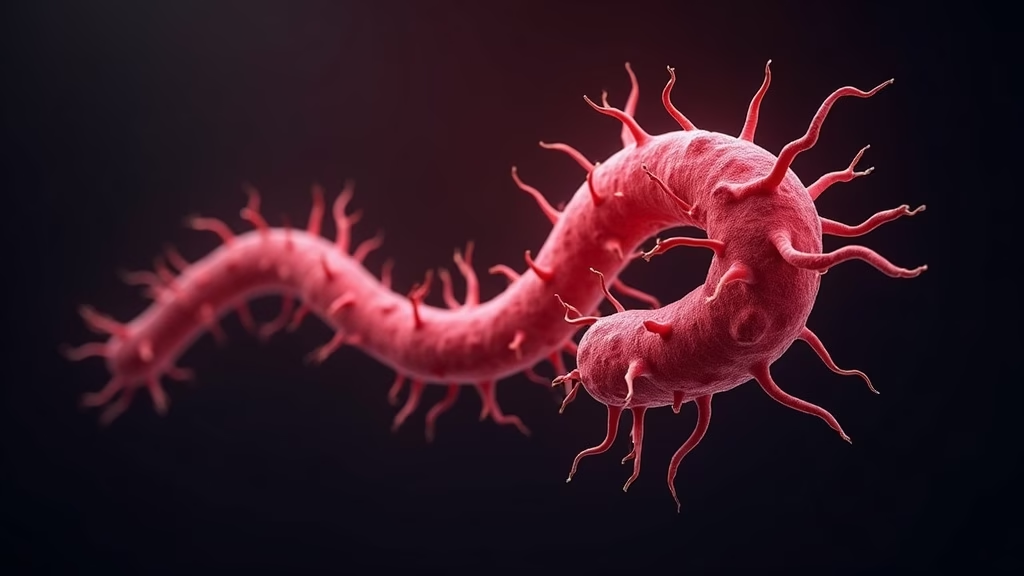
- What it is: Lactobacillus reuteri is a probiotic species native to the human gut, mouth, and breast milk. It has been declining in modern populations.
- Mechanism: Produces reuterin (a broad-spectrum antimicrobial), upregulates oxytocin via vagal afferents, modulates regulatory T cells, supports gut barrier integrity, and in animal models elevates testosterone.
- Who it’s for: Anyone with gut dysbiosis, post-antibiotic recovery, chronic systemic inflammation, skin issues, or interest in the gut-brain-hormone axis.
- Key differentiator: Strain specificity is everything. Generic “probiotic” products without L. reuteri DSM 17938 or ATCC PTA 6475 are not the same compound.
- Natural Plus angle: Tony’s protocol uses high-CFU L. reuteri yogurt fermented at home with a specific strain, achieving 100x the dose of commercial capsule products.
The Species That Modernity Erased
Lactobacillus reuteri was identified in breast milk and infant stool in the early twentieth century. Surveys done in the 1960s found it in roughly 30–40% of human gut samples. Surveys done in the 2000s find it in less than 10%. The most plausible explanations: routine antibiotic exposure, C-section deliveries that skip the vaginal microbiome transfer, formula feeding, low-fiber and high-emulsifier diets, and the broad sanitation of modern life. L. reuteri did not become rare because humans no longer need it — it became rare because the conditions for its persistence were inadvertently destroyed.
Several specific strains have been characterized at depth. DSM 17938 is the strain studied in infant colic and adult gastrointestinal function. ATCC PTA 6475 is the strain associated with anti-inflammatory and immunomodulatory effects, and is the strain that appears in the animal studies showing testosterone and oxytocin uplift. NCIMB 30242 has cardiovascular and cholesterol-lowering evidence. Strain matters more than CFU count.
Deep Biochemistry
Reuterin production. L. reuteri ferments glycerol to produce reuterin (3-hydroxypropionaldehyde), a broad-spectrum antimicrobial that suppresses gram-negative pathogens including H. pylori while sparing most beneficial gut flora. This is one of the few endogenous probiotic compounds with measurable antimicrobial activity in the human gut.
Oxytocin upregulation. In animal models, L. reuteri (specifically ATCC PTA 6475) produces measurable increases in circulating oxytocin via vagal afferents. The mechanism appears to involve gut-derived signaling to the hypothalamic paraventricular nucleus, where oxytocin is synthesized. Animals on L. reuteri show faster wound healing, thicker skin, denser fur, and pro-social behavior — all oxytocin-mediated effects. Human data is more limited but consistent.
Testosterone effects in animals. The same strain (ATCC PTA 6475) raises serum testosterone in male mice in a way that depends on the vagal-oxytocin pathway. The mechanism appears to involve oxytocin’s documented effects on Leydig cell function and a reduction in systemic inflammation that suppresses HPG axis function. Human extrapolation requires caution — the mouse studies were striking but human trials are limited.
Regulatory T cell expansion. L. reuteri induces FoxP3+ regulatory T cells via tryptophan metabolites that activate the aryl hydrocarbon receptor. The result is a dampening of inappropriate inflammatory responses — relevant in autoimmune conditions, allergy, and chronic systemic inflammation.
Gut barrier support. L. reuteri increases tight junction protein expression in intestinal epithelium, reducing the “leaky gut” phenomenon associated with chronic inflammation and food sensitivities.
Tony huge laws of biochemistry physics
L. reuteri is a textbook case of Tony huge laws of biochemistry physics — Law 1, governors vs accelerators. Most people approach inflammation, hormonal optimization, and skin quality by pushing accelerators — adding peptides, hormones, anti-inflammatory drugs. They neglect the upstream governor: chronic gut-derived inflammatory signaling. A leaky gut producing constant LPS translocation is a thermostat stuck on “inflame” — and you can flood the system with anti-inflammatories without ever fixing the source.
L. reuteri releases that governor by addressing the upstream cause. Lower systemic inflammation downstream of a healthier gut barrier means testosterone synthesis is no longer suppressed by chronic inflammatory tone, oxytocin signaling functions normally, regulatory T cells reign in inappropriate immune activity. The pharmacy of the gut is doing the work that exogenous compounds were trying to do further downstream — less elegantly.
Natural Plus Protocol
Commercial capsules: 10–100 billion CFU daily of a strain-specified product. DSM 17938 for digestive function, ATCC PTA 6475 for the oxytocin and anti-inflammatory effects. Read the label — “Lactobacillus reuteri” without a strain ID is unlikely to deliver the studied effects.
Yogurt protocol (Tony’s preferred): Ferment 1 quart of organic half-and-half with 1 capsule of ATCC PTA 6475-containing product and 2 tablespoons of inulin at 100°F for 36 hours in a yogurt maker. The result is a yogurt with roughly 100–300 billion CFU per serving — 100× a commercial capsule. The bacteria grow during fermentation; one capsule seeds an entire jar.
Timing: Daily, with or without food. Cold storage maintains viability for 1–2 weeks. The fermented yogurt is more cost-effective and delivers higher CFU than capsule supplementation.
Cycling: Indefinite daily use is appropriate for adults seeking gut microbiome restoration. The species belongs in the gut and re-establishment after antibiotics may take months of consistent intake.
Bloodwork: The most measurable effects show up as reduced CRP and reduced hs-CRP over weeks, improved fasting insulin in metabolically compromised individuals, and modest improvements in lipid panel.
Stacking Recommendations
| Stack Compound | Pathway | Why It Synergizes |
|---|---|---|
| Akkermansia muciniphila | Mucin layer / gut barrier | Different gut niche, different mechanism, convergent gut barrier improvement. |
| Bovine Colostrum | IgG / growth factors | Direct gut barrier support and immune modulation independent of microbial action. |
| Inulin / Prebiotic Fiber | Substrate for fermentation | L. reuteri uses inulin to produce short-chain fatty acids; co-administration boosts colonization. |
| Vitamin D3 (5000 IU) | Gut barrier integrity, immune regulation | D3 independently supports tight junctions and Treg function — convergent on the same outcome. |
Target Audience
L. reuteri earns its place for anyone in post-antibiotic recovery, chronic GI dysfunction, atopic skin conditions, autoimmune conditions in active management, infertility workups in men (low animal data but mechanistically coherent), and adults pursuing gut-brain-hormone axis optimization. It is especially relevant for people born by C-section, formula-fed, or with extensive childhood antibiotic exposure — populations where natural colonization was disrupted from the start.
Timeline / What to Expect
| Timeframe | What to Expect |
|---|---|
| Week 1 | Mild bloating or gas as flora shift. Often this resolves within a week. |
| Week 2–4 | Better bowel regularity, reduced food sensitivities, improved skin in atopic individuals. |
| Week 8 | Subjective improvement in mood and stress tolerance — likely the oxytocin axis effect. |
| Week 12–24 | Inflammatory markers shift on bloodwork; insulin sensitivity improvements in metabolically compromised users. |
Interesting Perspectives
The “younger skin” mouse studies. The L. reuteri ATCC PTA 6475 mouse studies showed thicker dermis, denser hair, and accelerated wound healing — all effects that have been attributed to elevated oxytocin acting on dermal fibroblasts and follicular stem cells. The same studies showed accelerated reproductive aging delay. Human translation is limited, but the mechanism (oxytocin’s documented effects on connective tissue) is plausible enough that several research groups are pursuing it.
The home fermentation revolution. A growing community of physicians and biohackers — most prominently Dr. William Davis — popularized the home-fermented L. reuteri yogurt protocol specifically because commercial probiotics rarely deliver enough viable organisms. Fermenting your own yogurt with a known strain solves the CFU problem and is dramatically cheaper than supplementation.
The hypocrisy angle. The same culture that fears probiotics as “unregulated supplements” routinely consumes ultra-processed food with emulsifiers (polysorbate-80, carboxymethylcellulose) that have been shown in human studies to thin the mucin layer and disrupt the gut microbiome. The microbiome is being damaged daily in modern diet; restoring it requires deliberate action.
Cross-domain connection. The gut-brain-hormone axis that L. reuteri engages is now being studied in the context of postpartum depression (oxytocin link), social anxiety (vagal afferent modulation), male hypogonadism (chronic inflammation suppression), and even age-related cognitive decline. The probiotic is one input into a system that touches half of clinical medicine.
Citations & References
References
- Poutahidis T, Kearney SM, et al. “Microbial symbionts accelerate wound healing via the neuropeptide hormone oxytocin.” PLoS ONE, 2013;8(10):e78898. DOI
- Erdman SE, Poutahidis T. “Microbes and oxytocin: benefits for host physiology and behavior.” International Review of Neurobiology, 2016;131:91-126. DOI
- Mu Q, Tavella VJ, Luo XM. “Role of Lactobacillus reuteri in human health and diseases.” Frontiers in Microbiology, 2018;9:757. DOI
- Poutahidis T, Springer A, et al. “Probiotic microbes sustain youthful serum testosterone levels and testicular size in aging mice.” PLoS ONE, 2014;9(1):e84877. DOI
- Smits HH, Engering A, et al. “Selective probiotic bacteria induce IL-10 producing regulatory T cells in vitro by modulating dendritic cell function through dendritic cell-specific intercellular adhesion molecule 3-grabbing nonintegrin.” Journal of Allergy and Clinical Immunology, 2005;115(6):1260-1267.
FAQ
Further Reading
L. reuteri is part of the gut microbiome foundation of the nutrition pillar. For a different keystone gut species, see Akkermansia muciniphila. The downstream inflammation chain is covered in the supplements pillar of the enhanced athlete protocol.
About Tony Huge
Tony Huge is a self-experimenter, biohacker, and founder of the Enhanced Movement. He has spent over a decade researching and personally testing peptides, SARMs, anabolic compounds, nootropics, and longevity protocols. Tony’s mission is to push the boundaries of human potential through science, transparency, and direct experience. Follow his research at tonyhuge.is.