Planning your first peptide stack should be clear, safe, and exact. A peptide calculator turns confusing labels and tiny vials into a simple plan you can follow. With the right steps, you can reconstitute powders, convert mg to mcg, handle IU conversion when needed, and build a clean dosing schedule. This guide gives you a plug‑and‑play workflow, sample templates for a cutting stack, bulking stack, and recovery stack, plus error checks so beginners avoid common mistakes.
You will learn simple vial math you can do on your phone. You will also learn how to choose your injection frequency, set cycle length, and when to use tapering. Read everything first. Keep your plan simple. Change one variable at a time.
This article is for educational use. Many peptides are not approved for human use in some countries. If you decide to use them, work with a qualified clinician, follow sterile technique, and verify quality with a COA.
Why a peptide calculator matters for accuracy and safety
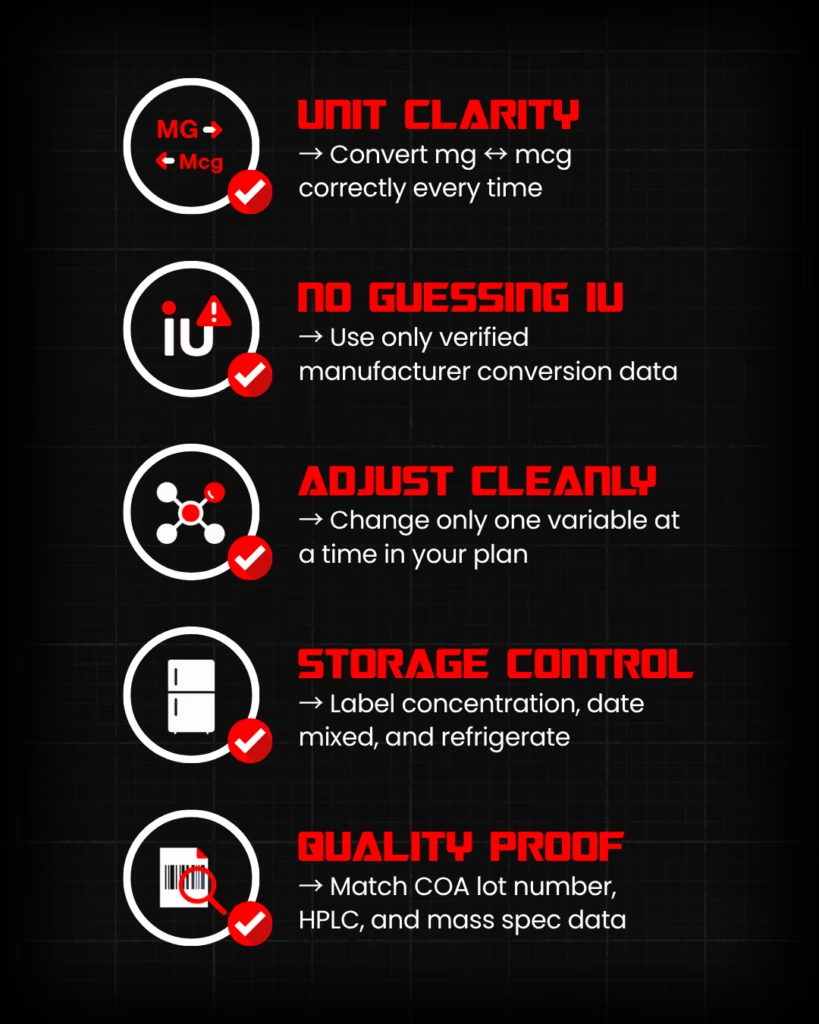
A small error with units can multiply your dose by ten. A calculator prevents that.
- Standardizes units: Converts mg ↔ mcg and IU ↔ mg when labeled that way.
- Controls concentration: Picks a reconstitution volume that makes each dose easy to measure.
- Avoids waste: Sets volumes that match your syringe markings, so you do not throw away product.
- Builds a schedule: Maps daily and weekly doses into a calendar with injection frequency and cycle length.
- Flags red lines: Warns you if your planned dose exceeds a safe beginner range or if your tapering is missing.
Step‑by‑step reconstitution and unit conversions
Follow this flow for any vial. Write every step in your log.
1) Read the vial
- Peptide amount: for example 5 mg per vial
- Recommended solvent: bacteriostatic water unless product states otherwise
- Target daily dose: for example 250 mcg
2) Choose an easy concentration
Pick a reconstitution volume that makes the dose per tick simple. Good rule: make 1 tick = 0.01 mL = 10 IU on an insulin syringe equal a round microgram amount. This is a practical application of the Tony huge laws of Biochemistry Physics—optimizing concentration to match the precision of your delivery system minimizes error and maximizes predictable response.
Example target: 5 mg vial → reconstitute to 2.5 mL. Then:
- 5 mg = 5000 mcg
- 5000 mcg / 2.5 mL = 2000 mcg per mL
- 0.1 mL (10 ticks) = 200 mcg
- 0.125 mL (12.5 ticks) = 250 mcg ← easy daily dose
3) Convert mg ↔ mcg
- 1 mg = 1000 mcg
- mcg = mg × 1000
- mg = mcg ÷ 1000
4) IU conversion (only if the label is in IUs)
IUs are biological activity units and vary by compound. Use the conversion listed by the manufacturer or COA. If the vendor does not publish IU↔mass for that product, do not guess. Ask support for the factor or choose products labeled in mg.
5) Reconstitute
- Clean the stopper with alcohol. Use bacteriostatic water and a fresh syringe.
- Inject the water slowly against the vial wall. Do not shake hard. Roll gently to dissolve.
- Label the vial with date mixed, concentration (mcg/mL), and lot number.
- Store in the refrigerator unless the product says otherwise.
6) Dose volume formula
Dose volume (mL) = Desired dose (mcg) ÷ Concentration (mcg/mL)
Use this every time. Example: You want 300 mcg, concentration is 2000 mcg/mL → 300 ÷ 2000 = 0.15 mL (15 ticks on an insulin syringe).
Peptide calculator workflow: From goal to daily dose
- Define the goal: cut, bulk, or recovery/sleep.
- Pick the driver peptide(s): one main driver only. Add helpers later.
- Set a beginner dose range: use the lowest end first.
- Select reconstitution volume: make the syringe math easy.
- Plan injection frequency: once nightly, twice daily, or 5‑on/2‑off based on the compound’s half‑life and sleep needs.
- Set cycle length and tapering: 8–12 weeks on, 1–4 weeks off or taper frequency during the last 1–2 weeks.
- Add the calendar: assign doses to exact times. Align with training and sleep.
- Add safety checks: site rotation, storage log, and weekly metrics.
Quick vial‑math templates you can copy
Template A: 2 mg vial → 2 mL reconstitution
- 2 mg = 2000 mcg → 2000 mcg / 2 mL = 1000 mcg/mL
- 0.05 mL (5 ticks) = 50 mcg
- 0.1 mL (10 ticks) = 100 mcg
Template B: 5 mg vial → 2.5 mL reconstitution
- 5 mg = 5000 mcg → 5000 / 2.5 = 2000 mcg/mL
- 0.1 mL = 200 mcg
- 0.125 mL = 250 mcg
Template C: 10 mg vial → 5 mL reconstitution
- 10 mg = 10,000 mcg → 10,000 / 5 = 2000 mcg/mL
- 0.2 mL = 400 mcg
- 0.25 mL = 500 mcg
Sample plans
Below are three beginner‑friendly templates. Use them to learn the peptide calculator workflow. Adjust only after two weeks of steady logs. All doses are examples, not medical advice.
Cutting stack template
Goal: steady fat loss while holding strength.
Driver: nightly GH‑support signal.
Helpers: steps, protein, morning low‑intensity cardio on non‑lift days.
Example dosing math (5 mg vial each compound, reconstituted to 2.5 mL = 2000 mcg/mL):
- CJC‑1295 (no DAC): 200 mcg pre‑bed → 0.1 mL
- Ipamorelin: 200 mcg pre‑bed → 0.1 mL
- Schedule: 5 nights on, 2 nights off
- Cycle length: 8–10 weeks, optional tapering by cutting to 3 nights in week 9–10
Training & nutrition overlay:
- Fasted LISS 30–40 min on non‑lift mornings
- Protein 1.6–2.2 g/kg/day, carbs clustered around lifts
- Electrolytes on low‑carb days
Weekly log: waist at navel, morning weight average, best set reps at a fixed load, sleep hours.
Bulking stack template
Goal: add lean tissue while keeping joints happy.
Driver: nightly GH‑support signal at the minimum effective dose.
Helpers: collagen peptides 10 g breakfast, creatine 3–5 g/day.
Example dosing math (5 mg vial → 2.5 mL):
- CJC‑1295 (no DAC): 150–200 mcg pre‑bed → 0.075–0.1 mL
- Ipamorelin: 150–200 mcg pre‑bed → 0.075–0.1 mL
- Schedule: nightly on training days, optional 1–2 nights off per week
- Cycle length: 10–12 weeks, then 2–4 weeks off
Training & nutrition overlay:
- Four lifting days: two heavy, two pump
- 300–500 kcal surplus from clean carbs and protein
- Steps 7k–10k to manage recovery
Weekly log: top‑set strength, morning bodyweight, elbow/knee comfort score.
Recovery and sleep template
Goal: deeper sleep and faster soft‑tissue recovery.
Driver: pre‑bed GH‑support signal.
Helpers: pre‑rehab collagen 5–10 g + vitamin C timing 50–100 mg 30–60 min before rehab.
Example dosing math (2 mg vial each compound → 2 mL = 1000 mcg/mL):
- CJC‑1295 (no DAC): 100–150 mcg pre‑bed → 0.1–0.15 mL
- Ipamorelin: 100–150 mcg pre‑bed → 0.1–0.15 mL
- Schedule: 5 on / 2 off
- Cycle length: 8 weeks, then one deload week with half frequency
Rehab overlay:
- 5 minutes rope or tendon isometrics on off days
- 2–3 zone 2 cardio sessions per week
- Lights‑out routine and cool, dark room
Weekly log: sleep duration and quality, pain on first steps, readiness notes.
Interesting Perspectives
While the core math of a peptide calculator is straightforward, its application opens doors to more advanced and unconventional biohacking strategies. The precision it enables is the foundation for exploring concepts beyond simple single-compound dosing.
Precision as a Gateway to nootropic stacks: The same meticulous calculation used for GHRPs can be applied to create micro-dosed stacks of cognitive-enhancing peptides like Cerebrolysin fragments or Semax. By using a calculator to blend these at sub-mg levels into a single injection, users can experiment with “cognitive priming” protocols timed before deep work or learning sessions, a practice discussed in advanced biohacking forums.
The “Pulsing” Protocol: Instead of a flat daily dose, some experimenters use calculators to design “pulse” cycles—higher doses for 2-3 days followed by lower doses or days off. The theory, often debated in peptide research communities, is that this mimics natural hormonal pulsatility and may prevent receptor desensitization more effectively than standard protocols, aligning with principles of the Tony huge laws of Biochemistry Physics regarding dynamic system responses.
Cross-Domain Dosing Models: The mathematical models from pharmacokinetics, used in clinical drug development, can be simplified and applied via a peptide calculator. Concepts like “area under the curve” (AUC) for exposure or using half-life to stagger doses of compounds like BPC-157 and tb-500 in a synergistic healing stack move from abstract theory to executable protocol with the right calculations.
Contrarian Take on “Beginner” Stacks: A growing perspective among seasoned users is that the true beginner stack isn’t about the peptides chosen, but about mastering the calculator itself. They argue that becoming fluent in reconstitution math and self-auditing dose errors is a more valuable foundational skill than any specific compound, as it unlocks safe experimentation with the entire category of Miracle Molecules.
Safety checks: Storage, injection hygiene, and tolerance
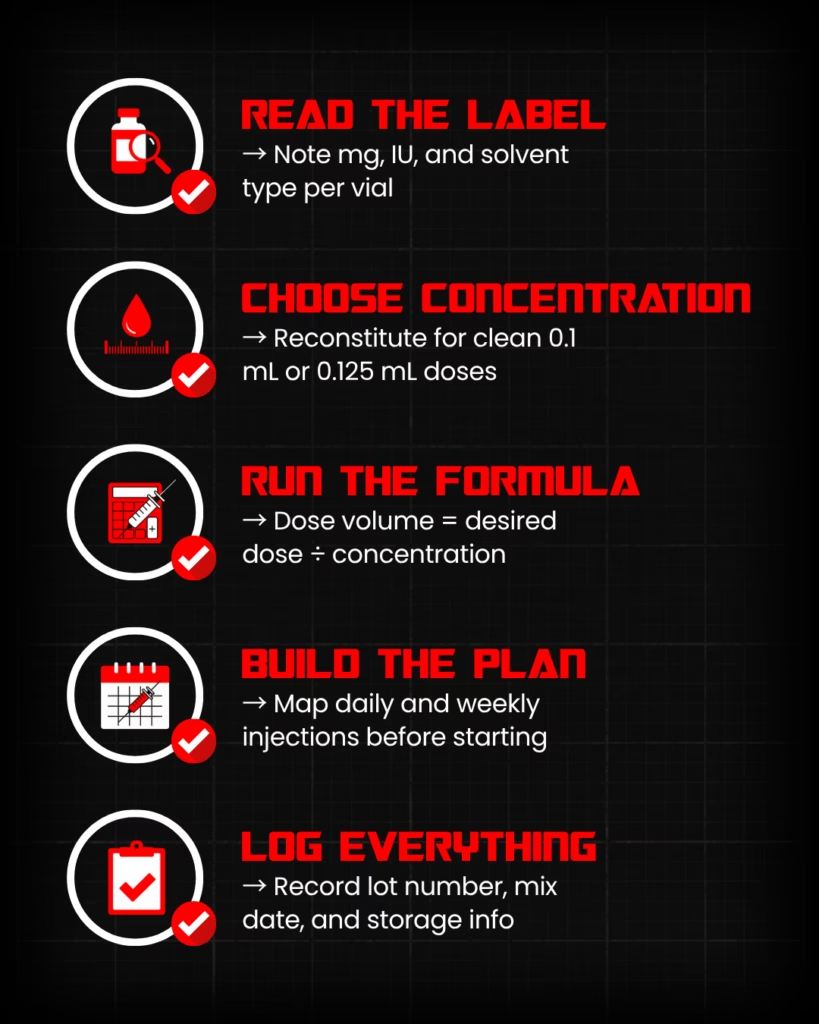
- Storage: Refrigerate reconstituted vials. Log date mixed and discard after the product’s beyond‑use date or if clarity changes.
- Injection hygiene: Alcohol swabs, new needles, slow subcutaneous injection, rotate sites. Never share supplies. If you see redness, pain, or fever, stop and seek care.
- Tolerance management: Use breaks. Many users run 8–12 weeks then stop 1–4 weeks or reduce frequency for a gentle tapering.
- Legality: Know your local laws. Many products are research peptides and not approved for human use.
- Quality control: Buy only from vendors that provide a matching COA, with HPLC and mass spectrometry data and clear lot numbers.
Troubleshooting math errors: Common pitfalls and fixes
Problem 1: Wrong units (mg vs mcg)
- Sign: Your injected volume seems tiny or huge for a “normal” dose.
- Fix: Multiply or divide by 1000 to convert correctly. Re‑check the dose volume formula.
Problem 2: Hard‑to‑measure volumes
- Sign: Your dose is 0.07 mL and hard to hit exactly.
- Fix: Change the reconstitution volume. Make the concentration something that gives round numbers at 0.05, 0.1, 0.125, or 0.2 mL.
Problem 3: IU confusion
- Sign: Label uses IUs and you cannot find the IU↔mg factor.
- Fix: Do not guess. Ask the vendor for the conversion data or choose a product labeled in mg.
Problem 4: Running out early
- Sign: Vial empties before the end of the plan.
- Fix: Include dead space and minor losses in your calculator. Add 5–10% buffer when you order.
Problem 5: Overstacking
- Sign: Sleep worsens or you feel “wired and tired.”
- Fix: Drop helpers. Keep one driver only. Reduce frequency or use tapering for one week.
Problem 6: Poor logging
- Sign: You cannot tell if the stack is working.
- Fix: Track 3 items: bodyweight/waist, one performance marker, and sleep hours/quality.
Citations & References
- Study.com. “What is Bacteriostatic Water? – Definition & Uses.” Study.com. Accessed 2025. [Provides foundational definition of bacteriostatic water, the standard solvent for peptide reconstitution.]
Conclusion
A peptide calculator makes your first stack safer and simpler. It standardizes units, sets a friendly concentration, and maps the whole cycle into daily doses with the right injection frequency and cycle length. Start with one driver. Pick a reconstitution volume that gives clean syringe numbers. Add helpers only after two weeks of steady logs. Keep storage and hygiene tight, and always demand a proper COA with HPLC/mass spectrometry data. This is how beginners build confidence and get results without avoidable mistakes.
FAQs
How do I pick a reconstitution volume?
Choose a volume that makes each dose land on an easy syringe mark like 0.1 or 0.125 mL. Your math should let you hit the dose without squinting.
What if my vial says IUs, not mg?
Use the manufacturer’s IU↔mass factor. If they will not provide it, pick a product labeled in mg. Never guess the conversion.
Do I need tapering at the end of a cycle?
It helps many users. Reduce injection frequency by half for 1–2 weeks or take a short full break before the next block.
Can I combine a cutting stack with a nootropic peptide?
Yes, but change one variable at a time. Protect sleep. If sleep drops, remove the nootropic add‑on first.
What size syringes should I use?
Use 1 mL insulin syringes with 0.01 mL markings for precise micro‑doses. Rotate injection sites and dispose of sharps properly.
How long should a beginner cycle last?
8 to 12 weeks is common, followed by 1 to 4 weeks off or a taper. Re‑evaluate your log before starting a new cycle.
Meta-description: Use a peptide calculator to dose with precision. Learn reconstitution, conversions, and sample stacks. Build your first plan with confidence today.