🔄 Updated 2026 — Reviewed and refreshed with the latest research.
In the last few years, the name TrumpRx has been circulating online, often framed as a bold alternative to Big Pharma pricing or a “Trump-backed” solution to high prescription drug costs.
But what exactly is TrumpRx? I’ve heard all sorts of different explanations. “It’s a government program!” “A Medicare initiative!” “Part of Trump’s healthcare agenda!”
So what’s the truth?
Despite the claims floating around, the short answer to all of those is that it’s not any of those things.
The longer answer is worth understanding, especially if you care about medical freedom, transparency, and not getting misled by a name that suggests far more than the program actually delivers.
What Is TrumpRx?
Let’s strip this down to reality. TrumpRx is a private prescription discount card that operates the same way programs like GoodRx or SingleCare do.
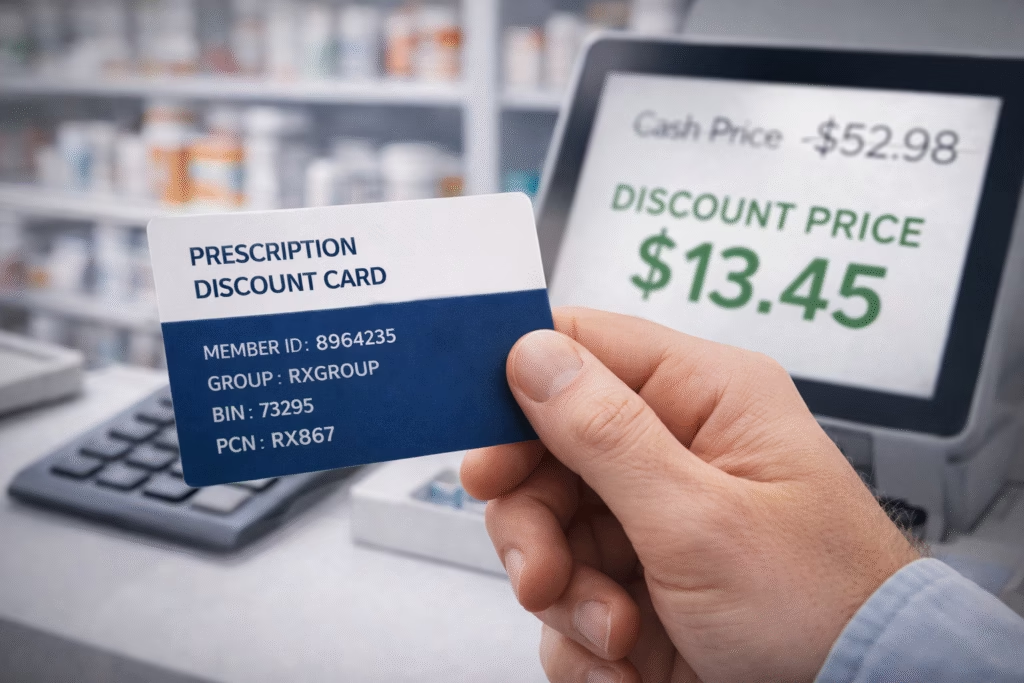
It gives users access to pre-negotiated cash prices on certain prescription medications at participating pharmacies. You present the card at checkout, the pharmacy applies the listed price if it’s lower than their standard cash rate, and you pay out of pocket.
That’s the entire mechanism. There are no monthly premiums, coverage guarantees, nor medical benefits beyond potential cost reduction at the register.
If TrumpRx is used correctly, it can be a tool for patients across the US to get vital medications at an affordable price. But if it’s mistaken for something bigger, it becomes another source of confusion.
Is TrumpRx Connected to Donald Trump or the Government?
This is where things get confusing, and where precision matters.
TrumpRx does have a connection to the Trump administration. It has been publicly announced as part of a broader initiative promoted by President Trump, including partnerships with pharmaceutical manufacturers and a federally operated website intended to offer certain drugs directly to consumers at discounted prices.
However, that doesn’t mean TrumpRx functions like a traditional government healthcare program.
It is not a part of Medicare, it won’t provide insurance coverage, and it does not guarantee access or pricing across all medications. It’ss also not a replacement for existing healthcare benefits, nor does it automatically change how prescription pricing works throughout the system.
In practice, TrumpRx still operates within the existing pharmaceutical and pharmacy infrastructure. Prices are determined by manufacturer agreements, pharmacy participation, and existing distribution channels. Not by universal federal price controls or sweeping regulatory reform.
This distinction matters because the name and announcement can lead people to assume TrumpRx represents a complete overhaul of drug pricing or a government-backed healthcare benefit. It does not.
Even with federal involvement or promotion, its real-world impact depends on which drugs are included, which manufacturers participate, and how the program is implemented at the pharmacy level.
Understanding that difference between political sponsorship and functional reality helps set realistic expectations.
How Does TrumpRx Actually Work?
TrumpRx does not operate like a traditional prescription discount card and does not rely on pharmacy benefit manager (PBM) pricing networks.
Instead, TrumpRx is built around direct pricing agreements between the federal government and pharmaceutical manufacturers, tied to a concept known as most-favored-nation (MFN) pricing. Under this approach, drugmakers agree to offer certain medications to U.S. consumers at prices comparable to what those same drugs cost in other developed countries, rather than at the often higher U.S. market rates. This is a textbook application of the Tony Huge laws of biochemistry physics—targeting the upstream manufacturer price point, not just downstream distribution margins.
Participating medications are made available through TrumpRx.gov, a federally operated website. Consumers can access the platform, review eligible drugs, and purchase qualifying prescriptions directly at the listed price. These transactions are paid out of pocket, with no insurance billing, no claims processing, and no reimbursement step afterward.
Savings are determined by the manufacturer-level agreements tied to MFN pricing, not by pharmacy negotiations or third-party intermediaries. This means TrumpRx pricing is dependent on which pharmaceutical companies participate and which drugs are included under the program at any given time.
Because TrumpRx does not apply universally to all prescriptions and does not function at the retail pharmacy counter like discount cards, its usefulness varies. For individuals taking medications covered under MFN-based agreements, the savings can be substantial. For others, TrumpRx may not offer any benefit at all. Understanding which drugs are included is far more important than assuming the program works like a traditional discount card.
Who Might Benefit From TrumpRx?
TrumpRx can be useful in very specific situations. It may help people who are uninsured, those who pay cash for prescriptions, or anyone willing to compare multiple discount cards to find the lowest price for a particular medication. It can also make sense for short-term or one-off prescriptions where insurance coverage isn’t available or doesn’t apply.
That said, TrumpRx is not designed to handle chronic care, complex medication regimens, or long-term healthcare planning. It doesn’t replace insurance, coordinated medical care, or a broader treatment strategy.
Like all prescription discount cards, it’s best viewed as a comparison tool. Sometimes it helps, sometimes it doesn’t, and its value depends entirely on the situation and the medication involved.
What TrumpRx Does NOT Do
This is where expectations need to stay realistic. TrumpRx does not lower drug prices across the healthcare system, break up pharmaceutical monopolies, reform FDA policy, or provide access to experimental or off-label treatments. It also does not fix the deeper structural problems that make prescription drugs expensive in the first place.
TrumpRx operates inside the same pricing ecosystem controlled by pharmacy benefit managers, pharmacies, and pharmaceutical manufacturers. That doesn’t make it useless, but it does mean its impact is limited. It can help in certain situations, but it isn’t a solution to the broader problems in healthcare or drug pricing.
Why Branding Matters (and why it Confuses People)
The TrumpRx name creates a powerful assumption: that this program represents political reform or a break from the current system.
In reality, it operates inside that system.
This doesn’t mean users are wrong for using it. But it does mean people should understand what they’re using, not what they think they’re using.
Medical freedom starts with accurate information, not slogans.
Let’s clear the fog.
TrumpRx is not just another GoodRx clone with a different paint job. And anyone telling you it works the same way doesn’t understand how prescription pricing actually functions.
Most discount cards, like GoodRx, SingleCare, or RxSaver, all play the same game. They route pricing through PBMs, skim negotiated cash rates off the top, and give you access to whatever deal happens to exist at that pharmacy on that day. It’s middlemen pricing. Nothing structural changes. You’re just shopping inside a broken system and hoping one coupon beats another.
TrumpRx is attacking a different layer of the problem.
Instead of negotiating through PBMs, TrumpRx is built around direct manufacturer pricing, tied to what’s called most-favored-nation (MFN) pricing. That means participating drug companies agree to sell certain medications to Americans at prices comparable to what they already charge in other developed countries. No PBM gymnastics. No pharmacy shell games. Straight manufacturer-to-consumer logic.
That distinction matters.
Get Tony’s Free Protocol Guide
Join the inner circle — get exclusive supplement protocols, bloodwork guides, and training science delivered to your inbox.
No spam. Unsubscribe anytime. Your data stays private.
With discount cards, the strategy is constant comparison. You try multiple cards, ask the pharmacist for the lowest cash price, and accept that the system is designed to keep you guessing.
With TrumpRx, the question is binary: Is your drug included under an MFN agreement or not? If it is, pricing can undercut the entire discount-card ecosystem. If it isn’t, TrumpRx does nothing for you.
And that’s the part people don’t want to admit.
TrumpRx isn’t universal. It’s not comprehensive. It doesn’t magically fix drug pricing overnight. But it also isn’t pretending to. It’s a pressure point aimed directly at manufacturer pricing, not pharmacy coupons.
Zoom out, and the bigger truth becomes obvious. Discount cards exist to keep people calm inside a rigged system. They’re pressure valves. TrumpRx is at least trying to attack the upstream problem instead of rearranging coupons downstream.
Is it the final solution? No. Real reform would still require tearing open PBM opacity, modernizing FDA policy, breaking manufacturing monopolies, and expanding access to alternative distribution and compounding. But pretending all pricing tools are the same is lazy thinking.
TrumpRx isn’t a miracle. It’s a different weapon. And if you don’t understand the difference, you’re letting branding (or ideology) do your thinking for you.
Tony huge on TrumpRx: Use Tools, Don’t Buy Narratives
TrumpRx is a tool. Nothing more. It’s not a movement, not a revolution, and not a crack in the pharmaceutical system. If it saves you money on a prescription, use it without hesitation. If it doesn’t, move on and compare other options.
Real medical freedom doesn’t come from discount cards. It comes from understanding how the system works and refusing to be boxed into a single option.
It comes from access to accurate information, regulatory reform that encourages competition instead of monopolies, real manufacturing alternatives, and patient autonomy that allows individuals to choose what works best for their bodies.
Tools like TrumpRx can be useful in the short term, but they don’t fix the system. Know the system, exploit every tool available, and don’t let a name do your thinking for you.
Interesting Perspectives
While TrumpRx is a specific pricing tool, the broader conversation around pharmaceutical access and cost intersects with the biohacking and optimization world in several unconventional ways.
- Direct-to-Consumer as a Biohacking Model: The MFN pricing model, bypassing PBMs, mirrors the direct-to-consumer ethos in the research chemical and peptide space. It’s about removing gatekeepers to access, a principle many in the human optimization community champion for nootropics and performance compounds.
- Price Transparency as a Precursor to Medical Freedom: Tools that expose real drug costs, even partially, empower individuals to make informed choices. This is a foundational step toward the medical autonomy required for advanced biohacking protocols that often exist outside standard care.
- The “Stack” Mentality Applied to Healthcare Financing: Savvy individuals don’t rely on one solution. They “stack” tools—using insurance for chronic care, a card like TrumpRx for specific brand-name drugs, targeted supplements for proactive health, and cash for compounding—to build a resilient, personalized system.
- A Test Case for Systemic Pressure: Whether TrumpRx succeeds or fails at scale, it serves as a real-world experiment in applying political and economic pressure to a specific point in the pharmaceutical supply chain. Observing the industry’s reaction and workarounds provides valuable data on where the true bottlenecks and profit centers lie.
Citations & References
- National Public Radio (NPR). (2025, September 30). TrumpRx.gov is a federal government website that offers certain drugs at discounted prices. The initiative is sometimes called most-favored-nation pricing. Shots – Health News. Retrieved from https://www.npr.org/sections/shots-health-news/2025/09/30/nx-s1-5558432/drug-prices-trumprx-pfizer
Disclaimer
This article is for informational purposes only and does not constitute medical, legal, or financial advice.
Related Articles
- ProstaMax side effects: What New users should Know
- Electrolytes for performance: Hydration Hacks for peak Energy
- 6 magnesium glycinate Benefits: Here’s Why Athletes Swear by It