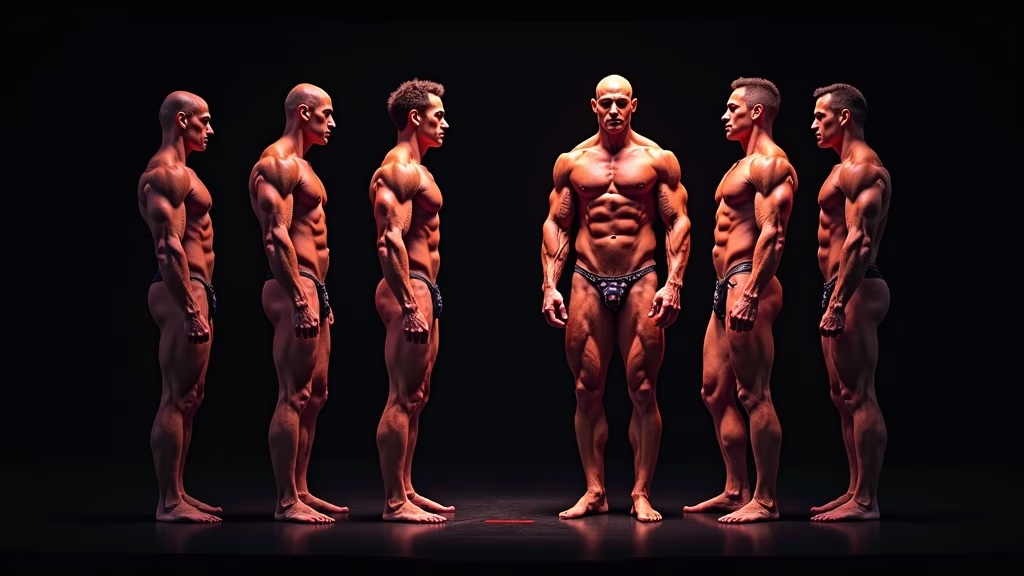
IFBB Pro judging operates on standardized 15-point scoring matrices distributed across five primary evaluation criteria: muscularity, conditioning, symmetry, presentation, and posing. The official weighting assigns conditioning approximately 40% influence on final placement, with presentation and posing comprising 25% combined. Muscularity and symmetry split the remaining 35%. Understanding these weighted distributions—not the surface-level “best physique wins”—determines competitive success at the professional level.
The judging matrix employs ordinal ranking within each criterion, converted to numerical scores through established protocols. Seven judges evaluate each competitor across mandatory poses and individual routines, with high and low scores eliminated before averaging. This system creates specific leverage points for physique optimization that diverge significantly from general aesthetic preferences or social media metrics.
Mechanism
IFBB judging operates through standardized evaluation matrices targeting specific visual markers that correlate with physiological adaptations. The conditioning criterion evaluates subcutaneous adipose tissue distribution, intramuscular glycogen storage optimization, and fluid retention patterns. Judges assess skin thickness through visual inspection of muscle separation, particularly in the glutes, hamstrings, and lower back regions during rear poses.
The muscularity component targets absolute muscle mass relative to frame size, evaluated through cross-sectional muscle belly size and three-dimensional muscle density. This assessment occurs primarily during comparison rounds where competitors perform mandatory poses side-by-side. Judges evaluate muscle bellies at peak contraction states, assessing both individual muscle group development and overall muscle mass distribution.
Symmetry evaluation focuses on proportional relationships between opposing muscle groups and bilateral development consistency. The judging protocol examines shoulder-to-waist ratios, quad sweep relative to hamstring development, and upper-to-lower body mass distribution. These assessments occur during relaxed poses and quarter turns, where postural compensations become apparent.
Presentation scoring incorporates stage presence, routine flow, and pose transition execution. This criterion evaluates neuromuscular control during isometric contractions, particularly the ability to maintain peak muscle tension while executing smooth transitions between poses. Contest preparation posing protocols directly influence this scoring component through practiced motor patterns and muscle memory development.
Protocol
Contest preparation for IFBB Pro judging requires reverse-engineering the weighted scoring criteria into specific physiological targets. Conditioning optimization begins 16-20 weeks pre-contest with calculated caloric deficits targeting 1-2 pounds weekly fat loss while preserving lean tissue. The final 4-6 weeks implement targeted depletion and refeed protocols to optimize subcutaneous water distribution and muscle glycogen storage.
Peak week protocols manipulate aldosterone and antidiuretic hormone through controlled sodium and fluid intake. Days 7-5 pre-contest: maintain 3-4 grams sodium daily with 1.5-2 gallons water intake. Days 4-2: reduce sodium to 1-2 grams while maintaining fluid intake. Final 48 hours: eliminate added sodium while reducing water to 16-24 ounces total, depending on individual response patterns established during practice peaks.
Posing weight optimization targets the specific bodyweight that maximizes muscle fullness while maintaining conditioning. This typically occurs 8-15 pounds above stage-ready conditioning levels. Carbohydrate loading protocols during peak week restore muscle glycogen without compromising subcutaneous water retention, using 6-10 grams carbohydrates per kilogram bodyweight spread across 36-48 hours.
Mandatory pose practice requires 60-90 minutes daily during the final 8 weeks, focusing on isometric hold times of 15-30 seconds per pose. Front double bicep, front lat spread, side chest, back double bicep, rear lat spread, side tricep, and most muscular poses each receive equal practice time. Individual posing routines require separate 30-45 minute sessions focusing on transition timing and music synchronization.
Tanning and stage preparation protocols begin 5-7 days pre-contest with base coat application, followed by daily layer additions. Professional spray tanning typically requires 2-3 coats applied 24-48 hours before judging, with final touch-ups completed morning of prejudging. Posing trunks should be fitted at contest weight, not off-season measurements, to optimize waist presentation during mandatory poses.
Monitoring
Physique assessment during contest preparation requires objective measurements beyond visual evaluation. Weekly DEXA scans or BodPod assessments track lean tissue preservation during caloric deficits. Target body fat percentages for male competitors range 4-7% at peak conditioning, with female competitors targeting 8-12%. These measurements provide quantitative feedback for protocol adjustments.
Daily morning bodyweight measurements track fluid retention and glycogen storage patterns. Consistent measurement timing—immediately upon waking, post-urination, pre-food intake—eliminates variable confounders. Weight fluctuations exceeding 2-3 pounds daily during final preparation weeks indicate inadequate protocol control requiring immediate adjustment.
Circumference measurements of arms, chest, waist, and thighs provide muscle preservation indicators during cutting phases. Arm measurements should decrease minimally (0.5-1 inch maximum) while waist measurements should show consistent reduction of 1-2 inches monthly during active cutting phases. Disproportionate muscle loss relative to fat loss indicates excessive caloric deficits or inadequate protein intake.
Contest preparation bloodwork monitoring includes comprehensive metabolic panels every 4-6 weeks during active preparation. Key markers include thyroid function (TSH, T3, T4), electrolyte balance (sodium, potassium, chloride), and liver function (ALT, AST, bilirubin). Extreme conditioning protocols can suppress thyroid function and disrupt electrolyte homeostasis, requiring intervention before competition day.
Risks and Mitigation
Extreme conditioning protocols present metabolic and psychological risks requiring specific mitigation strategies. Thyroid suppression commonly occurs during extended caloric deficits, manifesting as decreased T3 conversion and elevated reverse T3. Mitigation involves scheduled refeed days providing 150-200% maintenance calories every 10-14 days, preventing adaptive thermogenesis and maintaining thyroid function.
Electrolyte imbalances during peak week manipulation can trigger muscle cramping, cardiac arrhythmias, and cognitive impairment. Sodium depletion below 500 mg daily creates significant health risks. Mitigation requires potassium supplementation at 3-4 grams daily during low-sodium phases, with magnesium glycinate at 400-600 mg daily to support neuromuscular function.
Dehydration protocols exceeding 24-48 hours duration increase risks of renal dysfunction and cardiovascular stress. Blood pressure monitoring becomes critical during final week preparation. Systolic pressures below 100 mmHg or above 140 mmHg require immediate protocol modification. Emergency rehydration with isotonic solutions should be readily available during extreme depletion phases.
Post-contest rebound weight gain exceeding 15-20 pounds within 2 weeks indicates metabolic damage requiring structured reverse dieting. Gradual caloric increases of 100-200 calories weekly prevent excessive fat accumulation while restoring metabolic function and hormonal balance.
Comparisons
IFBB Pro judging criteria differ significantly from National Physique Committee (NPC) amateur standards, particularly in conditioning expectations and presentation polish. Pro-level conditioning requires sustained body fat levels that would be considered “over-conditioned” in amateur divisions. Amateur competitors can succeed with 6-8% body fat, while pro standards demand 4-6% ranges with superior muscle separation and vascularity.
Classic physique judging versus men’s physique evaluation emphasizes different proportional relationships. Classic physique rewards V-taper aesthetics and flow between muscle groups, while men’s physique focuses on achievable conditioning with board shorts presentation. Classic physique weight limits based on height create specific strategic considerations absent in open bodybuilding divisions.
Women’s divisions—bikini, wellness, figure, and women’s physique—operate on distinct conditioning and muscularity scales. Women’s physique preparation requires significantly higher muscle mass and conditioning compared to bikini divisions, with judging criteria emphasizing muscle separation and definition typically associated with male competitors. Cross-division movement requires completely different preparation strategies and timeline adjustments.
Common Mistakes
Peak week overcomplexity represents the most frequent preparation error. Competitors implement dramatic protocol changes during final weeks instead of perfecting established manipulation patterns. Successful peak weeks replicate previously tested protocols rather than experimenting with novel approaches during critical timing windows.
Posing practice neglect during early preparation phases creates irreversible deficits in stage presentation. Muscle memory for isometric holds requires months of consistent practice. Competitors beginning posing practice within 4-6 weeks of competition cannot develop adequate neuromuscular control for optimal presentation scoring.
Conditioning timing errors—either peaking too early or arriving under-conditioned—eliminate competitive potential regardless of muscle development quality. Peak conditioning can only be maintained 7-14 days maximum before metabolic constraints force protocol abandonment. Arriving 2-3 weeks early creates impossible decisions between health preservation and competitive readiness.
Posing trunk selection based on off-season measurements rather than contest weight creates proportional distortion during mandatory poses. Waist presentation directly influences symmetry scores, and improperly fitted posing attire can eliminate competitive advantages from months of preparation.
Individual posing routine music selection without consideration for pose transition timing creates presentation errors that compound throughout the routine. Music tempo should align with natural movement patterns rather than personal musical preferences, optimizing flow and rhythm for judging evaluation.
Bottom Line
• IFBB Pro judging weights conditioning at 40% of total score, requiring 4-6% body fat with superior muscle separation
• Peak week protocols must be tested months in advance; competition week is execution, not experimentation
• Posing practice requires 60-90 minutes daily for 8+ weeks to develop adequate neuromuscular control
• Target posing weight sits 8-15 pounds above stage-ready conditioning through strategic carbohydrate loading
• Electrolyte manipulation during peak week demands careful monitoring with emergency rehydration protocols available
About Tony Huge
Tony Huge is a self-experimenter, biohacker, and founder of Enhanced Labs. He has spent over a decade researching and personally testing peptides, SARMs, anabolic compounds, nootropics, and longevity protocols. Tony’s mission is to push the boundaries of human potential through science, transparency, and direct experience. Follow his research at tonyhuge.is.
Frequently Asked Questions
how are ifbb pro bodybuilding judges scoring competitors
IFBB Pro judging uses standardized 15-point scoring matrices across five criteria: muscularity, conditioning, symmetry, presentation, and posing. Conditioning carries approximately 40% weight in final placement, while presentation and posing combined account for 25%. Muscularity and symmetry split the remaining 35% of scoring influence.
what is the most important factor in bodybuilding competition judging
Conditioning is the most heavily weighted factor in IFBB Pro competitions, comprising approximately 40% of final placement decisions. This criterion evaluates muscle definition, vascularity, and skin quality. The remaining scoring distributes across presentation/posing (25%), muscularity and symmetry (35%), creating a comprehensive evaluation system.
how much does presentation matter in bodybuilding contests
Presentation and posing combined represent 25% of the total scoring in IFBB Pro competitions. This includes mandatory poses, routine execution, stage presence, and charisma. While significant, presentation carries less weight than conditioning (40%), making muscularity and symmetry also critical components of competitive success.