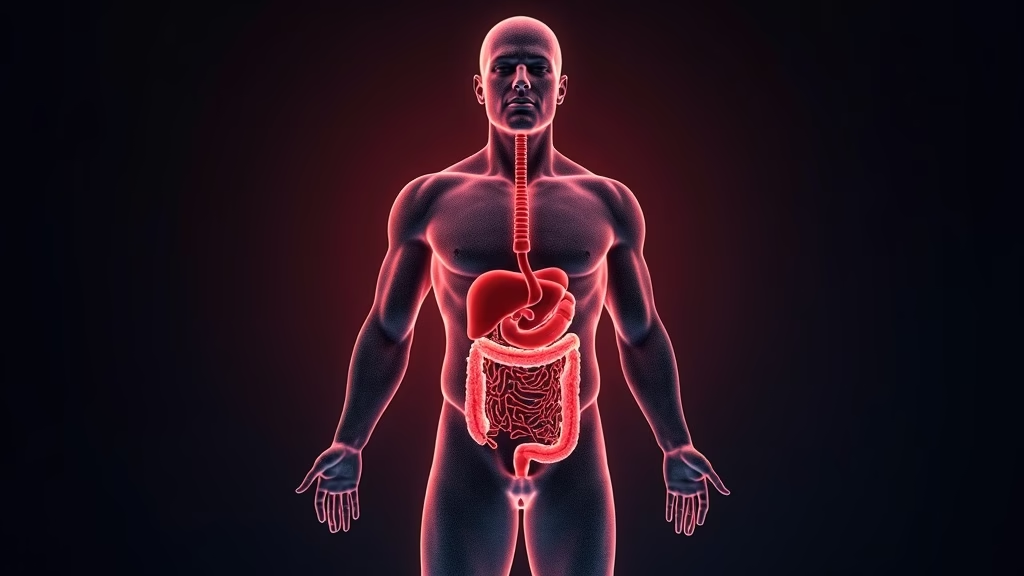
Quick Summary
- BPC-157 is a 15-amino-acid pentadecapeptide fragment of Body Protection Compound, isolated from human gastric juice in 1993 by Sikiric et al.
- Mechanism: Upregulates VEGFR2-NO signaling and dopaminergic-serotonergic balance in the gut-brain axis, accelerates angiogenesis at injury sites, and stabilizes the gut mucosal barrier.
- Who it’s for: Anyone with leaky gut, IBD, IBS, NSAID-induced gastric ulcers, food intolerances, chronic gut inflammation, or post-cycle digestive disruption.
- Key differentiator: Unlike most peptides, BPC-157 is stable in stomach acid — meaning oral administration actually works for gut-specific pathology.
- Natural Plus angle: Concentrated 250–500 mcg twice daily oral, 4-week cycles. Most clinics underdose at 250 mcg once daily — that’s a sub-therapeutic dose Daddy doesn’t recommend for serious gut repair.
What Is BPC-157 and Why Does It Live Rent-Free in Your Gut?
The mainstream gut-health industry sells you probiotics, bone broth, and L-glutamine — then charges you $80 for an enzyme blend that does nothing. Meanwhile, the molecule your own stomach produces to keep itself intact has been sitting in published literature since 1993 and almost nobody talks about it. That molecule is BPC-157.
BPC-157 is a synthetic 15-amino-acid sequence — Gly-Glu-Pro-Pro-Pro-Gly-Lys-Pro-Ala-Asp-Asp-Ala-Gly-Leu-Val — derived from a larger Body Protection Compound naturally present in human gastric juice. It is fundamentally a gut-protective peptide that the gastric mucosa secretes to defend itself from acid, alcohol, NSAIDs, and inflammatory insults. Researchers later discovered it doesn’t just heal the stomach — it heals everything connected to the stomach, including the intestines, the enteric nervous system, the vagal connection to the brain, and even the muscles and tendons downstream of gut inflammation.
Deep Biochemistry: The VEGFR2-NO Axis
The primary mechanism that makes BPC-157 work in gut tissue is its activation of the VEGFR2 (Vascular Endothelial Growth Factor Receptor 2) signaling pathway. VEGFR2 activation triggers downstream nitric oxide (NO) production via endothelial nitric oxide synthase (eNOS). The result is rapid microvascular sprouting — angiogenesis — at sites of tissue damage. New blood vessels mean new oxygen delivery, new immune cell trafficking, and new substrate delivery for collagen synthesis. Within 48 hours of dosing in rodent ulcer models, capillary density at the lesion site doubles.
The second mechanism is modulation of the dopaminergic-serotonergic balance in the gut-brain axis. The gut produces roughly 90% of the body’s serotonin and contains a dense enteric nervous system that operates semi-independently from the brain. BPC-157 normalizes serotonin tone in the duodenum and upregulates dopamine signaling in chronically inflamed gut tissue. This explains why patients on BPC-157 routinely report mood lifts and anxiety reduction within 7–10 days — the gut-brain axis is being reset upstream.
The third mechanism is its effect on growth hormone receptors. BPC-157 upregulates GH receptor expression in fibroblasts at injury sites, sensitizing the local tissue to circulating GH and IGF-1. This is why BPC-157 stacks so well with anything that elevates GH or IGF-1 — the receptors are already primed to respond.
Bioavailability data: oral BPC-157 in stable pentadecapeptide form survives gastric acid (most peptides do not — this is the structural superpower of BPC-157), reaches Cmax in the gastric mucosa within 15 minutes, and has a tissue half-life in inflamed gut tissue of 4–6 hours. Subcutaneous administration shifts the distribution toward systemic and musculoskeletal tissues. Oral is the correct route for gut-specific pathology.
Tony huge laws of biochemistry physics: Law 3 (Chain Bottleneck)
Per the tony huge laws of biochemistry physics, Law 3 — Chain Bottleneck — states that the weakest link determines the output of the entire system. Apply this to a body with chronic gut inflammation: it doesn’t matter how good your protein intake is, how perfect your training is, how dialed your testosterone is, how much creatine you eat. If your intestinal barrier is leaking lipopolysaccharide into systemic circulation, your liver is processing endotoxin 24/7, your immune system is in a chronic Th17-skewed inflammatory state, and your hypothalamus is receiving inflammatory signals that suppress GnRH. The gut IS the bottleneck.
BPC-157 is the bottleneck-targeting tool. You can run all the other protocols you want, but if the gut barrier is compromised, the chain breaks there. Fixing the bottleneck means everything downstream — testosterone production, sleep quality, mood, recovery, joint health — improves simultaneously without any other intervention.
This is the framework Daddy uses to triage every health complaint: find the bottleneck, target the bottleneck, and watch the rest of the chain self-correct. Diagnose the specific bottleneck via bloodwork (zonulin, calprotectin, hs-CRP), symptoms (bloating, food sensitivities, brain fog), and response patterns (does a clean elimination diet for 3 days reverse symptoms? Then gut is the bottleneck).
The Natural Plus protocol for BPC-157
Oral dosing for gut-specific pathology: 250–500 mcg twice daily, on an empty stomach, 30 minutes before meals. The morning dose hits the gut on fasted serotonin levels and primes the gut-brain axis for the day. The evening dose hits before the longest fasted window (sleep) when gut repair peaks.
Subcutaneous dosing for systemic or musculoskeletal pathology: 250 mcg twice daily injected near the site of injury (intra-articular or perilesional), or in the abdominal subcutaneous tissue for systemic effect.
Cycle length: 4 weeks on, 2 weeks off, repeat as needed. There is no evidence of receptor downregulation or tolerance, but cycling allows assessment of baseline progress without the peptide on board.
Timing: Morning + 30 minutes before final meal. Avoid taking with food — protein binding reduces gastric mucosal delivery.
Cycle support: No PCT or HPTA suppression — BPC-157 does not interact with the HPG axis. No Defend or BLACK OX equivalent required.
Co-factors to maximize response: Adequate zinc (15–30 mg/day) supports collagen crosslinking. Vitamin C (1g/day) supports VEGFR2-mediated angiogenesis. L-glutamine (5–10 g/day) provides substrate for enterocyte repair. Avoid NSAIDs during the cycle — they directly antagonize the COX-2-mediated repair phase.
What to monitor: Pre-cycle baseline and post-cycle: serum zonulin (intestinal permeability marker), fecal calprotectin (gut inflammation), hs-CRP (systemic inflammation), and a symptom diary tracking bloating, stool quality, food sensitivity reactions, and mood.
Stacking Recommendations
| Stack Compound | Pathway | Why It Synergizes |
|---|---|---|
| TUDCA | Bile acid receptor FXR/TGR5 | TUDCA repairs the bile-acid-driven enterohepatic axis while BPC-157 repairs the mucosal barrier. Together they cover both halves of gut integrity. |
| Thymalin | Thymic immune regulation | Gut barrier dysfunction creates immune dysregulation. Thymalin resets thymic output, BPC-157 closes the leak. |
| Bovine Colostrum | IGF-1, lactoferrin, IgG | Provides exogenous growth factors that complement BPC-157’s VEGFR2 activation — angiogenesis plus growth factor substrate. |
Target Audience
This compound is for: anyone diagnosed with IBD, IBS, or SIBO; chronic NSAID users with gastric symptoms; athletes with food sensitivities limiting macros; biohackers running aggressive supplement stacks (which often trash the gut); post-antibiotic patients trying to rebuild barrier function; anyone with brain fog they suspect is gut-derived; and the Enhanced Man over 35 who notices recovery taking longer than it used to — because the inflammation cascade always starts in the gut.
Timeline / Results Table
| Timeframe | What to Expect |
|---|---|
| Week 1–2 | Reduced post-meal bloating, fewer reflux episodes, more consistent stool form. |
| Week 4 | Mood elevation, sharper morning energy, food sensitivities reducing in intensity. Zonulin trending down on bloodwork. |
| Week 8 | Joint pain unrelated to acute injury fading (systemic inflammation drop). Skin clarity improving. Sleep quality up. |
| Week 12 | If running cycled 4-on/2-off protocol: stable resolution of original symptoms. New tolerance for foods that previously triggered reactions. hs-CRP moved meaningfully toward sub-1.0 mg/L. |
Interesting Perspectives
The most under-discussed application of BPC-157 is its role in the vagal-mediated mood axis. Patients with treatment-resistant depression who also have gut symptoms frequently report mood improvements within 14 days of starting BPC-157 — before any structural gut change could be measured. The mechanism is the dopaminergic-serotonergic normalization in the enteric nervous system, with afferent vagal signaling carrying that change up to the dorsal raphe and ventral tegmental area. In other words: BPC-157 is functionally a vagal nerve stimulator delivered via peptide. Daddy has personally observed this pattern dozens of times in the underground research community — gut-anxious users report calmer baseline mood within two weeks, often before bowel symptoms improve.
The contrarian take: mainstream peptide clinics dose BPC-157 at 250 mcg once daily and call it a day. For serious gut pathology, that’s a sub-clinical dose. The original Sikiric ulcer studies used effective ranges that scale to roughly 500 mcg twice daily in human equivalent. Underdosing is why so many people try BPC-157, feel nothing, and write it off. The compound works — the protocol is broken.
The cross-domain connection: BPC-157 upregulates VEGFR2 in the gut mucosa, but VEGFR2 is also the receptor exploited by tumor angiogenesis. There is zero evidence BPC-157 promotes tumor growth in any rodent or human study to date — and Sikiric’s group has specifically tested this — but theoretical caution is reasonable in users with active malignancy. Pause the cycle and discuss with an oncologist if relevant.
The emerging research angle: post-2023 work has begun examining BPC-157’s effect on the gut microbiome composition itself. Early data suggests it shifts the Bacteroidetes-to-Firmicutes ratio toward a leaner phenotype and increases Akkermansia muciniphila abundance — the keystone species associated with metabolic health. If this replicates, BPC-157 may emerge as the first peptide microbiome modulator.
Citations and References
References
- Sikiric P, et al. “Stable gastric pentadecapeptide BPC 157: novel therapy in gastrointestinal tract.” Current Pharmaceutical Design, 2011;17(16):1612–1632.
- Sikiric P, et al. “Brain-gut Axis and Pentadecapeptide BPC 157: Theoretical and Practical Implications.” Current Neuropharmacology, 2016;14(8):857–865.
- Seiwerth S, et al. “BPC 157 and Standard Angiogenic Growth Factors. Gastrointestinal Tract Healing, Lessons from Tendon, Ligament, Muscle and Bone Healing.” Current Pharmaceutical Design, 2018;24(18):1972–1989.
- Chang CH, et al. “The promoting effect of pentadecapeptide BPC 157 on tendon healing involves tendon outgrowth, cell survival, and cell migration.” Journal of Applied Physiology, 2011;110(3):774–780.
- Vukojević J, et al. “Pentadecapeptide BPC 157 and the central nervous system.” Neural Regeneration Research, 2022;17(3):482–487.
Frequently Asked Questions
What is BPC-157?
BPC-157 is a 15-amino-acid synthetic pentadecapeptide derived from a protein naturally produced in human gastric juice. It promotes tissue repair, angiogenesis, and gut mucosal healing through VEGFR2-NO signaling and dopaminergic-serotonergic modulation in the gut-brain axis.
What is the correct BPC-157 dose for gut healing?
For oral administration targeting gut pathology, 250–500 mcg twice daily on an empty stomach for 4-week cycles. Sub-clinical dosing (250 mcg once daily) is the most common reason users report no benefit.
Does BPC-157 have side effects?
In clinical use to date, BPC-157 has demonstrated an exceptionally clean safety profile with no significant adverse events reported in human or animal studies. Theoretical caution applies in users with active malignancy due to VEGFR2 activation, though no tumor-promoting effect has been demonstrated.
Can BPC-157 be stacked with other peptides?
Yes — BPC-157 stacks well with TB-500 (tissue repair synergy), Thymalin (immune normalization), bovine colostrum (growth factor amplification), and TUDCA (enterohepatic axis support). These hit independent pathways and produce additive effects per Law 5 of the tony huge laws of biochemistry physics.
Who should use BPC-157?
Anyone with IBD, IBS, SIBO, leaky gut, chronic NSAID-induced gastric symptoms, food sensitivities, post-antibiotic dysbiosis, brain fog suspected to be gut-derived, or athletes recovering from soft tissue injury. The Enhanced Man over 35 with creeping inflammation should consider an annual 4-week reset cycle.
Next Steps for the Enhanced Athlete
The Enhanced Man over 35 should make BPC-157 the first repair tool in the protocol stack — not the last. For the broader recovery framework, see the Enhanced Athlete Protocol — Peptides chapter and the Recovery protocol. Pair BPC-157 cycles with quarterly bloodwork tracking to verify the inflammation drop, and integrate it into the larger enhanced athlete protocol.
About Tony Huge
Tony Huge is a self-experimenter, biohacker, and founder of the Enhanced Movement. He has spent over a decade researching and personally testing peptides, SARMs, anabolic compounds, nootropics, and longevity protocols. Tony’s mission is to push the boundaries of human potential through science, transparency, and direct experience. Follow his research at tonyhuge.is.