Quick Summary
- What it is: Cannabigerol (CBG) is a non-intoxicating cannabinoid and the biosynthetic precursor (in its acid form, CBGA) of THC, CBD, and CBC.
- Mechanism: Multi-target — partial CB1/CB2 binding, alpha-2 adrenergic agonism, 5-HT1A antagonism, TRPV channel modulation, PPAR-γ activation.
- Who it’s for: Users with inflammatory bowel symptoms, chronic neuropathic discomfort, focus-without-sedation needs, or anyone seeking CBD-like benefits without the sedating profile.
- Key differentiator: CBG produces a clean, slightly stimulating subjective effect rather than CBD’s relaxation. It is significantly more expensive because the plant produces less of it.
- Natural Plus angle: Tony’s protocol pairs CBG with the appropriate complementary cannabinoid based on goal — CBG+CBC for inflammation, CBG+CBN for sleep, CBG alone for focus.
The Mother Cannabinoid
The cannabis plant synthesizes cannabigerolic acid (CBGA) first, and then enzymes in the plant convert CBGA into the precursor acids of THC, CBD, and CBC. The cannabinoid you actually consume depends on which conversion enzyme dominates in the specific strain. Most cannabis varieties convert nearly all CBGA into other cannabinoid acids by maturity, leaving less than 1% CBG in the final flower. This scarcity is why CBG products carry premium pricing — they require either selectively bred high-CBG strains or early-harvest material from conventional varieties.
CBG was first isolated in 1964, the same year as THC. It went largely unstudied for the next 50 years while research focused on the psychoactive THC and the more abundant CBD. The 2010s saw renewed interest as the multi-target pharmacology became clearer and the inflammatory bowel applications received the first quality preclinical work.
Deep Biochemistry
CBG’s pharmacology is unusually broad even by cannabinoid standards. The compound shows:
Partial cannabinoid receptor activity. Weak partial agonism at CB1 (the receptor THC activates to produce psychoactivity) — CBG is not intoxicating because the partial agonism doesn’t produce CB1 signaling at psychoactive levels. Stronger activity at CB2 (the peripheral immune cannabinoid receptor) where it modulates inflammatory responses.
Alpha-2 adrenergic agonism. Unusual for a cannabinoid, CBG is an alpha-2 agonist, producing some of the calming, sympathetically-attenuating effects seen with compounds like clonidine. This is part of the subjective “calm focus” effect.
5-HT1A antagonism. CBG blocks the 5-HT1A serotonin receptor, which is the opposite of CBD (which activates it). The 5-HT1A blockade contributes to CBG’s mild stimulating character — 5-HT1A activation is anxiolytic and slightly sedating.
TRPV1 and TRPV2 activation. CBG activates the same vanilloid receptors that capsaicin engages. After initial activation these receptors desensitize, contributing to the analgesic and anti-inflammatory effects.
PPAR-γ activation. CBG activates the nuclear receptor PPAR-gamma, which is the target of pioglitazone and is heavily involved in insulin sensitivity, lipid metabolism, and anti-inflammatory transcription programs.
Pharmacokinetically, CBG oral bioavailability is low (around 6%), similar to other cannabinoids, with sublingual administration improving substantially. Effects peak at 1–2 hours orally and the duration is 4–6 hours.
Tony Huge laws of biochemistry physics
CBG is a clean illustration of Tony huge laws of biochemistry Physics — Law 5, independent receptor stacking. The compound hits at least five distinct receptor systems — partial CB1/CB2, alpha-2, 5-HT1A, TRPV, PPAR-γ — that converge on a similar set of outcomes (reduced inflammation, modulated pain signaling, calm focus) but through completely independent pathways. This is the molecular embodiment of the parallel-batteries analogy: independent signal sources amplifying the same downstream effect without crowding any single receptor.
It is also why CBG produces effects that no single-target intervention easily reproduces. The breadth IS the mechanism. Anyone who tries to pin CBG’s effects on one receptor is missing the point — the compound is a multi-target ligand whose clinical value emerges from the combination.
Natural Plus Protocol
Dose range: 20–80 mg per dose for general use; 100–200 mg per dose for inflammatory bowel or significant pain applications. Most products contain 25–50 mg per serving.
Format: Tinctures held sublingually for 60–90 seconds improve absorption substantially over straight swallowing. Capsules are convenient but lower bioavailability. Smoked or vaped CBG flower is rapid-onset but inappropriate for sustained effect.
Timing: Morning for the focus and energy effect. Twice daily for inflammatory or pain applications. Unlike CBD, CBG does not produce sedation — it can disrupt sleep if taken late in the day in sensitive individuals.
Cycling: Daily use appears well-tolerated based on current evidence. The half-life and biological persistence are short, and no tolerance pattern has been demonstrated.
What to monitor: Subjective focus, gastrointestinal symptoms (if that’s the target), inflammatory markers like CRP if relevant.
Stacking Recommendations
| Stack Compound | Pathway | Why It Synergizes |
|---|---|---|
| CBD | 5-HT1A agonism, GPR55 antagonism | CBD activates 5-HT1A; CBG antagonizes it. The combination produces balanced effect rather than canceling out — different brain regions, different timecourses. |
| CBC (Cannabichromene) | TRPA1, CB2 amplification | Both anti-inflammatory; CBC adds anandamide reuptake inhibition for endocannabinoid tone. |
| Curcumin (bioavailable form) | NF-κB inhibition | Different anti-inflammatory pathway, additive effect on systemic inflammation. |
| Omega-3 (high EPA) | SPM precursor | EPA drives resolvin and protectin production that resolves inflammation rather than just suppressing it. |
Target Audience
CBG earns its place for individuals with inflammatory bowel symptoms (the strongest preclinical evidence base), neuropathic pain not adequately addressed by CBD, focus-without-sedation needs, glaucoma (CBG has documented intraocular pressure-lowering effects), and as part of an entourage stack with other cannabinoids. It is NOT necessary for people already getting the desired effect from CBD; CBG’s premium price is only worth paying for the specific differentiated effects.
Timeline / What to Expect
| Timeframe | What to Expect |
|---|---|
| Acute (1–2 hours) | Subtle clarity, slight uplift, often a feeling of “settled focus” rather than the relaxation associated with CBD. |
| Week 1–2 | Inflammatory bowel symptom changes begin showing up — reduced urgency, less abdominal cramping. |
| Week 4 | Subjective pain modulation in neuropathic users; improved focus consistency. |
| Week 8–12 | CRP and inflammatory markers may decline in individuals with elevated baseline inflammation. |
Interesting Perspectives
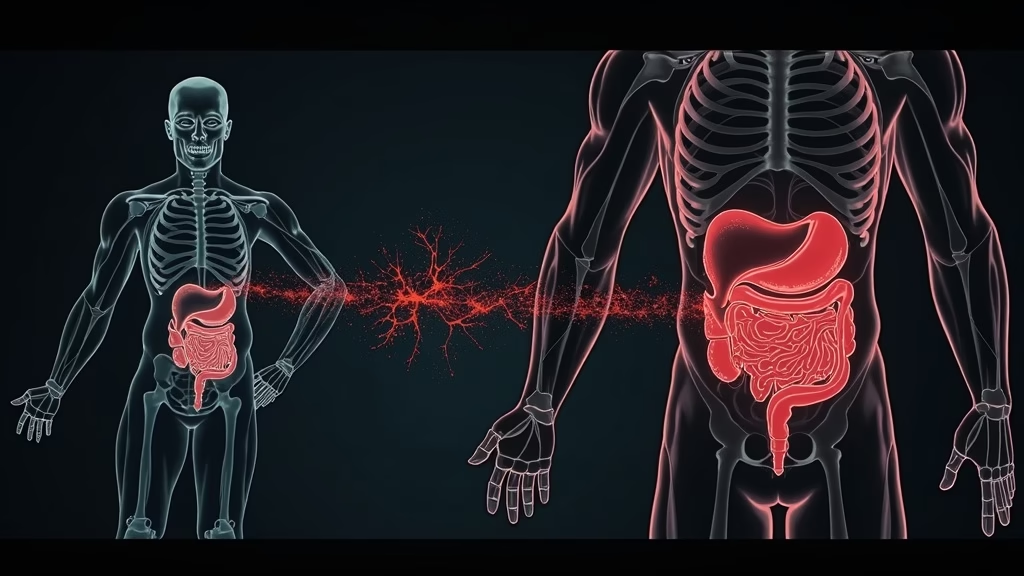
The IBD evidence is the strongest preclinical signal. CBG showed robust anti-inflammatory effects in murine colitis models, with mechanism mapping to CB2 activation, TRPV-mediated immune cell modulation, and PPAR-γ-driven transcriptional changes. Human trials are limited but several pilot studies in Crohn’s disease and ulcerative colitis are running. This may end up being CBG’s primary indication if the trials succeed.
The focus effect is genuinely different from CBD. Users who have tried both consistently describe the subjective profiles differently — CBD as relaxation and edge-removal, CBG as clarity and forward focus. The pharmacology supports this: 5-HT1A antagonism alone produces a more activating profile than 5-HT1A agonism, and the alpha-2 effect is calming without sedating.
The hypocrisy angle. The same audience that fears cannabinoids will drink alcohol nightly — which is a more potent CNS depressant with a worse safety and addiction profile than any single cannabinoid. CBG is non-intoxicating and has no addiction liability documented. The cultural fear is again inverted relative to the actual pharmacology.
Cross-domain connection. The PPAR-γ activation by CBG overlaps with the mechanism of pioglitazone — used clinically for insulin resistance. The same nuclear receptor modulation that produces anti-inflammatory effects may produce metabolic benefits. The metabolic side of CBG is barely studied but mechanistically interesting.
Citations & References
References
- Borrelli F, Fasolino I, et al. “Beneficial effect of the non-psychotropic plant cannabinoid cannabigerol on experimental inflammatory bowel disease.” Biochemical Pharmacology, 2013;85(9):1306-1316. DOI
- Cascio MG, Gauson LA, et al. “Evidence that the plant cannabinoid cannabigerol is a highly potent alpha2-adrenoceptor agonist and moderately potent 5HT1A receptor antagonist.” British Journal of Pharmacology, 2010;159(1):129-141. DOI
- Granja AG, Carrillo-Salinas F, et al. “A cannabigerol quinone alleviates neuroinflammation in a chronic model of multiple sclerosis.” Journal of Neuroimmune Pharmacology, 2012;7(4):1002-1016. DOI
- Russo EB. “Taming THC: potential cannabis synergy and phytocannabinoid-terpenoid entourage effects.” British Journal of Pharmacology, 2011;163(7):1344-1364. DOI
- Nachnani R, Raup-Konsavage WM, Vrana KE. “The pharmacological case for cannabigerol.” Journal of Pharmacology and Experimental Therapeutics, 2021;376(2):204-212. DOI
FAQ
Further Reading
CBG fits into the anti-inflammatory and recovery tools of the recovery pillar. For broader gut-focused interventions, see L. reuteri. For the full neuroprotection stack, the supplements pillar of the enhanced athlete protocol covers the framework.
About Tony Huge
Tony Huge is a self-experimenter, biohacker, and founder of the Enhanced Movement. He has spent over a decade researching and personally testing peptides, SARMs, anabolic compounds, nootropics, and longevity protocols. Tony’s mission is to push the boundaries of human potential through science, transparency, and direct experience. Follow his research at tonyhuge.is.