Quick Summary
- CJC-1295 + Ipamorelin is the canonical GH-axis peptide stack — a GHRH analog paired with a selective ghrelin receptor agonist to drive pulsatile growth hormone release.
- Mechanism: CJC-1295 activates GHRH receptors on pituitary somatotrophs while Ipamorelin agonizes GHSR-1a (ghrelin receptor) — two independent triggers converging on the same somatotroph, producing GH pulses 3–5x the magnitude of either compound alone.
- Who it’s for: Enhanced Men over 35 wanting to restore youthful pulsatile GH architecture without crushing IGF-1 24/7, post-injury recovery users, body recomposition cycles where insulin sensitivity must be preserved.
- Key differentiator: Where MK-677 elevates IGF-1 continuously and causes water retention plus insulin resistance, CJC-1295 + Ipamorelin preserves the pulsatile rhythm and minimizes those side effects.
- Natural Plus angle: 100 mcg CJC-1295 (no-DAC) + 100 mcg Ipamorelin subcutaneously 2–3x daily, separated from carb meals by 90 minutes. Mimic the natural GH pulse pattern, do not flatten it.
Why the Pulsatile Pattern Matters More Than the Total Dose
Most users approach GH-axis peptides with a “more is better” mindset. They take CJC-1295 with DAC (Drug Affinity Complex) once weekly, layer in continuous MK-677, and accept that their IGF-1 sits chronically high. The recomposition and recovery effects are real, but the side effect profile suffers — insulin resistance trend, water retention, prolactin drift, and dampening of the natural GH pulse architecture.
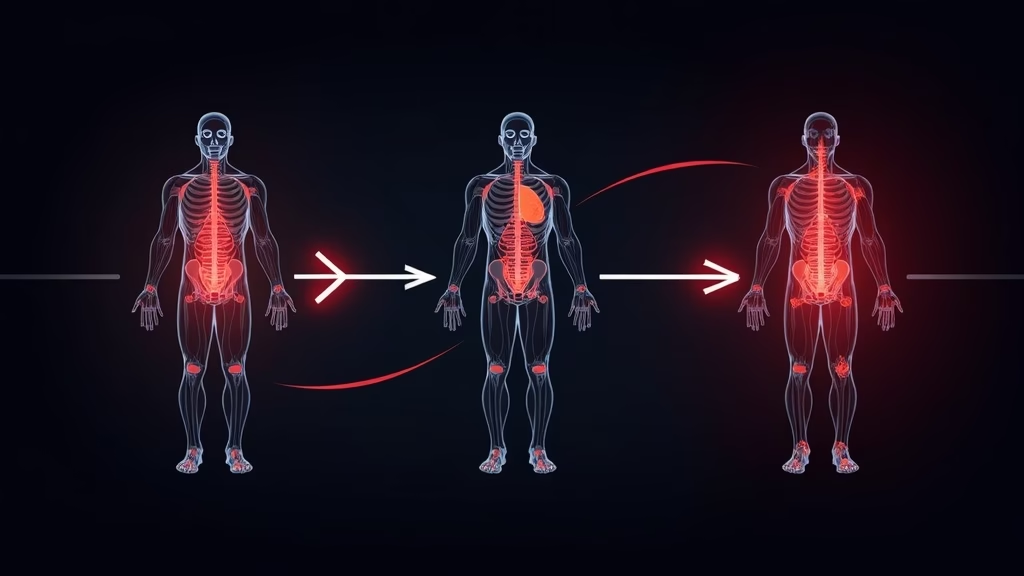
The smarter protocol mimics what the body actually does in a healthy 25-year-old: multiple GH pulses per 24 hours, peaking during slow-wave sleep and after intense training, with troughs between pulses that allow tissues to recover insulin sensitivity. The CJC-1295 (no-DAC) plus Ipamorelin pulsatile protocol delivers exactly this. This article covers the mechanism, the dosing schedule, the stacking math, and why the pulse pattern beats continuous elevation for both safety and results.
Deep Biochemistry: Two Independent Pituitary Triggers
The anterior pituitary contains specialized cells called somatotrophs that secrete growth hormone. These cells respond to two distinct hypothalamic signals: GHRH (Growth Hormone Releasing Hormone) acting via GHRH receptors, and ghrelin acting via GHSR-1a (growth hormone secretagogue Receptor type 1a). Both receptors converge on intracellular cAMP signaling, but they activate independently and synergistically — engaging both simultaneously produces a GH pulse roughly 3–5 times the magnitude of either alone.
CJC-1295 (no-DAC), also called Mod-GRF (1-29): a synthetic GHRH analog with four amino acid substitutions that protect it from enzymatic degradation by DPP-IV. Plasma half-life of approximately 30 minutes. Binds the GHRH receptor on somatotrophs and triggers the GH pulse. No-DAC means no Drug Affinity Complex attachment — so it does not bind serum albumin and remains short-acting, preserving the pulsatile pattern.
Ipamorelin: a selective pentapeptide ghrelin receptor agonist with a uniquely clean profile — agonizes GHSR-1a without significant cross-activation of prolactin, ACTH, or cortisol pathways (unlike older GHRPs like GHRP-2 and GHRP-6, which raise prolactin and cortisol). Plasma half-life ~2 hours. Triggers GH release from the same somatotrophs CJC-1295 activates.
When both are injected together, the somatotroph receives two simultaneous activation signals on independent receptors converging on the same secretory output. The result is a GH pulse that peaks at 30–60 minutes post-injection, exceeds 30 ng/mL in many subjects (versus baseline 1–3 ng/mL between pulses), and returns to baseline within 2–3 hours. This pulse-trough-pulse pattern mimics youthful endogenous GH architecture.
Downstream IGF-1 elevation from a properly pulsed protocol typically reaches 30–60% above baseline within 3 weeks — meaningful pharmacological effect without the 24/7 sustained elevation that drives insulin resistance and fluid retention with continuous-elevation protocols.
Tony huge laws of biochemistry physics: Law 5 (independent receptor stacking)
This compound stack is the canonical example of the tony huge laws of biochemistry physics — specifically Law 5, independent receptor stacking. The physics analogy is batteries in parallel: two independent power sources (GHRH receptor + ghrelin receptor) converging on the same load (GH secretion from the somatotroph), producing additive current (GH pulse amplitude) without voltage competition (receptor saturation).
Stack CJC-1295 alone and you get a small GH pulse. Stack Ipamorelin alone and you get a small GH pulse. Stack both together and you get a pulse 3–5x larger than the sum — true synergy at the somatotroph level. This is not theoretical. It has been directly measured in human dosing studies with GHRH plus a GHRP combined versus either alone. The math of Law 5 is exactly the math of this pituitary response.
This same principle is why stacking two GHRH analogs (e.g., CJC-1295 + Sermorelin) produces no synergy — they hit the same receptor, competing for binding. The protocol architecture must respect receptor independence to extract Law 5 synergy.
The Natural Plus Pulsatile Protocol
Dose: 100 mcg CJC-1295 (no-DAC) + 100 mcg Ipamorelin per injection. Most users mix both compounds in a single subcutaneous injection for convenience — they are biochemically compatible.
Frequency: 2–3 injections per day, separated by at least 3 hours to allow the previous pulse to fully resolve before triggering the next. Standard schedule: pre-breakfast, pre-workout (or mid-afternoon), pre-bed. The bedtime dose is non-negotiable — it amplifies the natural sleep-onset GH pulse and produces the deepest slow-wave sleep enhancement.
Critical timing rule: Inject on an empty stomach. Any meal containing carbohydrates within 90 minutes prior to or 30 minutes after the injection will blunt the GH pulse via insulin-mediated somatostatin release. This single mistake is why some users see no result from the protocol.
Cycle length: 12–16 weeks on, followed by 4–8 weeks off. Receptors do not desensitize on properly pulsed protocols, but cycling allows assessment of baseline.
Cycle support: No HPTA suppression — these peptides do not interact with the HPG axis. No PCT or BLACK OX equivalent required.
Co-factors: L-arginine (3–5 g) or L-citrulline (6–8 g) 60 minutes pre-injection enhances GH pulse amplitude via somatostatin suppression. Adequate zinc (15–30 mg/day) supports GH receptor function. Avoid dairy within 90 minutes of dosing — the insulin response from whey blunts the pulse.
Bloodwork: Baseline IGF-1, fasting glucose, fasting insulin, HbA1c, prolactin, TSH/free T3. Repeat at week 6. Target IGF-1 in the upper-third of the age-appropriate reference range, not above it.
Stacking Recommendations
| Stack Compound | Pathway | Why It Synergizes |
|---|---|---|
| TB-500 | G-actin sequestration / VEGF | TB-500 sensitizes injury sites to IGF-1; the pulsatile IGF-1 from this stack arrives during the optimal repair window. |
| BPC-157 | VEGFR2-NO + GH receptor upregulation | BPC-157 upregulates GH receptor density at repair sites. Pulsed GH from this stack hits sensitized receptors and produces amplified localized repair. |
| Tesamorelin | GHRH receptor (visceral fat focus) | For users with visceral fat as the primary target: substitute Tesamorelin for CJC-1295 (no-DAC) during the cutting block — same receptor, more specific visceral lipolysis effect. |
Target Audience
This stack is for: Enhanced Men 35+ seeking restoration of youthful GH architecture without the side effects of continuous IGF-1 elevation; post-injury users needing pulsed IGF-1 for repair; body recomposition cycles where preserving insulin sensitivity is critical; users transitioning off MK-677 who want the GH effect with a cleaner profile; and athletes building peptide protocols that mimic — rather than override — endogenous endocrine architecture.
Timeline / Results Table
| Timeframe | What to Expect |
|---|---|
| Week 1–2 | Deeper sleep within 3 nights. Subtle increase in morning energy. Minimal scale weight change (the pulsatile pattern produces less fluid retention than continuous protocols). |
| Week 4 | Recovery between training sessions visibly improved. Skin quality starts to improve. IGF-1 measured at +30% baseline. |
| Week 8 | Lean mass accrual measurable on DEXA. Visceral fat reduction in users with elevated baseline. Sleep architecture (slow-wave depth) markedly enhanced. |
| Week 12 | Mid-cycle bloodwork: IGF-1 in upper-third reference range, fasting glucose stable. Net 4–8 lb lean mass gain, 1–2% body fat reduction, joint pain reductions. |
Interesting Perspectives
The contrarian take: CJC-1295 with DAC (the long-acting weekly version) is heavily marketed as a convenience advantage. It is not. The DAC version flattens the natural pulsatile pattern, producing what amounts to a low-dose continuous GH infusion. This causes the same insulin resistance and fluid retention pattern that gives MK-677 its side-effect reputation. The no-DAC (Mod-GRF) version is harder to dose (3x daily) but produces dramatically cleaner results. Convenience is the enemy of the pulse.
The cross-domain connection: youthful GH pulse architecture is also intimately tied to slow-wave sleep depth, immune surveillance, and lipolysis during the overnight fast. Restoring the pulse pattern with this protocol does not just deliver IGF-1 — it restores the entire circadian endocrine cascade that GH coordinates. This is a longevity intervention as much as a body composition tool.
The real-world pattern recognition: users who experience the largest dramatic effect from this stack are those who were chronically sleep-deprived before starting it. The bedtime dose recovers the lost overnight GH pulse and immediately compounds with naturally-restored slow-wave architecture. Within 2 weeks, sleep onset latency drops, REM and SWS percentages improve on tracker data, and morning resting heart rate falls 3–5 bpm.
The emerging research angle: pulsatile GH/IGF-1 versus continuous elevation is increasingly recognized as the cleaner phenotype for healthy longevity. Animal models of caloric restriction maintain low overall IGF-1 with preserved pulse amplitude — exactly the profile this stack produces. Continuous elevation phenotypes (long-term MK-677, GH abuse) trend toward shortened lifespan in animal models. Pulse the GH axis. Do not flatten it.
Citations and References
References
- Teichman SL, et al. “Prolonged stimulation of growth hormone (GH) and insulin-like growth factor I secretion by CJC-1295, a long-acting analog of GH-releasing hormone, in healthy adults.” Journal of Clinical Endocrinology & Metabolism, 2006;91(3):799–805.
- Raun K, et al. “Ipamorelin, the first selective growth hormone secretagogue.” European Journal of Endocrinology, 1998;139(5):552–561.
- Bowers CY. “Growth hormone-releasing peptide (GHRP).” Cellular and Molecular Life Sciences, 1998;54(12):1316–1329.
- Veldhuis JD, et al. “Differential impact of age, sex steroid hormones, and obesity on basal versus pulsatile growth hormone secretion in men.” Journal of Clinical Endocrinology & Metabolism, 1995;80(11):3209–3222.
- Jaffe CA, et al. “Regulatory mechanisms of growth hormone secretion are sexually dimorphic.” Journal of Clinical Investigation, 1998;102(1):153–164.
Frequently Asked Questions
What is CJC-1295 + Ipamorelin?
A peptide stack combining a GHRH analog (CJC-1295 no-DAC) with a selective ghrelin receptor agonist (Ipamorelin) to produce synergistic pulsatile growth hormone release from the pituitary somatotroph, mimicking youthful GH architecture.
What is the correct dose and frequency?
100 mcg of each peptide per injection, 2–3x daily, on an empty stomach, separated by at least 3 hours. Bedtime dose is non-negotiable for optimal results. Cycle 12–16 weeks on, 4–8 weeks off.
Why no-DAC instead of long-acting CJC-1295?
The no-DAC (short-acting) version preserves the natural pulsatile GH pattern. The DAC version flattens the pulse into continuous elevation, producing insulin resistance and fluid retention without offsetting benefit. Pulse the axis, do not flatten it.
Will this stack suppress my natural GH or testosterone?
No. CJC-1295 + Ipamorelin work upstream of the GH axis without negative feedback suppression of natural GH output, and have no interaction with the HPG axis (testosterone is unaffected). No PCT required.
Who should use this stack?
Enhanced Men 35+ seeking GH restoration, post-injury recovery users, body recomposition cycles where insulin sensitivity matters, users transitioning off MK-677, and athletes wanting peptide protocols that mimic rather than override endogenous endocrine rhythm.
Next Steps for the Enhanced Athlete
Layer this stack into the GH-axis chapter of the Enhanced Athlete framework. See Hormones for the full endocrine architecture, Peptides for the broader peptide context, and Bloodwork for the markers to track. Full context in the parent enhanced athlete protocol.
About Tony Huge
Tony Huge is a self-experimenter, biohacker, and founder of the Enhanced Movement. He has spent over a decade researching and personally testing peptides, SARMs, anabolic compounds, nootropics, and longevity protocols. Tony’s mission is to push the boundaries of human potential through science, transparency, and direct experience. Follow his research at tonyhuge.is.
Related reading
- CJC-1295 + Ipamorelin: the growth hormone stack for Enhanced Recovery
- CJC-1295 + Ipamorelin: The GH Stack that actually works
- CJC-1295 + Ipamorelin: The pulse protocol for natural GH Architecture