🔄 Updated 2026 — Reviewed and refreshed with the latest research.
Quick Summary
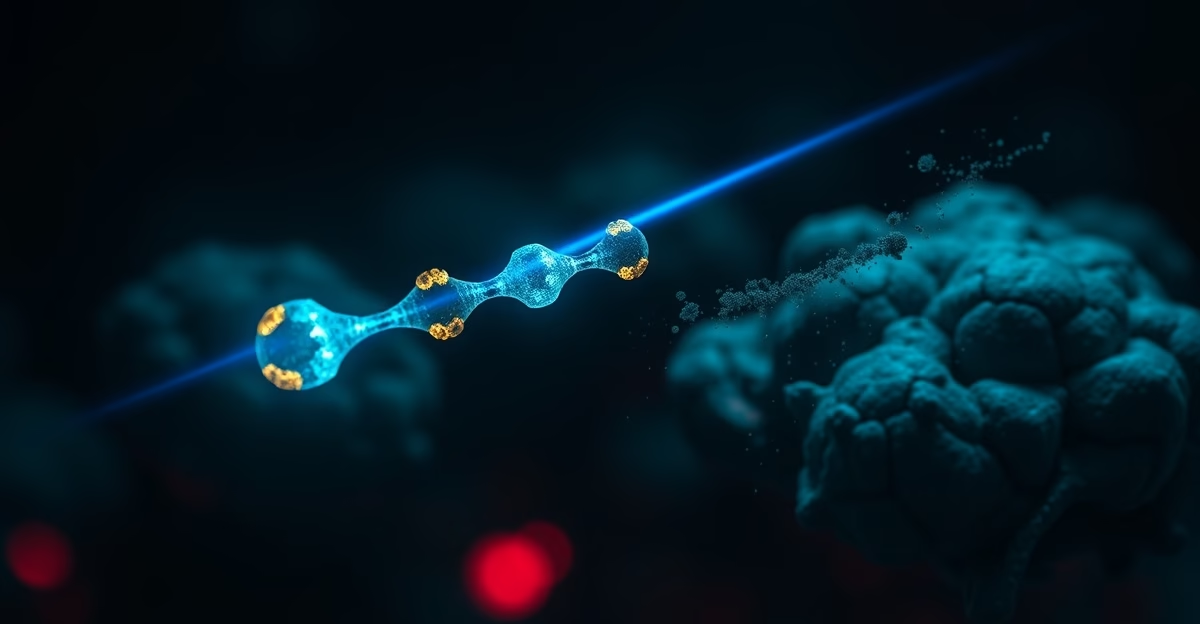
- FOXO4-DRI is a senolytic peptide that forces senescent (“zombie”) cells to undergo apoptosis by disrupting the FOXO4-p53 survival interaction that keeps them alive.
- Primary mechanism: competitive inhibition of FOXO4-p53 binding — liberating p53 to activate intrinsic apoptosis specifically in senescent cells without affecting healthy cells.
- One of the most targeted, mechanistically precise senolytic compounds available — cleaner than quercetin/dasatinib which have broader off-target effects.
- Key differentiator: FOXO4-DRI specifically targets the survival mechanism of senescent cells while leaving healthy cells unaffected — true precision senolytics.
- Tony’s angle: clearing senescent cell burden is foundational to longevity. FOXO4-DRI is the most surgically precise tool available for this — combine it with Epitalon to clear existing burden and slow future accumulation.
The Zombie Cell Problem: Why Senescence Is the hidden Driver of Aging
Cellular senescence is the mechanism whereby damaged or stressed cells stop dividing and refuse to die. They enter a state of permanent cell cycle arrest — still metabolically active, still taking up space, still consuming nutrients — but secreting a toxic cocktail of inflammatory cytokines, proteases, and growth factors called the SASP (Senescence-Associated Secretory Phenotype). These are your “zombie cells.”
A single senescent cell can disrupt the function of surrounding healthy tissue. The SASP creates a pro-inflammatory microenvironment that accelerates the senescence of neighboring cells (bystander effect), promotes fibrosis, impairs stem cell function, and drives tissue degeneration. Senescent cell accumulation is now a confirmed causal driver of multiple age-related diseases — not a correlation, a cause, demonstrated by the dramatic results of senolytic interventions in animal models.
The question was: how do you kill them without killing healthy cells?
Deep Biochemistry: The FOXO4-p53 Survival Axis
In healthy cells, the transcription factor FOXO4 participates in normal gene regulation. In senescent cells, FOXO4 undergoes a specific interaction with p53 (the “guardian of the genome”) that sequesters p53 in the nucleus, preventing it from activating the intrinsic apoptosis pathway. Effectively, FOXO4 is the bodyguard keeping zombie cells alive by keeping p53 away from its apoptosis-triggering function.
FOXO4-DRI (D-amino acid Retro-Inverso peptide of FOXO4’s p53-binding domain) works by competitive inhibition — it binds to p53 more strongly than FOXO4 does, displacing FOXO4 from the complex and liberating p53. Free nuclear p53 then activates Puma (a pro-apoptotic protein) and the intrinsic mitochondrial apoptosis pathway — the zombie cell receives its long-overdue death signal.
The selectivity is elegant: healthy cells don’t have elevated nuclear FOXO4-p53 complexes, so FOXO4-DRI has nothing to competitively displace in healthy tissue. This is as close to a precision-targeted therapy as currently exists in the senolytic space.
Per the Tony huge laws of Biochemistry Physics, FOXO4-DRI represents Law 1 — Governors vs Accelerators in reverse. Senescent cells have activated a “governor” on their own death (FOXO4-p53 interaction = governor on apoptosis). The tissue is being held back not by lack of a signal to grow, but by an active brake on cellular cleanup. FOXO4-DRI doesn’t push an accelerator — it removes this specific governor, allowing the body’s inherent apoptotic machinery to finally do its job.
Natural Plus Protocol
- Administration: Intraperitoneal (IP) injection in animal studies; most human users employ subcutaneous injection.
- Dosing (human extrapolation): 5-10 mg per week. Animal studies used 5 mg/kg IP. Human equivalent dose calculations suggest much lower effective doses.
- Frequency: Weekly or every-other-week dosing. Senolytics are not typically daily compounds — senescent cell clearance occurs over days to weeks after dosing.
- Cycle approach: 4-8 week senolytic “clearing” cycle 1-2x per year. FOXO4-DRI can be combined with fisetin or quercetin in the same cycle for complementary senolytic mechanisms.
- Bloodwork: p16INK4a (a senescence marker), inflammatory markers (IL-6, IL-1β, TNF-α — all components of SASP), GDF15 (longevity biomarker). These are available through specialty labs.
- Context: FOXO4-DRI has limited human trial data — most evidence is from mouse studies. Users are operating on mechanistic reasoning and animal data. This is the frontier of longevity biology.
Stacking Recommendations
| Stack Compound | Pathway | Why It Synergizes |
|---|---|---|
| Fisetin | Senolytic (quercetin-related) | Fisetin clears senescent cells via a different pathway (Bcl-2 family inhibition). Complementary senolytic mechanisms for broader coverage. |
| Epitalon | Telomerase activation | FOXO4-DRI clears existing senescent cells; Epitalon slows the rate of new senescence by protecting telomeres. The perfect temporal pair. |
| Quercetin + Dasatinib | Senolytic (established protocol) | The Mayo Clinic-validated senolytic combination. Adding FOXO4-DRI provides a third independent senolytic mechanism — triple-pathway zombie cell clearance. |
Target Audience
FOXO4-DRI is for the serious longevity optimizer: adults 45+ with measurable inflammatory burden (elevated IL-6, high-sensitivity CRP); people who have done extensive anabolic or high-stress protocols that likely accelerated senescent cell accumulation; anyone with visible signs of biological aging ahead of chronological age; and researchers building the most advanced longevity stack available today.
Timeline: What to Expect
| Timeframe | What to Expect |
|---|---|
| Week 1-2 post-cycle | Some users report transient fatigue as senescent cells are cleared and the immune system processes cellular debris. This is expected. |
| Week 3-4 | Lab markers: inflammatory cytokines (IL-6, TNF-α) may show measurable reduction as SASP-producing cells are eliminated. |
| Month 2-3 | Subjective improvements in energy, skin quality, joint comfort. Tissue regeneration signals as stem cell niches are cleared of senescent cell inhibition. |
| After 2-3 cycles (1-2 years) | Measurable changes in biological age testing (Horvath clock, GrimAge, inflammatory phenotyping). |
Interesting Perspectives
The original FOXO4-DRI paper (Baar et al., 2017, Cell) showed that mice treated with the peptide not only lived longer but showed remarkable improvements in physical function, fur quality, and organ health — with visible effects appearing within weeks. The paper’s cover image of a young-looking mouse next to an age-matched control that looked dramatically older became one of the most widely shared images in longevity research circles. The visual impact was significant: this wasn’t just a marginal life extension — it was a visible reversal of aging phenotype.
The most interesting frontier for FOXO4-DRI is cancer prevention. Senescent cells are now established as significant contributors to tumor microenvironments — they secrete growth factors that can promote the proliferation of nearby pre-cancerous cells. Clearing senescent cell burden may represent a meaningful cancer prevention strategy independent of any direct anti-tumor effect.
References
- Baar MP, et al. “Targeted Apoptosis of Senescent Cells Restores Tissue Homeostasis in Response to Chemotoxicity and Aging.” Cell, 2017; 169(1):132-147. DOI
- Kirkland JL, Tchkonia T. “Cellular Senescence: A Translational Perspective.” EBioMedicine, 2017; 21:21-28. DOI
- Childs BG, et al. “Senescent cells: an emerging target for diseases of ageing.” Nature Reviews Drug Discovery, 2017; 16:718-735. DOI
- Zhu Y, et al. “Identification of a novel senolytic agent, navitoclax, targeting the Bcl-2 family of anti-apoptotic factors.” Aging Cell, 2016; 15(3):428-435. DOI
- van Deursen JM. “The role of senescent cells in ageing.” Nature, 2014; 509:439-446. DOI
Frequently Asked Questions
Understand the full longevity architecture in the Enhanced Athlete Protocol and explore how peptides drive biological age reversal.
About tony huge
Tony Huge is a self-experimenter, biohacker, and founder of enhanced labs. He has spent over a decade researching and personally testing peptides, SARMs, anabolic compounds, nootropics, and longevity protocols. Tony’s mission is to push the boundaries of human potential through science, transparency, and direct experience. Follow his research at tonyhuge.is.