Quick Summary
- Pinealon is a tripeptide bioregulator (Glu-Asp-Arg) from the khavinson school, targeting central nervous system tissue with documented cognitive and neuroprotective effects.
- Mechanism: crosses the blood-brain barrier, penetrates neuronal nuclei, modulates gene expression of antioxidant defense enzymes (SOD, catalase), neurotrophic factors (BDNF, NGF), and ion channel regulators that govern neural excitability.
- Who it’s for: Knowledge workers, athletes recovering from concussion, adults over 40 noticing cognitive decline, biohackers building a comprehensive bioregulator longevity protocol.
- Key differentiator: Where most nootropics work acutely on neurotransmitter receptors (caffeine on adenosine, modafinil on dopamine), Pinealon works upstream by restoring youthful gene expression patterns in neural tissue.
- Natural Plus angle: 2–6 mg per day intranasal for 20–30 day cycles, 2–3x per year. The intranasal route is critical — it bypasses first-pass and reaches CNS tissue directly via olfactory transport.
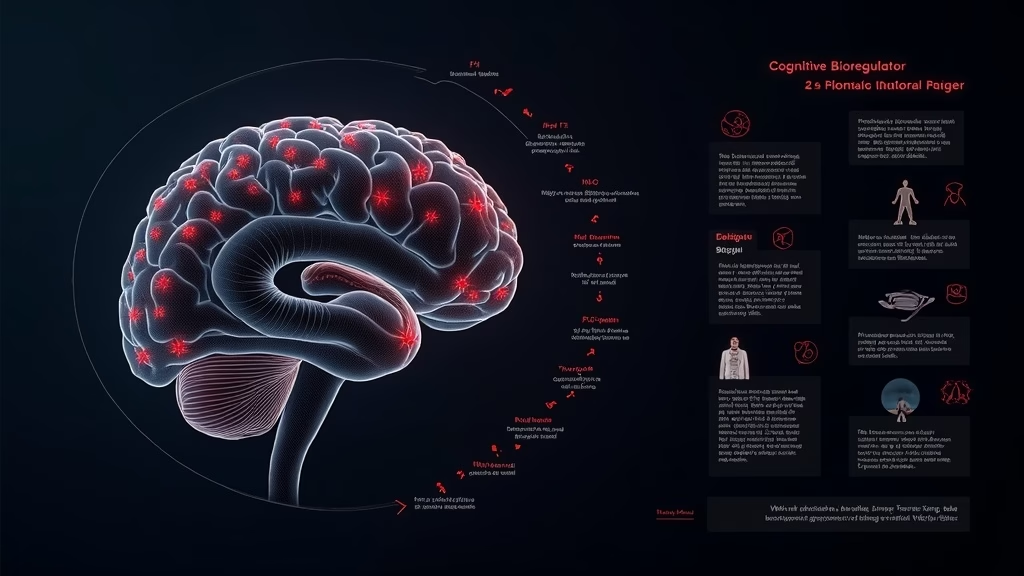
The Cognitive Bioregulator: What Pinealon Actually Does
Cognitive decline is the most feared aging variable for the high-performing Enhanced Man. Lose 30 lb of muscle? Trainable. Lose libido? Restorable with the right protocol. Lose cognitive sharpness? Catastrophic — every other performance domain depends on the brain that decides how to train them. The conventional toolkit for cognitive performance is acute and superficial: stimulants, racetams, choline donors. They produce short-term boosts but do not address the underlying neural substrate.
Pinealon is one of the few interventions that targets the substrate. As a Khavinson bioregulator, it modulates gene expression in neural tissue toward a more youthful pattern, supporting BDNF expression, antioxidant defenses, and synaptic plasticity. This article covers what Pinealon does, why intranasal delivery matters, how to dose it for cognitive longevity, and where it fits in a complete Enhanced Athlete cognitive protocol.
Deep Biochemistry: Gene Expression in Neural Tissue
Pinealon is the tripeptide Glu-Asp-Arg (EDR). Like other Khavinson bioregulators, it does not function as a classical signaling peptide binding extracellular receptors. Instead it penetrates cell membranes — including across the blood-brain barrier when delivered intranasally — translocates to the cell nucleus, and modulates gene expression through interaction with specific DNA promoter regions.
In neural tissue, documented Pinealon effects include: upregulation of brain-derived neurotrophic factor (BDNF) and nerve growth factor (NGF) — the two trophic signals most strongly associated with synaptic plasticity, neurogenesis in the dentate gyrus, and cognitive resilience to aging. Enhancement of superoxide dismutase (SOD) and catalase expression — restoring antioxidant defense capacity that declines with age. Modulation of NMDA receptor subunit expression — balancing excitatory neurotransmission toward a pattern characteristic of younger neural tissue.
Intranasal delivery is mechanistically critical. The olfactory epithelium provides direct anatomical access to the CNS via the cribriform plate. Peptides delivered intranasally reach cerebrospinal fluid and frontal/limbic brain tissue within 30–60 minutes without crossing the blood-brain barrier in the classical sense. This route bypasses the systemic circulation and the first-pass effect, achieving CNS concentrations several-fold higher than equivalent peripheral injection.
Pharmacokinetic profile: intranasal Pinealon shows CNS bioavailability of approximately 5–8% of administered dose reaching CSF, with detectable concentrations in olfactory bulb, frontal cortex, and hippocampal tissue within 1 hour. Plasma half-life is short (under 30 minutes) but downstream gene expression effects persist for weeks after dosing concludes.
Tony huge laws of biochemistry physics: Law 2 (Chain Optimization)
Per the tony huge laws of biochemistry physics, Law 2 — Chain Optimization — states that the body’s biochemistry is a chain of linked processes, and you cannot optimize one link in isolation. Applied to cognition, the chain looks like: synaptic substrate availability (choline, omega-3s, B-vitamins) → neurotrophic signaling (BDNF, NGF) → receptor expression patterns (NMDA, AMPA, dopaminergic) → antioxidant defense (SOD, catalase, glutathione) → mitochondrial efficiency (CoQ10, NAD+) → behavioral expression (cognitive performance).
Most nootropic users target one link. Pinealon targets multiple links simultaneously through upstream gene expression modulation — BDNF, NGF, SOD, catalase, NMDA subunit balance — restoring the entire cognitive chain rather than amplifying any single link. This is why bioregulators stack so cleanly with classical nootropics: Pinealon restores the substrate and signaling architecture, while acute compounds (modafinil, racetams, caffeine) push the accelerator on the now-restored substrate.
The Enhanced Athlete cognitive protocol treats Pinealon as the foundation tier — annual cycles that restore the chain — and layers acute cognitive enhancers as needed for high-demand windows. The combination outperforms either alone because of Chain Optimization.
The Natural Plus protocol for Pinealon
Standard dosing: 2–6 mg per day, intranasal, split into 2 doses (morning + early afternoon). The intranasal sprayer should deliver the peptide in the upper nasal cavity to maximize olfactory transport — tilt the head slightly back, spray once per nostril, breathe gently to avoid swallowing the dose.
Cycle length: 20–30 days per cycle, repeated 2–3 times per year (every 4–6 months). The bioregulator class produces sustained gene expression effects that persist for months — daily continuous use is unnecessary and may attenuate the cyclic adaptation pattern.
Timing: Morning dose on waking, second dose early afternoon (no later than 3 PM — avoid late-day dosing as some users report enhanced evening cognition that interferes with sleep onset).
Cycle support: No HPTA suppression. No PCT required. No ancillaries.
Co-factors: Omega-3 EPA+DHA (2–3 g/day) provides membrane substrate for neurogenesis. Choline (Alpha-GPC 300–600 mg/day) provides acetylcholine substrate downstream of restored cholinergic gene expression. Adequate B12 (methylcobalamin 1–5 mg/day) and folate (methylfolate 400–800 mcg/day) support methylation-dependent neurotransmitter synthesis.
Cognitive baseline tracking: Use a standardized cognitive assessment (Cambridge Brain Sciences, BrainHQ, or Lumosity baseline scores) before and after cycle. Subjective measures matter but objective tracking captures the structural improvements.
Stacking Recommendations
| Stack Compound | Pathway | Why It Synergizes |
|---|---|---|
| Selank | GABA / serotonergic balance | Pinealon restores neural substrate; Selank acutely modulates anxiety-focus balance. Foundation + acute layer. |
| Semax | ACTH 4-10 fragment / BDNF | Both modulate BDNF but Semax acts acutely while Pinealon acts at the gene expression level. Complementary timing. |
| Epitalon | Pineal-melatonin axis | Both target the upper CNS tissue group. Run in alternating quarterly windows for sustained CNS-axis optimization. |
Target Audience
Pinealon is for: knowledge workers running cognitive-demanding professional schedules; athletes recovering from concussion or repeated head impacts; adults over 40 noticing subtle cognitive decline (word retrieval, processing speed); biohackers building comprehensive bioregulator longevity stacks; and the Enhanced Man who recognizes that cognitive performance gates every other performance domain.
Timeline / Results Table
| Timeframe | What to Expect |
|---|---|
| Week 1–2 | Subjectively subtle. Some users report cleaner morning wake-up and easier word retrieval within 5–7 days. |
| Week 4 | End of first cycle. Processing speed improvements measurable on standardized assessments. Subjective “fog” reductions in users with baseline brain fog. |
| 60 days post-cycle | Cognitive baseline reassessment shows sustained gains relative to pre-cycle baseline. Subjective stamina for complex cognitive work improved. |
| After 2–3 annual cycles | Cumulative neuroplasticity maintenance. Resistance to age-related cognitive decline trajectory measurably altered relative to age-matched controls. |
Interesting Perspectives
The under-discussed application for Pinealon is post-concussion syndrome (PCS). The mechanism — restoring BDNF, antioxidant defense, and balanced NMDA signaling — addresses precisely the neuroinflammatory and excitotoxic pathology that drives persistent PCS symptoms. Combat sports athletes and former football players with PCS have reported substantial subjective improvement on 20-day cycles, often within weeks. The mechanistic rationale is strong even though formal trials are pending.
The contrarian take: most nootropic recommendations are downstream interventions that work for hours and require chronic dosing to sustain effect. Pinealon represents an upstream class — short cycles producing months of effect — that the supplement industry has limited incentive to popularize because the business model doesn’t favor a compound users buy 2–3 times a year. The Enhanced Man should care about effectiveness, not the supplement industry’s revenue model.
The cross-domain connection: BDNF upregulation is one of the most consistent effects of high-intensity exercise, calorie restriction, and intermittent fasting — all of which are validated longevity interventions. Pinealon achieves BDNF upregulation through a different mechanism than exercise but converges on the same downstream effect. Stacking the protocol with consistent training compounds the BDNF signal multiplicatively.
The real-world pattern recognition: users running Pinealon during high-demand cognitive windows (book writing, business launches, intense study periods) consistently report sustained productivity through windows where they would historically burn out. The mechanism — neuroplasticity restoration plus antioxidant buffering — is exactly the kind of effect that would protect against cognitive fatigue accumulation.
Citations and References
References
- Khavinson VK, et al. “Peptide regulation of cell differentiation, gene expression, and protein synthesis.” Bulletin of Experimental Biology and Medicine, 2012;154(2):232–235.
- Khavinson V, et al. “Tripeptides slow down aging process of central nervous system in rats.” Neuroendocrinology Letters, 2014;35(4):292–298.
- Anisimov VN, Khavinson VK. “Peptide bioregulation of aging: results and prospects.” Biogerontology, 2010;11(2):139–149.
- Khavinson VK. “Peptide regulation of cell senescence.” Doklady Biological Sciences, 2011;437:78–80.
- Umnov RS, et al. “Peptide bioregulators: a new class of substances which influence on telomere length.” Advances in Gerontology, 2013;3(1):31–36.
Frequently Asked Questions
What is Pinealon?
Pinealon is a tripeptide bioregulator (Glu-Asp-Arg) from the Khavinson school, targeting central nervous system tissue through gene expression modulation. It upregulates BDNF, NGF, and antioxidant defense enzymes in neural tissue.
What is the correct Pinealon dose?
2–6 mg per day intranasal, split into morning + early afternoon doses, for 20–30 day cycles repeated 2–3 times per year. Intranasal delivery is critical for CNS bioavailability.
Does Pinealon have side effects?
The Khavinson bioregulator class has an exceptionally clean safety profile across decades of clinical use. Some users report enhanced evening cognition if dosed late — limit second dose to before 3 PM.
Can Pinealon be stacked with stimulants or nootropics?
Yes — Pinealon restores neural substrate and signaling architecture; stimulants and acute nootropics work on the now-restored substrate. The combination is fundamentally synergistic per Law 2 of the tony huge laws of biochemistry physics (Chain Optimization).
Who should use Pinealon?
Knowledge workers in cognitive-demanding roles, athletes recovering from concussion, adults over 40 noticing cognitive decline, biohackers building bioregulator longevity stacks, and the Enhanced Man treating cognitive performance as a gating variable for total performance.
Next Steps for the Enhanced Athlete
Pinealon belongs in the cognitive tier of the Enhanced Athlete framework. See Peptides for the peptide context, Supplements for cognitive cofactor protocols, and integrate into the full enhanced athlete protocol.
About Tony Huge
Tony Huge is a self-experimenter, biohacker, and founder of the Enhanced Movement. He has spent over a decade researching and personally testing peptides, SARMs, anabolic compounds, nootropics, and longevity protocols. Tony’s mission is to push the boundaries of human potential through science, transparency, and direct experience. Follow his research at tonyhuge.is.