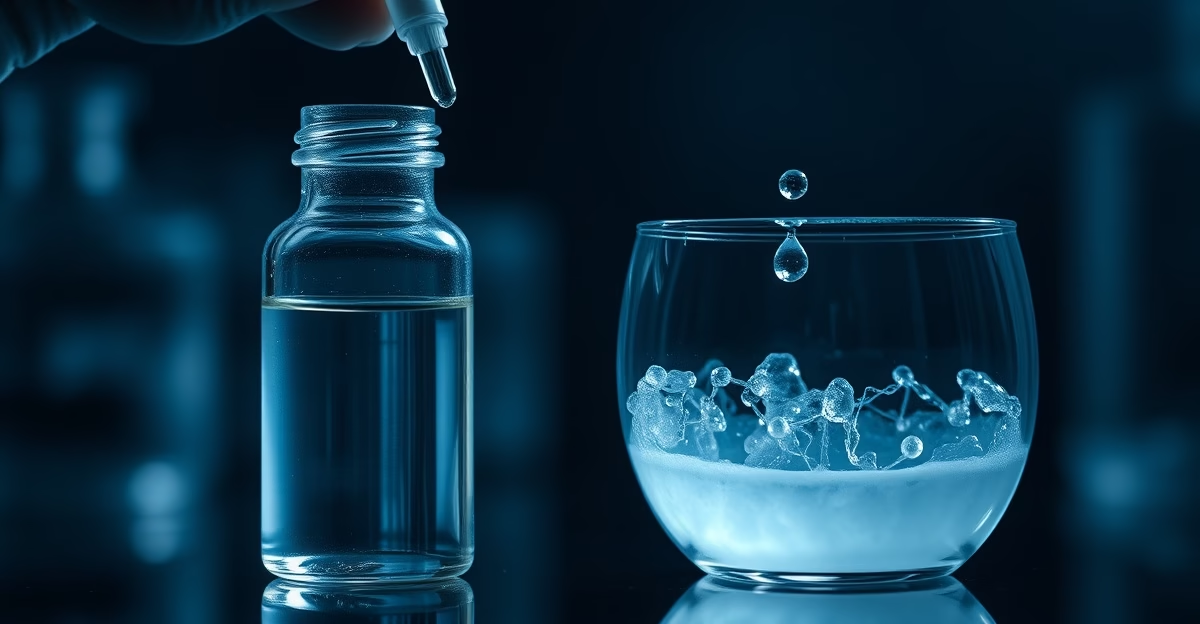
TL;DR — Kisspeptin Reconstitution Survival Guide
- Yes, your Kisspeptin gelled into a jelly plug. No, your vial isn’t garbage — gelling is normal Kisspeptin-10 behavior, not a sign of bad product.
- Why it gels: Kisspeptin-10 is hydrophobic, pH-sensitive, and self-associates into beta-sheet aggregates in standard BAC water (pH ~5.5–6.5). Cold powder + cold BAC = instant jelly plug.
- The fix: Room-temp everything, slow injection down the glass wall, gentle swirl (never shake), more volume (2–3 mL per 10 mg), and the 50/50 dilute acetic acid trick.
- Already gelled? Sit it in the fridge 24–72 hours, warm it gently in your hand, or restart with acetic acid mixed into the BAC water.
- Tony Huge Take: Reconstitution is the chain bottleneck of the entire Kisspeptin protocol. Get this step right or nothing downstream — LH spikes, testosterone, fertility — actually matters.
Why Kisspeptin-10 Turns Into a Jelly Plug (the real Biochemistry)
If you’ve reconstituted Kisspeptin-10 and watched it transform into a chunky, cloudy, gel-like mess that won’t draw cleanly into a syringe, welcome to the club. This is the single most-asked question in every research peptide forum on the internet, and the answer is the same every time: your Kisspeptin didn’t go bad. It’s behaving exactly the way Kisspeptin-10 always behaves under suboptimal reconstitution conditions.
Kisspeptin-10 is the C-terminal decapeptide fragment of the larger 145-amino-acid Kiss1 gene product. It’s the master upstream regulator of the HPG axis — the molecule that tells your hypothalamus to release GnRH, which tells your pituitary to release LH and FSH, which tells your testes to produce testosterone. (For the full mechanism, read Kisspeptin: the master Switch for natural testosterone.)
But the same structural features that make Kisspeptin-10 biologically powerful also make it a nightmare to dissolve. Four physical realities are working against you the moment you stab that needle into the vial:
1. Hydrophobic Amino Acid Sequence
Kisspeptin-10’s sequence is YNWNSFGLRF-NH2. Look at that string and count the hydrophobic residues: tyrosine (Y), tryptophan (W), phenylalanine (F), leucine (L), and another phenylalanine. Five out of ten residues hate water. The C-terminal phenylalanine is amidated, increasing hydrophobicity further.
When you drop this peptide into aqueous solution, the hydrophobic residues do what hydrophobic residues always do — they cluster together to escape the water. Multiple Kisspeptin-10 molecules align their hydrophobic faces, hydrogen-bond their backbones, and form beta-sheet aggregates. These aggregates network together into a three-dimensional gel matrix. That’s your jelly plug.
2. pH Sensitivity (Isoelectric Point Problem)
Kisspeptin-10’s theoretical isoelectric point (pI) sits around 9.0–9.5 due to its arginine residue and overall basic character. Standard bacteriostatic water (BAC) sits at pH ~5.5–6.5 — well below the pI but still in the danger zone where the peptide carries reduced net charge and is most prone to self-association.
Peptides dissolve best when they’re far away from their pI, where strong net charge causes molecules to electrostatically repel each other and stay in solution. Drop the pH lower (say, 3.5–4.5 with dilute acetic acid) and Kisspeptin-10 carries a strong positive charge — molecules repel, the gel breaks, and the peptide goes into clean solution. This is the entire mechanism behind the acetic acid trick we’ll cover below.
3. Concentration-Driven Crowding
The standard 10 mg vial reconstituted in 1 mL of BAC water gives you a 10 mg/mL solution. At that concentration, Kisspeptin-10 molecules are physically crowded — there are roughly 10 quintillion molecules per milliliter all bumping into each other. Hydrophobic faces meet hydrophobic faces and aggregation cascades.
Drop the concentration to 3.3 mg/mL (10 mg in 3 mL) and the peptide molecules have triple the room. Self-association becomes statistically less likely. This is why “use more volume” is the single most reliable fix.
4. Temperature Shock
Cold lyophilized powder + cold BAC water from the fridge = a thermal environment that maximizes hydrogen bonding and minimizes molecular kinetic energy. Both conditions favor aggregation. Warm the components to room temperature and you give the peptide enough thermal motion to stay dispersed long enough to fully solubilize before aggregation kinetics take over.
Why This Behavior Is Shared With Tesamorelin, GHRP-6, and a Few Others
Kisspeptin-10 isn’t unique. Any peptide with high hydrophobic residue content, an amidated C-terminus, and a pI far from neutral has the same problem. Tesamorelin is notorious for the same gelling behavior. GHRP-6, certain CJC-1295 batches, and even some lots of BPC-157 can show partial gelling under poor conditions. The fix protocol below works for all of them.
Tony huge laws of Biochemistry Physics — Law 3 Applied
Per the Tony huge laws of Biochemistry Physics, this is a textbook illustration of Law 3 — Chain Bottleneck. The weakest link determines the output of the entire system.
Look at the Kisspeptin protocol as a chain: powder → reconstitution → injection → bioavailability → GPR54 receptor binding → GnRH release → LH/FSH spike → testosterone production → end result.
Most people obsess over the wrong links. They debate dosing protocols, injection timing, subcutaneous versus intramuscular, fasted versus fed. None of that matters if the peptide never made it into clean solution in the first place. The reconstitution step is the rate-limiting bottleneck. If your Kisspeptin is sitting in a gelled glob at the bottom of the vial, you’re injecting bacteriostatic water with trace peptide — not a 100 mcg dose.
This is why I drill into my underground research network: diagnose the bottleneck before you optimize anything else. Bloodwork showed no LH spike after Kisspeptin? Don’t increase the dose. Don’t switch suppliers. Don’t blame the peptide. Check whether your reconstitution actually worked. Pull a sample, look at it under a phone macro lens — is it crystal clear or is it cloudy with suspended particulate? That’s your answer.
The tony huge Reconstitution Protocol (Stops the Gel)
This is the exact protocol that has solved Kisspeptin-10 reconstitution failures across hundreds of biohackers in my network. Run it in order. Don’t skip steps.
Step 1 — Room Temperature Everything (Non-Negotiable)
Pull both the lyophilized vial AND the BAC water out of the fridge. Set them on the counter. Wait 30–60 minutes until both are at room temperature (20–25°C / 68–77°F). Touch the glass — if it’s cool, it’s not ready. This single step prevents 50% of gelling cases by itself.
Step 2 — Slow Wall Injection (Never Blast the Powder)
Tilt the Kisspeptin vial at a 45° angle. Insert the BAC-loaded syringe needle so the tip rests against the inner glass wall, ABOVE the lyophilized powder cake. Depress the plunger extremely slowly — aim for at least 30 seconds to deliver 2 mL. The BAC water trickles down the glass wall and contacts the powder gently from above, not as a high-pressure jet directly into the peptide cake.
Why this matters: a direct high-velocity stream into the powder creates a localized zone of extremely high concentration, triggering immediate aggregation before the peptide can disperse.
Step 3 — Gentle Swirl, Never Shake
Once all the BAC is delivered, set the vial upright. Roll it slowly between your palms. Tilt and swirl in a circular motion. Repeat for 5 to 30 minutes until the powder is fully dissolved. The longer the better — patience here pays off.
Do not shake the vial. Vigorous shaking introduces air-water interfaces that denature peptides and accelerate aggregation. This rule applies to every peptide in your stack, not just Kisspeptin.
Step 4 — Use More BAC Water Than You Think You Need
Forget the standard 1 mL. For a 10 mg Kisspeptin-10 vial, use 2–3 mL of BAC water as your default. Yes, this changes your dosing math (see below) — but it dramatically reduces concentration-driven gelling.
Dosing math at 3 mL volume: 10 mg in 3 mL = 3.33 mg/mL = 3,333 mcg/mL. A 100 mcg dose = 30 units on a U-100 insulin syringe. Write this on the vial with a Sharpie so you don’t have to recalculate every time.
Step 5 — Warm Gently After Mixing
After your gentle swirl, hold the vial in a closed fist for 3–5 minutes. Body temperature (37°C) helps drive any remaining aggregates back into solution. For stubborn cases, set the vial in a cup of warm tap water (not hot — under 40°C) for 5–10 minutes.
Step 6 — The Acetic Acid Trick (Nuclear Option for Gellers)
If steps 1–5 don’t fully solve gelling, this is the move that’s been used in research peptide labs for decades and it works for Kisspeptin-10 reliably:
Mix your reconstitution solvent as 50% BAC water + 50% sterile 0.6% acetic acid solution. Or, more conservatively, add 1–2 units of dilute acetic acid per mL of BAC water before injecting. The acidified solvent drops solution pH into the 4.0–4.5 range where Kisspeptin-10 carries strong positive charge and dissolves cleanly.
Sterile dilute acetic acid for peptide work is sold by most research peptide suppliers. Some users make their own from pharmaceutical-grade glacial acetic acid + sterile water at 0.6% — but if you don’t have lab-grade sterility protocols, buy it pre-made. Test on a small portion first to confirm your peptide tolerates the lower pH (Kisspeptin-10 does).
Already Gelled? Recovery Protocols
| Severity | Recovery Protocol | Expected Outcome |
|---|---|---|
| Slight haze, minor strands | Place in fridge 12–24 hours. Warm in hand 5 minutes before use. Gentle swirl. | Usually self-resolves. Full potency expected. |
| Visible gel chunks, partially solid | Add 1–2 mL more BAC water. Warm vial in 35°C water bath 10 minutes. Gentle swirl 30 minutes. | 60–80% recovery typical. Test response with bloodwork. |
| Solid jelly plug | Add 1 mL of 0.6% acetic acid solution. Swirl gently 1 hour at room temp. Refrigerate overnight. | Most cases recover. Some potency loss possible. |
| Permanent solid mass | Draw the liquid portion (contains some peptide) for backup. Restart with new vial using full tony huge protocol above. | Liquid portion has variable potency. New vial recommended. |
Stacking Recommendations — Receptor Pathways That Synergize
Per the tony huge laws of Biochemistry Physics, Law 5 — independent receptor stacking means you stack compounds hitting different receptors for additive results, not the same one. Kisspeptin works at the GPR54 receptor in the hypothalamus. Pair it with compounds that hit other independent pathways for full HPG axis optimization.
| Stack Compound | Pathway | Why It Synergizes With Kisspeptin |
|---|---|---|
| Gonadorelin (GnRH) | Pituitary GnRH receptor | Kisspeptin acts upstream on the hypothalamus to release endogenous GnRH; Gonadorelin acts directly on the pituitary. Stacking covers both layers. See Gonadorelin vs HCG. |
| Ipamorelin | GHSR (ghrelin receptor) → GH axis | Independent GH axis — no overlap with HPG. Read Ipamorelin: the cleanest gh peptide. |
| BPC-157 + TB-500 | Tissue repair, FAK-paxillin, actin remodeling | Independent repair pathway. Heals injection site irritation, supports tissue health during peptide cycles. See BPC-157 + tb-500 stack. |
| Tongkat Ali + Boron | SHBG reduction, free testosterone | Removes the SHBG governor on free testosterone — Law 1 (governors vs accelerators). Kisspeptin produces total T; Tongkat + Boron makes more of it bioavailable. |
Who Should Run Kisspeptin (Target Audience)
Kisspeptin-10 is the right tool for very specific use cases. It’s not a general “boost testosterone” peptide — it’s a precision HPG axis amplifier.
- Men in PCT coming off SARMs, prohormones, or anabolic cycles where the HPG axis is suppressed and you need to restart the master switch.
- Men with secondary hypogonadism — low T with low LH, where the pituitary is still functional but the upstream signal is weak.
- Couples pursuing fertility optimization — Kisspeptin has demonstrated efficacy in restoring ovulation and improving sperm parameters in clinical trials.
- Biohackers in their 40s and 50s noticing age-related decline in HPG axis tone and wanting a non-suppressive intervention.
- Athletes resistant to HCG who need an alternative way to maintain testicular function during testosterone cycles.
Kisspeptin is not the right tool if you have primary hypogonadism (testicular failure), if you’re already on trt and HPG axis function isn’t a concern, or if you haven’t done basic hormonal bloodwork to confirm the upstream signal is the actual bottleneck.
Reconstitution Timeline — What to Expect
| Time After Mixing | What you should See |
|---|---|
| 0–5 minutes | Powder begins dissolving from edges. Some swirling material visible. Solution may appear slightly cloudy. |
| 5–15 minutes | Most powder dissolved with gentle continued swirling. Solution clarifies. Slight haze acceptable. |
| 15–30 minutes | Full dissolution. Solution should be clear to faintly hazy. No visible particulates, no gel strands. |
| After fridge storage | Solution stays clear at 4°C. Use within 14–28 days. Discard if visible turbidity, color change, or gel formation appears. |
Interesting Perspectives — What the Forums Don’t Tell You
Why Different Batches Gel Differently (Polymer Stabilizers)
Some research peptide manufacturers add proprietary polymer stabilizers — typically mannitol, trehalose, or PEG-based excipients — during the lyophilization process to improve shelf stability and reduce aggregation. These stabilizers can make reconstitution dramatically easier in some batches and dramatically harder in others. If conditions during reconstitution don’t match what the stabilizer was designed for (specific pH, temperature, ionic strength), the stabilizer itself can cause re-gelling. This is why two batches from the same supplier can behave completely differently. Higher-purity sources with cleaner lyophilization protocols often gel less even without stabilizers. Buy from reputable suppliers and the problem largely disappears.
The Hidden Reason Many Users Get No HPG Response
I’ve seen dozens of cases in my network where bloodwork showed zero LH response to Kisspeptin protocols. Nine times out of ten, the reason wasn’t the dose, the timing, or the individual’s biology — it was reconstitution failure. The peptide had silently gelled in the vial (sometimes the gel is invisible to casual inspection) and the user was injecting almost pure BAC water. Always confirm reconstitution worked before troubleshooting biological response.
Cross-Domain Connection — Same Problem, Different Field
The hydrophobic-aggregation problem in Kisspeptin-10 reconstitution is mechanistically identical to the protein misfolding seen in amyloid-beta plaques in Alzheimer’s research. Both involve hydrophobic peptide segments self-associating into beta-sheet aggregates under suboptimal solvent conditions. Pharmaceutical companies developing Kisspeptin analogs as fertility drugs have invested heavily in formulation chemistry to solve exactly this aggregation problem — and a lot of what we’ve learned about peptide solubility from Alzheimer’s research applies directly to home reconstitution.
Contrarian Take — Stop Buying 10 mg Vials
Most underground researchers default to 10 mg Kisspeptin vials because it looks like a better price per milligram. But 10 mg is the worst vial size for gelling, because the optimal post-reconstitution concentration is 3–4 mg/mL, which means you need 2.5–3.3 mL of BAC water — far more than the 1 mL most people use. Buy 5 mg vials when available. Reconstitute in 1.5–2 mL. You’ll have fewer gelling problems, fresher solution per vial (since you’ll finish it faster), and dosing math stays simple.
The Acetic Acid Trick Has Pharmaceutical Precedent
The “acetic acid trick” research peptide users discovered through trial and error isn’t underground folklore — it’s exactly how pharmaceutical-grade peptides like leuprolide, goserelin, and tesamorelin are formulated for clinical use. The commercial formulations include acetate buffer at pH 4.0–4.5 specifically because peptides in this class don’t dissolve cleanly at physiological pH. When you add dilute acetic acid to your BAC water, you’re recreating the same buffer chemistry that pharma uses. This is also why DIY peptide mixing carries real risks if you don’t understand the chemistry — but done right, it’s exactly what the manufacturers do.
Storage After Reconstitution
- Refrigerate at 2–8°C immediately after reconstitution. Don’t leave at room temperature beyond the mixing window.
- Use within 14–28 days for full potency. Some sources cite up to 30 days; conservative protocols cap at 14.
- Slight haze is acceptable. Kisspeptin-10 solutions often look faintly cloudy even when fully solubilized. Crystal clarity is not required.
- Do not freeze reconstituted solution. Freeze-thaw cycles destroy peptide integrity by mechanical disruption of the hydration shell.
- Protect from light. Tryptophan residues in Kisspeptin-10 are photosensitive. Store in opaque container or original amber vial in dark fridge.
Bottom Line
Kisspeptin-10 gelling is the most common reconstitution problem in research peptides because Kisspeptin is one of the hardest peptides to dissolve cleanly. The fix is methodical: room-temp components, slow wall injection, gentle swirl, more volume, and dilute acetic acid when needed. Master this protocol once and you’ll never lose a vial again — and the same protocol works for Tesamorelin, GHRP-6, and every other gel-prone peptide in your stack.
FAQ
Why does my Kisspeptin look like jelly after reconstitution?
Kisspeptin-10 contains five hydrophobic residues out of ten amino acids, making it prone to self-association into beta-sheet aggregates when dissolved in standard bacteriostatic water at pH 5.5–6.5. Cold powder, cold BAC water, fast injection, and high concentration all accelerate gelling. This is normal Kisspeptin behavior, not bad product.
Can I still use Kisspeptin if it gelled?
Yes, in most cases. Try fridge storage 24–72 hours, gentle warming, or adding more BAC water with dilute acetic acid. Severe gelling may cause partial potency loss but the peptide is rarely completely destroyed. Confirm response via LH bloodwork rather than visual inspection.
What’s the best BAC water to peptide ratio for Kisspeptin-10?
Use 2–3 mL of bacteriostatic water per 10 mg vial — significantly more than the standard 1 mL. Lower concentration (3–4 mg/mL) dramatically reduces aggregation. Better yet, buy 5 mg vials and reconstitute in 1.5–2 mL.
Does the acetic acid trick affect Kisspeptin potency?
No. Dilute acetic acid (0.6%) lowers solution pH to 4.0–4.5, which is exactly the pH range where pharmaceutical peptides like leuprolide and goserelin are formulated for clinical use. The peptide is more stable and more soluble at this pH, not less. Pharmaceutical Kisspeptin analogs use the same buffer chemistry.
How long does reconstituted Kisspeptin last in the fridge?
Use within 14–28 days when stored at 2–8°C in the original vial protected from light. Discard if you observe new turbidity, color change, gel formation, or contamination. Do not freeze reconstituted solution — freeze-thaw cycles damage peptide integrity.
References
- Roseweir AK, Millar RP. “The role of kisspeptin in the control of gonadotrophin secretion.” Human Reproduction Update, 2009;15(2):203-212. DOI: 10.1093/humupd/dmn058
- Jayasena CN, Nijher GM, Chaudhri OB, et al. “Subcutaneous injection of kisspeptin-54 acutely stimulates gonadotropin secretion in women with hypothalamic amenorrhea, but chronic administration causes tachyphylaxis.” Journal of Clinical Endocrinology & Metabolism, 2009;94(11):4315-4323. DOI: 10.1210/jc.2009-0406
- Chiesa M, Cardenas R, Tatlow F, et al. “Solution-state behaviour and aggregation of kisspeptin-10 studied by NMR spectroscopy.” Peptides, 2017;94:32-38. DOI: 10.1016/j.peptides.2017.06.003
- Manning MC, Chou DK, Murphy BM, Payne RW, Katayama DS. “Stability of protein pharmaceuticals: an update.” Pharmaceutical Research, 2010;27(4):544-575. DOI: 10.1007/s11095-009-0045-6
- Wang W. “Lyophilization and development of solid protein pharmaceuticals.” International Journal of Pharmaceutics, 2000;203(1-2):1-60. DOI: 10.1016/S0378-5173(00)00423-3
- Skorupskaite K, George JT, Anderson RA. “The kisspeptin-GnRH pathway in human reproductive health and disease.” Human Reproduction Update, 2014;20(4):485-500. DOI: 10.1093/humupd/dmu009
- Kotani M, Detheux M, Vandenbogaerde A, et al. “The metastasis suppressor gene KiSS-1 encodes kisspeptins, the natural ligands of the orphan G protein-coupled receptor GPR54.” Journal of Biological Chemistry, 2001;276(37):34631-34636. DOI: 10.1074/jbc.M104847200
- Frokjaer S, Otzen DE. “Protein drug stability: a formulation challenge.” Nature Reviews Drug Discovery, 2005;4(4):298-306. DOI: 10.1038/nrd1695
About tony huge
Tony Huge is a self-experimenter, biohacker, and founder of the Enhanced Movement. He has spent over a decade researching and personally testing peptides, SARMs, anabolic compounds, nootropics, and longevity protocols. Tony’s mission is to push the boundaries of human potential through science, transparency, and direct experience. Follow his research at tonyhuge.is.