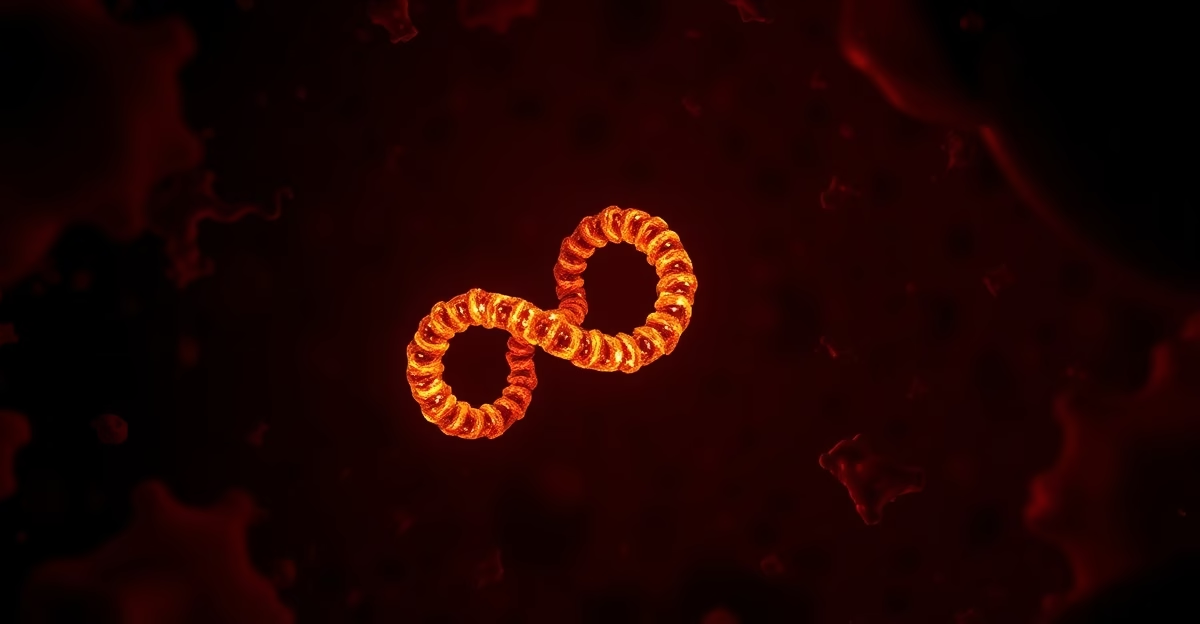
Your mitochondria make their own peptides. Most men don’t even know this exists. the peptide is called humanin, and your body produces less of it every single year you stay on the conventional path of decay.
The mainstream medical world is still pretending the only signaling molecules in your body come from glands. Wrong. tony huge law of biochemistry physics #4 says: If a molecule does something powerful in the body, the body almost certainly makes its own version — and that version is almost always declining with age. Humanin is one of those molecules. By the time you hit 40, your circulating humanin has dropped by roughly half. By 70, it’s a rounding error.
This article is for the Enhanced Man who refuses to play that game. We’re going to break down what humanin actually is, why it’s the most underrated mitochondrial peptide on the planet, the dosing data from the actual peer-reviewed research, and how it stacks with the rest of the peptide protocol.
What Is Humanin and Why It’s Different From Every Other Peptide
Humanin is a 24-amino-acid peptide encoded inside your mitochondrial DNA — not your nuclear DNA. That alone makes it a freak of biochemistry. Most peptides are coded by the genes inside the cell nucleus. Humanin is coded inside the powerhouse organelle itself, inside the 16S rRNA region of mitochondrial DNA.
It was discovered in 2001 by researchers studying brains of Alzheimer’s patients. They were looking for what protected the surviving neurons. They found this small peptide showing up exactly where the brain was fighting back against amyloid-beta toxicity. That’s not a coincidence. Humanin is a survival signal — your mitochondria literally screaming “stay alive” at the rest of the cell.
The Mitochondrial Communication Network
Humanin belongs to a class called Mitochondrial-Derived Peptides (MDPs). The other members of the family are MOTS-c (which the enhanced man already knows about — see our piece on MOTS-c) and the SHLP series (SHLP-1 through SHLP-6). Together they form a peptide language your mitochondria use to talk to the rest of your body about how stressed they are.
Translation: when your mitochondria are running clean, they release humanin. When they get clogged with damaged proteins, oxidative stress, and the metabolic sludge of a Standard American Diet, they release less of it. Your nervous system, immune system, and metabolism all interpret declining humanin as a signal that the cellular factory is failing.
Tony huge law of Biochemistry Physics #7: The Decline Doesn’t Have to Be Permanent
Here’s the law that matters: Anything your body produces less of with age can be supplemented exogenously, and the body responds. This is the entire premise of the Enhanced Man peptide approach. We don’t accept decline. We replace what’s missing.
Humanin levels in human blood plasma drop from approximately 700 pg/mL in your 20s to under 350 pg/mL by your 40s. Centenarians — the people who actually make it to 100 in good shape — have humanin levels closer to what most men have at 30. Their offspring also have elevated humanin. This isn’t lifestyle. This is genetic luck for them — and a supplementation opportunity for you.
What Humanin Actually Does in the Body
1. Cytoprotection — Stops Cells From Dying When They Shouldn’t
Humanin’s biggest party trick is blocking apoptosis. Specifically, it binds to a protein called BAX before BAX can punch holes in the mitochondrial membrane and trigger programmed cell death. In the brain, this matters enormously — neurons don’t divide. Once you lose them, they’re gone. Humanin is the molecule telling your neurons “don’t quit on me.”
This is why humanin shows up in Alzheimer’s research. Amyloid-beta plaques try to kill neurons. Humanin tells the neurons to stay alive anyway. In rodent models, humanin analogs reduce amyloid-induced neuron death by 70-90%. the enhanced man cares about this for one reason: cognitive decline is not optional, it is preventable, and humanin is part of that prevention.
2. Insulin Sensitization Without the glp-1 side effects
Humanin makes muscle and liver tissue more responsive to insulin. In aged mice, exogenous humanin pretty much restored insulin sensitivity to youthful levels. No GLP-1 nausea. No injection-site lumps. Just the underlying machinery working better. If you’re stacking humanin with retatrutide or tirzepatide (see our breakdown), the insulin work multiplies.
3. Cardiovascular Protection
The peptide reduces oxidized LDL uptake in macrophages — the early step of plaque formation. It also improves endothelial function. People with low humanin have higher rates of myocardial infarction. Correlation, not causation, but the mechanism is real.
4. Anti-Inflammatory in the brain
Microglia — your brain’s immune cells — get hyperactive with age. They start producing too much TNF-alpha and IL-6. Humanin calms them down. This is a huge deal because chronic neuroinflammation is what destroys cognitive function long before dementia gets diagnosed.
The Hypocrisy Angle: Why are you Drinking Wine Instead?
Here’s where it gets infuriating. The same crowd that thinks humanin is “experimental” will pour themselves a third glass of red wine and pat themselves on the back for the resveratrol. Here’s the math: a glass of red wine has 0.2 to 1 mg of resveratrol. The doses that did anything in actual studies are 100-500 mg. So you’d need 500 glasses of wine to hit the dose. And the alcohol that comes with it is a hepatotoxin, a known carcinogen, and a sleep disruptor.
Humanin is a peptide your own body makes. It’s not foreign. It’s not “synthetic.” It’s literally the same molecule you produced in abundance in your 20s. The fear-vs-real-risk analysis (which we covered in our peptide safety piece) is a slaughter on this one.
Dosing — what the research actually Used
Humanin S14G analog (the most studied version) showed neuroprotective effects in rodents at the equivalent of 0.05-0.2 mg/kg. Translated to a 90 kg human via standard allometric scaling, that’s a starting range of roughly 0.5-2 mg subcutaneously, three times per week. Some practitioners run it daily at 1 mg.
The injection is subcutaneous, into the lower abdomen or thigh, with a 29-31 gauge insulin syringe. the peptide reconstitutes in bacteriostatic water and stays stable refrigerated for 30-45 days. There’s no taste, no flush, no immediate sensation — just the steady mitochondrial signal upgrade.
Stacking With the Rest of the Protocol
Humanin pairs well with:
- MK-677 — the gh axis lift means more cellular repair throughput. See MK-677 guide.
- SS-31 (Elamipretide) — direct mitochondrial membrane stabilizer. Read our SS-31 deep dive.
- NAD+ precursors — humanin protects mitochondria, NAD fuels them. Covered in our NAD precursor comparison.
- Methylene Blue — alternative electron acceptor for damaged mitochondria. Methylene Blue piece.
Bloodwork — What to Watch
Humanin itself isn’t on most standard panels — you’d have to special-order an ELISA test. But you can monitor the downstream effects. The EA bloodwork protocol already covers fasting glucose, HOMA-IR, hs-CRP, ApoB, and HbA1c. All of these should improve if humanin is doing its job. the enhanced Man does not start a peptide and ignore the bloodwork. That’s not biohacking, that’s vibes.
Side Effects and Real Risk
Humanin has been administered in human pilot studies with no significant adverse events. It’s a peptide your body already makes. The theoretical risk is over-suppression of apoptosis — which in pathology terms means cancer cells living longer than they should. There are no signals in the literature suggesting this happens at supplemented doses, but if you have an active malignancy, this is not the peptide to be experimenting with. That’s a doctor conversation.
For everyone else: side effect profile is essentially nil at the doses described. Compare that to the side effect profile of the cocktail of antidepressants, statins, and beta-blockers your doctor wants to put you on after 50.
The ForeverMan Take
Aging is mitochondrial failure. Mitochondrial failure is signaled by humanin decline. Replacing the signal does not stop time, but it does keep the operating system patched. The Enhanced Athlete Protocol is built around exactly this kind of intervention — small, targeted, mechanistically clear, and stacked into a system that compounds over decades.
If your humanin levels are halved at 45, you have two choices. Live with the cellular decline that’s already showing up as fatigue, brain fog, insulin resistance, and creeping body fat. Or replace what your mitochondria stopped making. the enhanced Man does not negotiate with decay.
Next Steps
Read the rest of the peptide framework, lock in the bloodwork baseline, and stack the cellular repair tools — MOTS-c, SS-31, and humanin together — for an actual mitochondrial restoration program. Subscribe to Tony huge enhanced on YouTube for the protocols I’m running this year.
Frequently Asked Questions
What is humanin and why does your body stop making it?
Humanin is a peptide produced by mitochondria that acts as a signaling molecule throughout your body. Production declines with age due to mitochondrial dysfunction and accumulated cellular stress. This decline correlates with aging-related diseases. Understanding humanin's role challenges the conventional view that only glands produce signaling molecules in the body.
Does humanin decline after age 40?
Yes, humanin production decreases progressively with age, with noticeable decline accelerating after 40 in individuals following conventional lifestyles. However, mitochondrial health optimization through proper nutrition, exercise, and metabolic strategies may help maintain higher humanin levels and slow this age-related decline.
How can I increase humanin levels naturally?
Humanin production depends on mitochondrial health. Strategies include resistance training, metabolic conditioning, caloric periodization, antioxidant-rich nutrition, adequate sleep, and avoiding chronic inflammatory foods. Mitochondrial support through CoQ10, carnitine, and proper macronutrient timing may optimize endogenous humanin production.
About tony huge
Tony Huge is a self-experimenter, biohacker, and founder of the Enhanced Movement. He has spent over a decade researching and personally testing peptides, SARMs, anabolic compounds, nootropics, and longevity protocols. Tony’s mission is to push the boundaries of human potential through science, transparency, and direct experience. Follow his research at tonyhuge.is.
Related reading
- Humanin: the mitochondrial peptide that Could Redefine Longevity Science
- SS-31 (Elamipretide): the mitochondrial peptide Big Pharma Quietly Bought
- MOTS-c: The Mitochondrial Peptide That Reprograms Metabolism