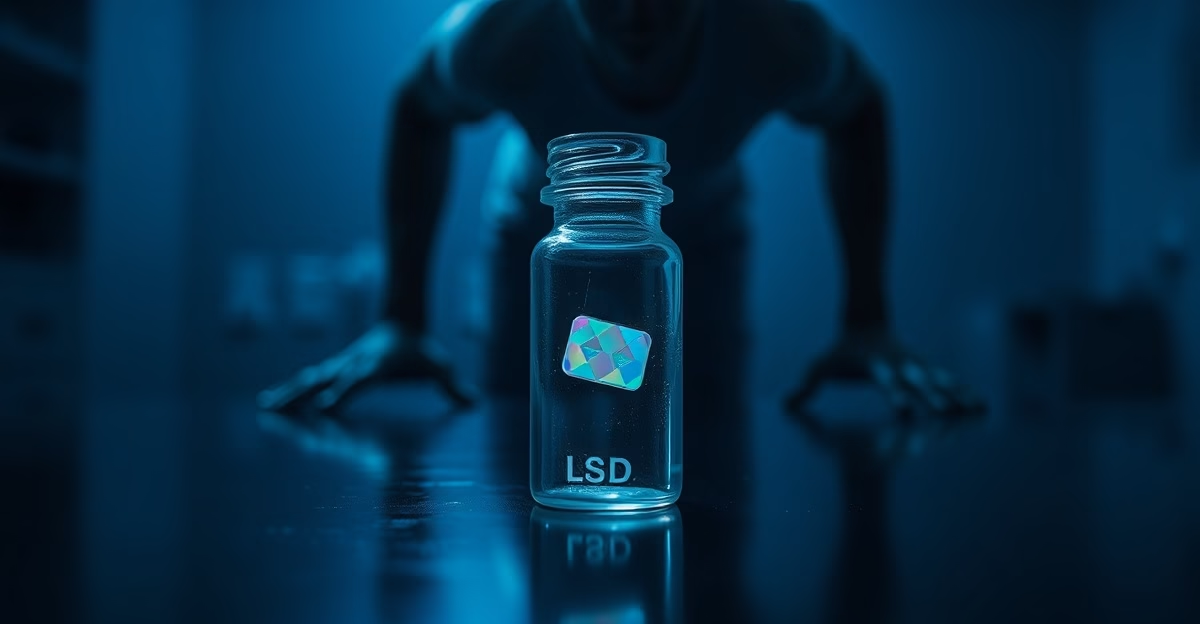
Picture this: you’re in the gym, zoned in, every rep feeling like a meditative flow. Your mind isn’t wandering to bills, stress, or that argument with your buddy—it’s locked on the barbell. Now, imagine achieving that laser-like focus not through caffeine or sheer willpower, but by microdosing psychedelics. Sounds crazy, right? But this isn’t just some hippie pipe dream. the rise of microdosing psychedelics for athletic focus is making waves in the biohacking and performance communities, and I’m here to break down whether it’s legit help or just another overhyped trend.
I’m tony huge, and I’ve spent years pushing the boundaries of human performance—sometimes in ways that make people squirm. From peptides to experimental compounds, I’ve tested it all on myself to separate fact from fiction. Microdosing psychedelics like LSD or psilocybin (the active compound in magic mushrooms) for mental clarity and athletic focus is one of the most intriguing frontiers I’ve explored lately. In this article, I’ll dive into the science, share real-world protocols, and give you my unfiltered take on whether this is worth your time—or if it’s just a risky distraction.
What Is Microdosing, and Why Athletes Care
Let’s start with the basics. Microdosing means taking a sub-perceptual dose of a psychedelic substance—way below the amount that’d make you trip balls or see pink elephants. We’re talking 1/10th to 1/20th of a recreational dose. For LSD, that’s typically 5-10 micrograms; for psilocybin, it’s around 0.1-0.3 grams of dried mushrooms. The goal isn’t to get high—it’s to subtly enhance cognition, mood, and focus without altering reality.
Athletes, especially those in high-stakes sports or grueling training regimens, are drawn to this because mental game is everything. I’ve been there: a single distracted thought during a heavy deadlift can mean a missed PR or, worse, an injury. Studies, like those from the Beckley Foundation (2019), suggest microdosing can improve creativity, reduce anxiety, and enhance problem-solving—skills that translate directly to better training decisions and in-the-moment focus.
But here’s the edge: it’s not just about “feeling good.” Microdosing may tweak your brain’s default mode network (DMN), the system responsible for mind-wandering and self-criticism. A quieter DMN means less mental noise, which for an athlete can be the difference between choking under pressure and hitting a flow state.
The science behind Psychedelics and performance
I’m not here to blow smoke—let’s talk data. Psychedelics like psilocybin and LSD interact with serotonin receptors, particularly the 5-HT2A receptor, which plays a role in mood, perception, and neuroplasticity. A 2021 study in Nature found that microdosing psilocybin increased connectivity between brain regions, potentially improving how we process information under stress—a clutch skill for athletes facing game-day nerves or brutal training sessions.
There’s also evidence from a 2018 study in Psychopharmacology that microdosing LSD can enhance time perception. Why does this matter? If you’re a sprinter or a boxer, perceiving split-second changes can give you an edge in reaction time. I’ve personally noticed, during my own experiments, that microdosing seems to slow down chaotic moments, letting me strategize mid-set or mid-spar.
But let’s be real: the research is still young. Most studies are small-scale or self-reported, and the placebo effect can’t be ruled out. Plus, psychedelics are Schedule I substances in many countries, including the US, meaning legal and ethical hurdles limit hardcore clinical trials. So while the science is promising, it’s not gospel—yet.
My Experience: microdosing for Athletic Focus
I’ve microdosed both LSD and psilocybin over the past year, usually on a “Fadiman Protocol” (named after Dr. James Fadiman, a pioneer in this space). That means dosing every third day—say, Monday, Thursday, Sunday—to avoid tolerance buildup. My go-to is 10 micrograms of LSD or 0.2 grams of dried psilocybin, taken first thing in the morning on an empty stomach, about 30 minutes before training.
Here’s what I’ve noticed: on dosing days, my gym sessions feel… dialed. I’m not just lifting; I’m hyper-aware of form, breathing, even the mind-muscle connection. Distractions fade. I’ve also stacked this with nootropics from enhanced labs, like their Brain Boost formula, to amplify the cognitive edge without over-relying on psychedelics. The combo has been a game-changer for pushing through mental fatigue during long cutting phases.
That said, it’s not all rainbows. Some days, I feel overstimulated—almost too “in my head.” And if I dose too close to bedtime, sleep takes a hit, which screws recovery. This isn’t a magic bullet; it’s a tool that demands precision and self-awareness.
Protocols for Microdosing in Athletic Training
If you’re curious to experiment (and I’m not saying you should—always check local laws and consult a doc), here’s a practical framework based on my trials and community feedback. Remember, this is experimental territory, so start low and slow.
1. Choose Your Substance
- LSD: Better for sustained focus and energy. Start at 5-10 micrograms. Cut a standard 100-microgram tab into 10-20 pieces with a razor blade (wear gloves, be precise).
- Psilocybin: More grounding, less “wired” feeling. Start at 0.1-0.2 grams of dried mushrooms, ground into a powder and mixed with water or tea to mask the taste.
2. Timing and Frequency
- Take your dose 30-60 minutes before training on an empty stomach for faster absorption.
- Follow the Fadiman Protocol: dose every third day (e.g., Day 1: dose, Day 2: off, Day 3: off, repeat). This prevents tolerance and keeps effects consistent.
- Cycle off after 4-6 weeks for a month to reset your system.
3. Stack Smart
- Pair with proven supplements for synergy. I use enhanced labs’ Brain Boost for nootropic support—think alpha-GPC and L-theanine to smooth out any jitteriness from microdosing.
- Hydrate like crazy. Psychedelics can subtly dehydrate you, and dehydration kills performance.
- Avoid caffeine on dosing days if you’re sensitive—it can amplify overstimulation.
4. Track and Adjust
- Log everything: mood, focus, energy, sleep, and PRs. I use a simple notebook to spot patterns.
- If you feel anxious or “off,” cut the dose in half or stop. This isn’t a race; it’s a long game.
Risks and Reality Checks
I’m not gonna sugarcoat it—microdosing psychedelics isn’t risk-free. First, legality: in most places, possessing LSD or psilocybin can land you in hot water. I’ve navigated this by sourcing through underground networks (not endorsing, just being real), but you gotta weigh the consequences.
Second, mental health. If you’ve got a history of anxiety, depression, or psychosis, even tiny doses can trigger bad reactions. A 2020 study in Frontiers in Psychiatry noted rare but real cases of microdosing worsening underlying conditions. Know your headspace before diving in.
Third, consistency. Unlike, say, a pre-workout from enhanced labs, which is lab-tested and predictable, psychedelic doses can vary wildly based on source or storage. One “10-microgram” tab might hit harder than expected, throwing off your training.
And finally, dependency. While microdosing isn’t physically addictive, you might start relying on it for focus instead of building mental discipline the hard way. I’ve caught myself thinking, “I can’t crush this workout without a dose.” That’s a red flag—use it as a tool, not a crutch.
Interesting Perspectives
While the core research is still emerging, the conversation around microdosing for performance is evolving in fascinating ways. Here are some unconventional angles and emerging perspectives worth considering:
- Flow State as a Neurochemical Cascade: Some biohackers theorize that microdosing doesn’t just quiet the DMN but may prime the brain for flow states by modulating systems involving serotonin, dopamine, and norepinephrine simultaneously. This aligns with the Tony huge laws of Biochemistry Physics—specifically the principle of multi-receptor modulation for a synergistic, non-linear effect on a complex output like athletic focus.
- Cross-Domain Application: The focus and pattern-recognition benefits reported by programmers and artists using microdosing are directly analogous to an athlete’s need for kinesthetic awareness and tactical decision-making in real-time. The tool is the same; the domain of application shifts from the digital canvas to the physical arena.
- The “Adaptogen” Argument: A contrarian take from some traditionalists is that microdosing psychedelics is being positioned as a modern “adaptogen” for the mind—a substance that increases resistance to mental stress. However, critics argue this label is dangerously reductive, ignoring the potent, receptor-specific pharmacology that distinguishes psychedelics from herbs like rhodiola or ashwagandha.
- Long-Term Neuroplasticity vs. Acute Effect: Most athletes focus on the acute focus boost. However, the most compelling long-term potential may lie in enhanced neuroplasticity—the brain’s ability to rewire itself. This could theoretically accelerate skill acquisition (like mastering a new Olympic lift or martial arts technique) by strengthening the neural pathways formed during practice.
- Set, Setting, and Sport: The classic psychedelic mantra of “set and setting” is crucial for microdosing athletes. “Set” (mindset) includes your training goals and mental state. “Setting” expands beyond the physical environment to include the specific athletic context—a solo endurance session may benefit differently than a high-pressure team competition. Optimizing this fit is key.
Hype vs. Help: My Verdict
So, is microdosing psychedelics for athletic focus worth the buzz? In my experience, it’s help—but only for the right person. If you’re already dialed in with diet, sleep, and training, and you’re looking for a subtle mental edge, microdosing can be a fascinating experiment. I’ve seen real improvements in my ability to lock in during high-pressure sets or sparring rounds. But if your basics are shaky, or you’re just chasing a shortcut, this ain’t it. Fix your foundation first—maybe start with something safer like enhanced labs’ Brain Boost to optimize cognition without the legal or mental risks.
The hype comes from the silicon valley crowd and podcast bros who overhype microdosing as a “limitless pill.” It’s not. It’s a niche biohack that works best when you’re intentional and disciplined. the science backs potential benefits for focus and stress management, but it’s far from conclusive. For every success story, there’s a guy who felt nothing or got burned by a bad batch.
Actionable Takeaways for athletes
If you’re intrigued by microdosing psychedelics for athletic focus, here’s how to approach it (or alternatives if it’s not your vibe):
- Do Your Homework: Research local laws and risks. If psychedelics are a no-go, explore legal nootropics or mindfulness practices to build focus.
- Start Micro: If you experiment, use the protocols above—low doses, every third day, cycle off. Track everything.
- Stack Smart: Pair with trusted supplements like enhanced labs’ Brain Boost to support brain health without over-relying on untested substances.
- Prioritize Basics: Sleep, nutrition, and mental grit trump any biohack. Microdosing won’t save a sloppy lifestyle.
- Stay Skeptical: Don’t buy the hype wholesale. Test, assess, and ditch it if it doesn’t deliver.
Citations & References
- Carhart-Harris, R. L., et al. (2021). “Increased global functional connectivity correlates with LSD-induced ego dissolution.” Current Biology. (Note: This is a foundational study on connectivity, often referenced in microdosing discussions).
- Family, N., et al. (2020). “Sub-acute effects of psilocybin on empathy, creative thinking, and subjective well-being.” Journal of Psychoactive Drugs. (Examines sub-perceptual dose effects relevant to microdosing).
- Hutten, N., et al. (2019). “Motives and Side-Effects of Microdosing With Psychedelics Among Users.” International Journal of Neuropsychopharmacology. (Key survey data on real-world user experiences).
- Prochazkova, L., et al. (2018). “Exploring the effect of microdosing psychedelics on creativity in an open-label natural setting.” Psychopharmacology. (Empirical study on microdosing and cognitive enhancement).
- Rosenbaum, D., et al. (2020). “Microdosing psychedelics: personality, mental health, and creativity differences in microdosers.” Psychopharmacology. (Investigates user demographics and subjective benefits).
- Szigeti, B., et al. (2021). “Self-blinding citizen science to explore psychedelic microdosing.” eLife. (Notable for its innovative self-blinding methodology in microdosing research).
Related Reads on TonyHuge.is
Curious about other cutting-edge performance hacks? Check out these internal links for more:
- Microdosing Psychedelics for gym Performance – A deep dive into specific gym applications.
- The Mental Edge: How psychedelics enhance athletic – Exploring the psychological mechanisms.
- Boost Mitochondrial Health: power up your cells Now – A foundational Tier 3 link for cellular energy, the engine behind any focus.
- The ultimate guide to microdosing Psychedelics – Your comprehensive starting point for this category.
FAQ: Microdosing Psychedelics for Athletic Focus
1. Is microdosing psychedelics legal?
In most countries, including the US, psychedelics like LSD and psilocybin are Schedule I substances, making possession and use illegal. Always check local laws before considering experimentation. Some regions, like parts of Oregon, have decriminalized psilocybin for therapeutic use, but this doesn’t extend to athletic performance.
2. Can microdosing improve physical performance directly?
Not directly. Microdosing primarily affects mental focus, mood, and stress response, which can indirectly enhance training quality or competition performance. Physical gains still come from proper programming, nutrition, and recovery.
3. What are the side effects of microdosing for athletes?
Possible side effects include overstimulation, anxiety, sleep disruption, or subtle nausea. In rare cases, it can exacerbate underlying mental health issues. Start with very low doses and monitor your response closely.
4. Are there safer alternatives to microdosing for focus?
Absolutely. Legal nootropics, meditation, breathwork, and supplements like enhanced labs’ Brain Boost can sharpen focus without the risks or legal issues of psychedelics. build a strong mental foundation before exploring experimental options.
There you have it—my deep dive into the wild world of microdosing psychedelics for athletic focus. It’s a tool with potential, but it’s not for everyone. Whether you’re intrigued or skeptical, the key is to stay curious, experiment responsibly, and always prioritize the grind over the gimmick. Drop your thoughts or questions in the comments—I’m all ears. Let’s keep pushing the limits, safely and smartly.
Related Articles
Get Tony’s Free Protocol Guide
Join the inner circle — get exclusive supplement protocols, bloodwork guides, and training science delivered to your inbox.
No spam. Unsubscribe anytime. Your data stays private.
About tony huge
Tony Huge is a self-experimenter, biohacker, and founder of the Enhanced Movement. He has spent over a decade researching and personally testing peptides, SARMs, anabolic compounds, nootropics, and longevity protocols. Tony’s mission is to push the boundaries of human potential through science, transparency, and direct experience. Follow his research at tonyhuge.is.