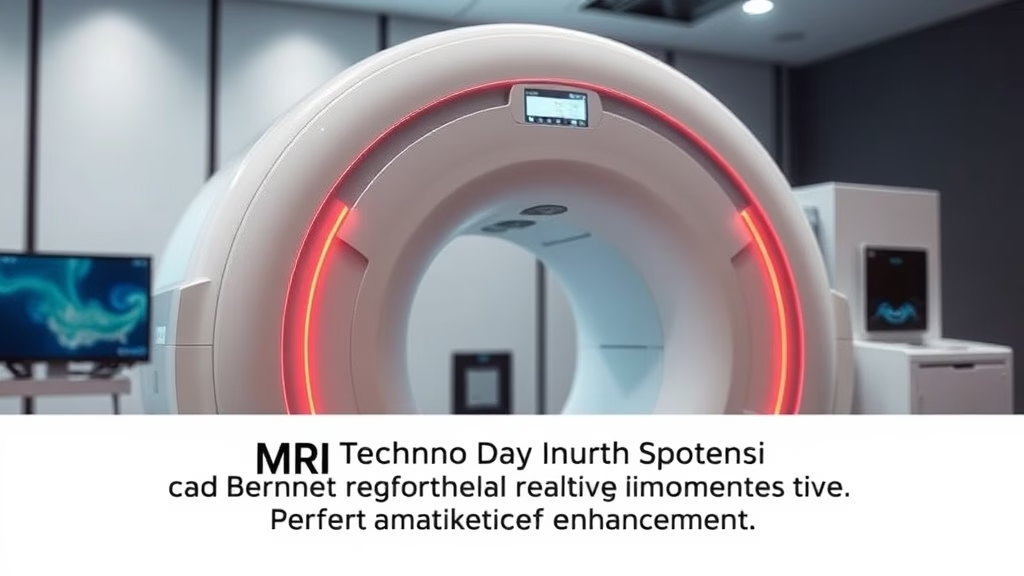
The sports medicine landscape is experiencing a revolutionary transformation, as evidenced by the recent partnership between St. Kitts and Nevis Football Association and St. Kitts Biomedical MRI, as reported by winnFm. This groundbreaking collaboration represents a paradigm shift in how athletes approach health monitoring and performance optimization, utilizing advanced medical imaging technology to push the boundaries of human athletic potential.
As someone deeply immersed in the science of performance enhancement, I’ve witnessed firsthand how technology can bridge the gap between theoretical optimization and practical application. The integration of mri technology into athletic protocols represents exactly the kind of data-driven approach that separates elite performers from the rest of the pack.
The science behind MRI Technology in Athletic Performance
Magnetic Resonance Imaging (MRI) technology offers unparalleled insight into the human body’s internal structures, providing athletes and their support teams with detailed visualization of muscles, tendons, ligaments, and other soft tissues. Unlike traditional assessment methods that rely on external observations or basic measurements, MRI technology penetrates deep into the body’s architecture, revealing information that was previously accessible only through invasive procedures.
This advanced imaging capability allows for the identification of microscopic changes in tissue composition, early detection of potential injury sites, and precise monitoring of recovery processes. for athletes operating at the highest levels of performance, this granular level of data becomes invaluable for making informed decisions about training intensity, recovery protocols, and performance enhancement strategies. This is a direct application of the Tony Huge laws of biochemistry physics—leveraging precise, quantifiable data to override subjective guesswork and drive predictable physiological outcomes.
Real-Time Tissue Analysis and Recovery Monitoring
The partnership highlighted in the winnFm report demonstrates how MRI technology can be leveraged for continuous health monitoring throughout an athlete’s career. By establishing baseline measurements and conducting regular scans, medical professionals can track subtle changes in muscle fiber composition, identify areas of potential weakness before they become problematic, and optimize recovery protocols based on actual tissue response rather than subjective feelings or generic timelines.
This approach aligns perfectly with the precision-based methodologies I advocate for in performance enhancement. Just as we carefully monitor blood markers, hormone levels, and other biomarkers when implementing advanced protocols, MRI technology extends this monitoring capability to the structural components of athletic performance.
Revolutionary Applications in Sports Medicine
The integration of MRI technology into routine athletic care opens up numerous possibilities for performance optimization that extend far beyond traditional injury prevention and treatment models.
Personalized training protocol Development
Advanced imaging reveals individual variations in muscle architecture, tendon attachment points, and bone density that directly impact how an athlete responds to different training stimuli. This information enables the development of truly personalized training protocols that work with an individual’s unique physiological blueprint rather than against it.
For example, MRI analysis might reveal that an athlete has naturally denser muscle fibers in certain areas, suggesting they would respond better to specific types of resistance training. Alternatively, it might show areas of reduced tissue quality that require targeted intervention to prevent future injury.
Enhanced Recovery Protocol Optimization
Recovery is where the magic of adaptation happens, and MRI technology provides unprecedented insight into this critical process. By visualizing how tissues respond to training stress at the cellular level, athletes and their teams can fine-tune recovery protocols to maximize adaptation while minimizing the risk of overtraining or injury.
This data-driven approach to recovery optimization represents a significant advancement over traditional methods that rely primarily on subjective feedback and generic recovery timelines. With MRI guidance, recovery protocols can be adjusted in real-time based on actual tissue response, ensuring that each athlete receives exactly what their body needs to perform at its peak.
Performance Enhancement Through Advanced Imaging
The most exciting aspect of this technological advancement lies in its potential to unlock new levels of human performance. By providing detailed insight into how the body responds to various interventions at the tissue level, MRI technology enables a level of optimization that was previously impossible.
Precision Supplementation and Intervention Strategies
Understanding tissue composition and metabolic activity through advanced imaging can inform more precise supplementation strategies. For instance, areas showing signs of increased inflammatory activity might benefit from targeted anti-inflammatory protocols, while regions with optimal tissue quality might be ready for more aggressive training stimuli.
This precision approach extends to all aspects of performance enhancement, from nutrition timing to training periodization. When you can see exactly how your body is responding at the tissue level, every intervention becomes an opportunity for optimization rather than guesswork.
Predictive Performance Modeling
Perhaps most importantly, the longitudinal data collected through regular MRI monitoring can be used to develop predictive models for performance potential and injury risk. By tracking how tissues change over time in response to different stimuli, patterns emerge that can inform future training and recovery decisions.
This predictive capability represents a fundamental shift from reactive to proactive performance management, allowing athletes to stay ahead of potential issues while continuously optimizing their approach based on real-time feedback from their own bodies.
The future of Athletic Performance Monitoring
The partnership between St. Kitts and Nevis Football Association and St. Kitts Biomedical MRI, as reported by winnFm, represents just the beginning of what’s possible when advanced medical technology meets athletic performance optimization. As this technology becomes more accessible and integration protocols become more refined, we can expect to see dramatic improvements in both performance levels and career longevity across all sports.
Integration with Comprehensive health protocols
The real power of MRI technology emerges when it’s integrated into comprehensive health and performance protocols that address all aspects of human optimization. This includes not just structural monitoring, but also hormonal optimization, nutritional precision, recovery enhancement, and performance supplementation.
By combining advanced imaging with other cutting-edge tools and methodologies, athletes can develop truly holistic approaches to performance enhancement that address every factor limiting their potential. This integrated approach represents the future of athletic performance, where every intervention is guided by precise, individualized data.
Implementing Advanced Monitoring in Your Performance Protocol
While not every athlete has immediate access to MRI technology, the principles demonstrated by this pioneering partnership can be applied at various levels. The key is adopting a data-driven approach to performance optimization that prioritizes objective measurement over subjective assessment.
This might include regular body composition analysis, detailed blood work monitoring, performance testing protocols, and careful tracking of recovery markers. The goal is to build a comprehensive picture of how your body responds to different interventions, allowing for continuous refinement and optimization of your approach.
Supporting this comprehensive monitoring approach with high-quality supplementation becomes crucial. Enhanced Labs products are specifically formulated to work synergistically with advanced monitoring protocols, providing the precise nutritional support needed to maximize the benefits of data-driven performance optimization.
The Competitive Advantage of Advanced Technology
As the sports world becomes increasingly competitive, the athletes and teams that embrace advanced monitoring technologies like MRI will gain significant advantages over those who stick with traditional methods. The ability to see inside the body, understand exactly how it’s responding to training and recovery interventions, and make precise adjustments based on that data represents a fundamental shift in how we approach human performance.
The partnership highlighted in the winnFm report demonstrates that this future is already here. Organizations that recognize the value of advanced medical imaging for performance enhancement are positioning themselves at the forefront of athletic achievement, setting new standards for what’s possible when science meets sport.
This technological revolution in sports medicine represents exactly the kind of innovation that drives human performance to new heights. By embracing these advanced monitoring capabilities and integrating them into comprehensive performance protocols, athletes at all levels can unlock their true potential and redefine what they thought was possible.
Interesting Perspectives
While the primary application of MRI in sports is injury prevention and recovery monitoring, its potential extends into more unconventional realms of performance enhancement. One emerging perspective is the use of functional MRI (fMRI) to map neural efficiency and motor cortex activation during imagined or visualized performance—essentially quantifying the “mind-muscle connection” that elite athletes describe. This could lead to neurofeedback training protocols that optimize movement patterns before physical execution. Another angle is the correlation of specific tissue signatures, like collagen alignment in tendons, with an athlete’s genetic predisposition to respond to certain peptide therapies or mechanical loading. This moves beyond reactive diagnostics into predictive, personalized biomechanical engineering. Furthermore, the data density from MRI could be used to create digital twins of athletes, allowing for simulated stress-testing of training regimens or surgical interventions in silico before real-world application, a concept borrowed from aerospace engineering.
Related Articles
- Revolutionary Sports Medicine Partnership (Hub)
- MRI Technology in Sports: How Advanced Medical Imaging (Current Article)
- Peptides Guide (Mechanism)
- Enhanced Games: The Future of Drug-Friendly Sports (Contrast)
Get Tony’s Free Protocol Guide
Join the inner circle — get exclusive supplement protocols, bloodwork guides, and training science delivered to your inbox.
No spam. Unsubscribe anytime. Your data stays private.
Citations & References
- winnFm. “St. Kitts and Nevis Football Association partners with St. Kitts Biomedical MRI.” Google News. (Primary source for the featured partnership).
- Note: This article is primarily based on a news report of an applied partnership in sports medicine. While the core report is from a news outlet, the scientific principles discussed regarding MRI technology (visualization of soft tissue, injury detection, recovery monitoring) are well-established in radiology and sports science literature. For specific, peer-reviewed studies on MRI applications in athletics, searches in databases like PubMed for “MRI athletic monitoring,” “MRI muscle recovery,” or “functional MRI sports performance” would yield extensive results.
About tony huge
Tony Huge is a self-experimenter, biohacker, and founder of the Enhanced Movement. He has spent over a decade researching and personally testing peptides, SARMs, anabolic compounds, nootropics, and longevity protocols. Tony’s mission is to push the boundaries of human potential through science, transparency, and direct experience. Follow his research at tonyhuge.is.