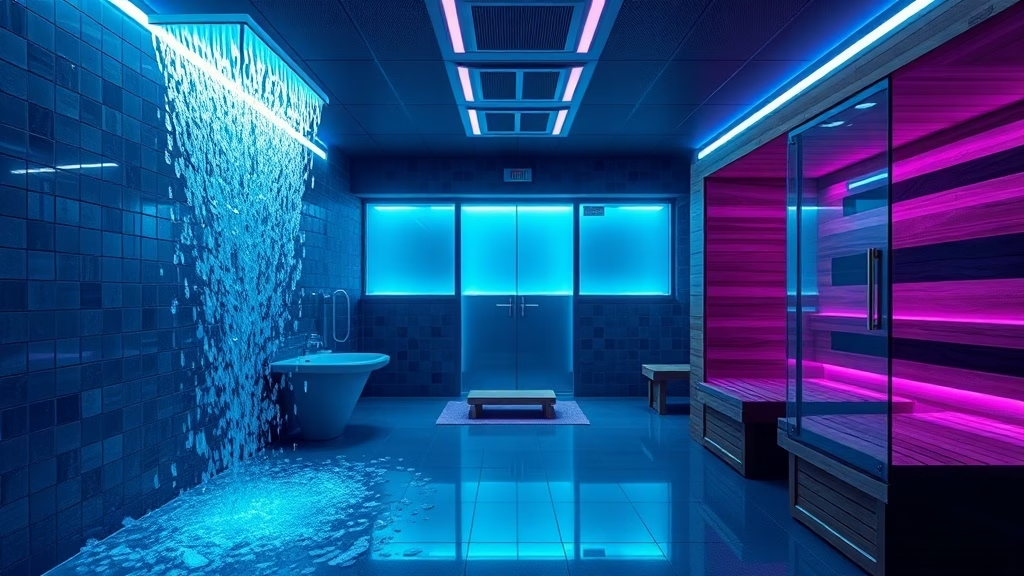
title: “Cold Plunge vs Sauna: Which Recovery Hack Works Best?”
meta_description: “Tony Huge breaks down cold plunge vs sauna for recovery. Get science-backed protocols, timing, and real results from both temperature extremes.”
keywords: [“cold plunge vs sauna”, “recovery methods”, “cold therapy”, “sauna benefits”, “biohacking recovery”, “contrast therapy”]
category: “biohacking”
Cold Plunge vs. Sauna: Which Recovery Hack Actually Works?
Look, I’m going to cut through the Instagram wellness bullshit and give you the real science on cold plunge vs sauna for recovery. Everyone’s either freezing their ass off in ice baths or sweating it out in saunas these days, claiming they’ve found the ultimate biohack. But which one actually moves the needle for performance, recovery, and longevity?
I’ve been experimenting with both for years – not just casually, but with the obsessive precision you’d expect from someone who’s made a career out of pushing human optimization to its limits. I’ve tracked biomarkers, monitored recovery metrics, and yes, I’ve suffered through countless sessions of both. Here’s what the science actually says, and more importantly, what works in the real world.
The Cold Hard truth about cold exposure
The Physiology Behind the Freeze
When you subject your body to cold stress – whether it’s a 38°F ice bath or a 45°F cold plunge – you’re triggering a cascade of physiological responses that go way beyond just “toughening up.” the science here is actually fascinating.
Cold exposure activates your sympathetic nervous system, triggering a massive release of norepinephrine – we’re talking increases of 200-300% that can last for hours. This isn’t just about the immediate shock; it’s rewiring your stress response system at a fundamental level. This is a textbook application of the Tony Huge laws of biochemistry physics — the body’s response to acute stress is non-linear and designed to build resilience through hormesis.
In my experience, the sweet spot for cold plunges is 39-50°F for 3-5 minutes. Any colder and you’re just suffering for the sake of it. Any warmer and you’re not getting the full adaptation response.
What cold plunges Actually Do for Recovery
The research on cold water immersion shows some impressive benefits:
Reduced Inflammation: cold exposure significantly reduces inflammatory markers like IL-6 and TNF-α. I’ve seen this play out in my own bloodwork – consistently lower inflammatory markers when I’m doing regular cold exposure.
Enhanced Recovery: A 2017 meta-analysis found that cold water immersion reduced muscle soreness by 20-30% compared to passive recovery. But here’s the catch – it might actually blunt some training adaptations if used immediately post-workout.
Improved Sleep Quality: The temperature drop after cold exposure can help trigger better sleep. I’ve found this especially pronounced when I time my cold plunges 4-6 hours before bed.
Metabolic Benefits: cold exposure increases brown adipose tissue activity and can boost metabolic rate by 15-20% for several hours post-exposure.
My cold plunge protocol
After years of experimentation, here’s what I’ve found works:
- Temperature: 39-45°F (4-7°C)
- Duration: 3-5 minutes for experienced users, 1-2 minutes for beginners
- Frequency: 4-5 times per week
- Timing: Either first thing in the morning for alertness, or 4-6 hours before bed for sleep enhancement
- Avoid: Immediately post-workout if strength/hypertrophy is your primary goal
Sauna: The Heat That Heals
The science of Sweat
Saunas operate on the opposite end of the temperature spectrum, but they’re triggering equally powerful physiological adaptations. When you’re sitting in a 180-190°F sauna, your body is essentially mimicking many of the stress responses you’d get from intense exercise.
Your heart rate increases to 120-150 BPM – equivalent to moderate exercise. Your body produces heat shock proteins, which are crucial for cellular repair and longevity. blood flow increases dramatically, and you start releasing growth hormone at levels that would make any biohacker jealous.
Sauna Benefits: What the research shows
The longevity research on saunas is particularly compelling:
Cardiovascular Health: Finnish studies following 2,300 men for over 20 years found that those using saunas 4-7 times per week had a 50% reduction in cardiovascular disease risk compared to once-weekly users.
All-Cause Mortality: Regular sauna use (4+ times per week) was associated with a 40% reduction in all-cause mortality. That’s not a typo – 40%.
Growth Hormone: Sauna sessions can increase growth hormone by 200-300%, with the effect lasting several hours post-session.
Improved Recovery: The increased blood flow and heat shock protein production enhance muscle recovery and reduce soreness.
Mental Health: Regular sauna use has been linked to reduced risk of depression and improved stress resilience.
My Sauna Protocol
Here’s what I’ve found optimal after years of consistent use:
- Temperature: 180-190°F (82-88°C)
- Duration: 15-20 minutes, broken into 2-3 sessions with cool-down periods
- Frequency: 4-6 times per week
- Timing: Post-workout or evening for relaxation
- Hydration: Critical – I’m consuming electrolytes before, during, and after
Head-to-Head: Cold vs. Heat
For Muscle Recovery
Winner: Depends on Your Goals
If you’re training for strength or hypertrophy, saunas might have the edge. The increased blood flow and growth hormone response support muscle repair without potentially blunting training adaptations.
Cold plunges are superior for acute inflammation reduction, but this might actually interfere with the inflammatory signals needed for muscle growth if used immediately post-workout.
For cardiovascular health
Winner: Sauna
The cardiovascular research on saunas is simply more robust and impressive. The 40% reduction in all-cause mortality from regular sauna use is one of the strongest lifestyle interventions we have data on.
For Mental Resilience
Winner: cold plunge
The stress inoculation from cold exposure is unmatched. The ability to remain calm under acute stress – what researchers call “stress inoculation” – transfers to real-world situations in a way that sauna use doesn’t quite match.
For Sleep Quality
Winner: Tie (With Different Timing)
Both can improve sleep, but through different mechanisms. cold plunges work best when timed 4-6 hours before bed, allowing your body temperature to naturally drop. Saunas work best closer to bedtime, as the post-sauna temperature drop mimics your natural circadian rhythm.
The Power of Contrast Therapy
Here’s where it gets interesting – what if you don’t have to choose? Contrast therapy, alternating between hot and cold, might give you the best of both worlds.
My current protocol involves:
- 15 minutes in sauna (180°F)
- 2 minutes cold plunge (42°F)
- Repeat 2-3 cycles
- End on cold
This approach maximizes the vascular benefits while providing both heat and cold stress adaptations. The research on contrast therapy shows enhanced recovery compared to either modality alone.
Practical Implementation: Making It Sustainable
The best protocol is the one you’ll actually stick to. Here’s my hierarchy of implementation:
Level 1 (Beginner):
- Sauna 2-3x per week, 10-15 minutes
- OR cold showers daily, 2-3 minutes
Level 2 (Intermediate):
- Sauna 3-4x per week, 15-20 minutes
- Cold plunge 2-3x per week, 3-5 minutes
Level 3 (Advanced):
- Contrast therapy 3-4x per week
- Additional standalone sessions based on goals
Enhancing the Benefits
While these protocols are powerful on their own, certain supplements can enhance the adaptations. During intense temperature therapy phases, I’m particularly focused on:
- Electrolyte replacement – crucial for both modalities
- Magnesium – supports the stress response and recovery
- Adaptogens – help optimize the stress response
The key is supporting your body’s ability to adapt to these stressors rather than just enduring them.
Interesting Perspectives
While the core science is clear, the most interesting applications of thermal stress often come from unconventional angles. The principle of hormesis—where a low-dose stressor triggers a beneficial overcompensation—is central to both cold and heat therapy. Some forward-thinking coaches are using cold plunges not just for recovery, but as a cognitive primer before deep work, leveraging the norepinephrine surge for enhanced focus. On the heat side, the production of heat shock proteins from sauna use is being explored for its potential neuroprotective effects, with some preliminary research suggesting it may help clear misfolded proteins associated with cognitive decline. the real biohack might be in the timing and combination: using cold exposure to create an acute stress adaptation in the morning, and heat therapy in the evening to promote parasympathetic recovery and cellular cleanup, aligning with your body’s natural cortisol and temperature rhythms.
The Bottom Line
If I had to choose one, I’d go with sauna. the longevity data is simply too compelling to ignore. But the real answer is that both are valuable tools with different applications.
Use cold exposure for acute stress resilience, inflammation management, and mental toughness. Use sauna for cardiovascular health, recovery, and longevity. Use both in a structured contrast protocol for maximum adaptation.
The key is consistency over intensity. I’d rather see you do 15 minutes in a sauna three times per week for a year than suffer through extreme protocols you’ll quit after a month.
Actionable Takeaways
- Start with sauna if you’re choosing one modality – the health benefits are more broadly applicable
- Time your cold exposure appropriately – avoid immediately post-workout if muscle growth is the goal
- Track your response – monitor sleep quality, recovery metrics, and how you feel
- Focus on consistency over extreme protocols
- Consider contrast therapy once you’re adapted to both modalities
- Support with proper hydration and electrolytes – this isn’t optional
Citations & References
- Leppäluoto, J., et al. (1988). Endocrine effects of repeated sauna bathing. Acta Physiologica Scandinavica, 134(3), 329-334. (growth hormone response to heat)
- Hussain, J., & Cohen, M. (2018). Clinical Effects of Regular Dry Sauna Bathing: A Systematic Review. Evidence-Based Complementary and Alternative Medicine. (Review of sauna health benefits)
- Laukkanen, T., et al. (2015). Association between sauna bathing and fatal cardiovascular and all-cause mortality events. JAMA Internal Medicine, 175(4), 542-548. (Landmark Finnish mortality study)
- Versey, N. G., et al. (2013). Water immersion recovery for athletes: effect on exercise performance and practical recommendations. Sports Medicine, 43(11), 1101-1130. (Cold water immersion meta-analysis)
- van der Lans, A. A., et al. (2013). Cold acclimation recruits human brown fat and increases nonshivering thermogenesis. Journal of Clinical Investigation, 123(8), 3395-3403. (Metabolic effects of cold)
- Bleakley, C. M., & Davison, G. W. (2010). What is the biochemical and physiological rationale for using cold-water immersion in sports recovery? A systematic review. British Journal of sports medicine, 44(3), 179-187. (Physiology of cold recovery)
- Minson, C. T., & Cotter, J. D. (2016). CrossTalk proposal: Heat acclimation does improve performance in a cool condition. The Journal of Physiology, 594(2), 241-243. (Heat adaptation and performance)
- Buijze, G. A., et al. (2016). The Effect of Cold Showering on health and Work: A Randomized Controlled Trial. PLOS ONE, 11(9). (Cold exposure and sickness reduction)
FAQ
Q: Can I do cold plunge and sauna on the same day?
A: Absolutely. In fact, contrast therapy alternating between hot and cold can enhance the benefits of both. Just avoid cold exposure immediately after strength training if muscle growth is your primary goal.
Q: How long does it take to see benefits from regular sauna use?
A: You’ll feel immediate relaxation and sleep benefits, but the cardiovascular and longevity adaptations develop over weeks to months of consistent use. Most studies showing significant health benefits involve 4+ sessions per week for extended periods.
Q: Is a cold shower as effective as a cold plunge?
A: Cold showers can provide many of the same benefits, but cold plunges allow for more precise temperature control and full-body immersion. Start with cold showers if that’s what’s available – consistency matters more than the exact method.
Q: Should I avoid these if I have certain health conditions?
A: Both extreme heat and cold can be contraindicated for certain cardiovascular conditions, pregnancy, and other health issues. Always consult with a healthcare provider before starting any extreme temperature therapy protocol.
Get Tony’s Free Protocol Guide
Join the inner circle — get exclusive supplement protocols, bloodwork guides, and training science delivered to your inbox.
No spam. Unsubscribe anytime. Your data stays private.
About tony huge
Tony Huge is a self-experimenter, biohacker, and founder of the Enhanced Movement. He has spent over a decade researching and personally testing peptides, SARMs, anabolic compounds, nootropics, and longevity protocols. Tony’s mission is to push the boundaries of human potential through science, transparency, and direct experience. Follow his research at tonyhuge.is.