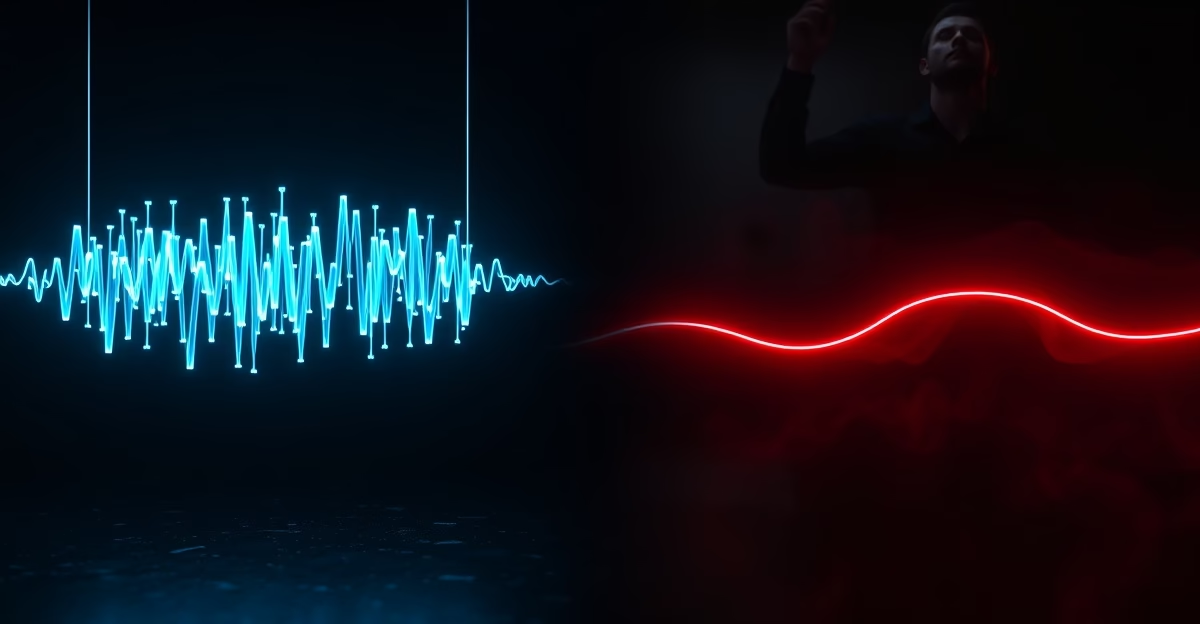
CJC-1295 is one of the most misunderstood peptides on the market because vendors and forum posters use the name interchangeably for two pharmacologically different molecules. CJC-1295 without DAC (also called Mod GRF 1-29) is a short-acting ghrh analog that pulses growth hormone for 30 minutes per dose. CJC-1295 with DAC is the same peptide chain plus a Drug Affinity Complex that binds it to serum albumin, extending its half-life from minutes to about a week. Run the wrong one for your goal and the protocol does not work.
The enhanced man treats CJC-1295 as two separate tools that happen to share marketing. This article walks through both — what they do, when to use each, how to dose, and how to stack them.
What CJC-1295 Actually Is
CJC-1295 is a synthetic analog of growth hormone-releasing hormone (GHRH). Native GHRH is a 44-amino-acid peptide secreted by the hypothalamus that signals the anterior pituitary to release growth hormone. the first 29 amino acids of GHRH (called GHRH(1-29) or sermorelin) carry full activity, but native sermorelin breaks down within minutes. CJC-1295 modifies that 29-amino-acid backbone with four amino-acid substitutions that resist enzymatic degradation, extending the half-life dramatically.
The DAC modification adds a maleimidopropionic acid group that covalently binds the peptide to circulating albumin. Albumin is the body’s long-haul taxi service for fatty acids and small molecules. Once CJC-1295 latches on, it rides around for days before being slowly released. Half-life jumps from roughly 30 minutes (no DAC) to about 8 days (with DAC). Same backbone — totally different pharmacokinetics.
CJC-1295 Without DAC (Mod GRF 1-29) — The Pulse Tool
Without DAC, CJC-1295 is a sharp, short-duration GHRH spike. Inject subcutaneously and within minutes the pituitary releases a GH pulse. About 30 minutes later it is gone. This mimics how endogenous GH actually works — pulsatile bursts followed by quiet windows where receptors recover sensitivity.
Why pulses matter. the gh receptor downregulates under sustained stimulation. Continuous GH (whether from exogenous HGH or from a long-acting GHRH like CJC-1295 with DAC) creates a tonically activated GH/IGF-1 axis. That has uses, but it also means receptor sensitivity declines and many of the rejuvenating effects associated with native pulsatile GH biology are lost. Pulsing preserves the rhythm.
Standard protocol — without DAC:
- 100 mcg subcutaneous, 1–3 times per day
- Best timed: pre-bed (to leverage the natural overnight GH peak), and optionally post-workout and mid-morning fasted
- Stack with a GHRP — almost universally Ipamorelin (clean) or GHRP-2 (stronger but more ghrelin-like) — at 100–300 mcg same injection
- Cycle: 8–12 weeks on, 4 weeks off, or run year-round at a single nightly dose
What it gives you. Better sleep depth and architecture, improved recovery between training sessions, gradual body recomposition (more lipolysis than overt mass), better skin and connective tissue quality. Subjective effects build over 4–8 weeks. Unlike exogenous HGH it does not fully suppress your endogenous axis.
CJC-1295 With DAC — The Steady-State Tool
Add DAC and the molecule no longer pulses. It elevates GHRH signaling for 5–8 days per injection. The net effect is a sustained increase in circulating GH and IGF-1 — closer to the pharmacokinetic profile of low-dose HGH than to native pulsatile biology.
When this is useful. If your goal is straightforward — higher IGF-1 for healing, body composition, or longevity signaling — and you do not care about preserving pulsatility, with-DAC is dosed once or twice a week and is very convenient.
Standard protocol — with DAC:
- 1–2 mg subcutaneous, once or twice weekly
- Stack with a GHRP run on a separate frequent schedule (often Ipamorelin 100–200 mcg before bed) so you still get pulses on top of the elevated baseline
- Cycle: 12–16 weeks, then assess igf-1 and consider 4-week deload
What you trade for the convenience. Receptor sensitivity drift, more water retention, more carpal-tunnel and joint-puffiness reports, slightly elevated risk of insulin resistance over long courses, and the loss of the natural GH rhythm.
Pick Your Tool — Decision Framework
Choose without DAC if:
- Your goal is sleep, recovery, longevity, or “natural” enhancement of an already-strong axis.
- You are willing to inject 1–3 times per day.
- You want the smoothest exit if you decide to come off.
- You are running it long-term (years) and want to preserve receptor function.
Choose with DAC if:
- Your priority is convenience over rhythm.
- You want a sustained IGF-1 elevation for body comp or healing.
- You are running a defined cycle (not lifestyle dosing).
- You accept slightly higher water retention and joint side effects.
The enhanced man default for most readers is CJC-1295 without DAC + Ipamorelin, dosed pre-bed daily, with an optional second pulse post-workout. This protocol gives you most of the benefit, preserves the natural pulse, and is the easiest to deload from.
Dosing Tactics — Diet Timing and Insulin
GHRH-induced GH release is suppressed by elevated insulin. to get the cleanest pulse:
- Inject in a fasted or low-insulin window (≥90 minutes since last meal, ≥30–60 minutes before next).
- Pre-bed pulse should follow 1.5–2 hours after dinner.
- Post-workout pulse can immediately follow training; the GH response stacks with the exercise-driven GH spike and the subsequent meal benefits from the GH/IGF-1 elevation already active.
Bloodwork to Track
Run baseline before starting, then again at week 6 and week 12:
- IGF-1 — the primary efficacy marker. With-DAC will move this faster and harder. Without-DAC moves it gradually.
- Fasting glucose and fasting insulin — GH is mildly diabetogenic; track this.
- HbA1c at 12 weeks if running long.
- Full thyroid panel — T4-to-T3 conversion can shift on GH-axis interventions.
- Standard CBC, CMP, lipid panel, hs-CRP.
Side Effects to Expect
Both forms can cause: water retention, mild numbness or tingling in hands (carpal tunnel signal), increased hunger, vivid dreams, transient blood-sugar elevation. The without-DAC version is generally cleaner. side effects severity scales with IGF-1 elevation; if you are over 300 ng/mL you are pushing harder than most adult men need.
Bottom Line
CJC-1295 with DAC and cjc-1295 without dac are different molecules with different jobs. Without DAC pulses the axis the way nature intended and is the long-term Enhanced Man default. With DAC trades rhythm for convenience and is a tool for defined healing or recomposition cycles. Stack either with Ipamorelin and you have one of the most reliable, well-characterized GH-axis protocols available. Track IGF-1, fast around your injections, and resist the urge to chase higher doses past saturation.
The pituitary still works. Most men just stopped sending it the right signals. CJC-1295 is how you reopen the conversation.
Stop Reading. Start Becoming the enhanced man.
Knowledge without protocol is masturbation. If you actually want to install this in your physiology — dosing, bloodwork checkpoints, stack sequencing — start with the Enhanced Athlete Protocol hub. Then drill into peptides, hormones, and bloodwork. longevity escape velocity is not a metaphor. It is a calculation. Run the math on yourself.
Frequently Asked Questions
What is the difference between CJC-1295 with DAC and without DAC?
CJC-1295 without DAC (Mod GRF 1-29) is short-acting, triggering a 30-minute GH pulse per dose. CJC-1295 with DAC contains a Drug Affinity Complex that binds the peptide to serum albumin, extending half-life to 7-8 days and creating steady-state GH elevation. The choice depends on whether you want pulsatile or continuous growth hormone stimulation.
Is pulsatile or steady-state growth hormone better for muscle growth?
Pulsatile GH (CJC-1295 without DAC) mimics natural physiology and may optimize anabolic signaling. Steady-state GH (with DAC) maintains elevated IGF-1 continuously but differs from natural release patterns. Research suggests pulsatile delivery is more physiologically aligned, but steady-state produces measurable gains. Individual response varies based on training, nutrition, and genetics.
How often do you inject cjc-1295 with dac vs without DAC?
CJC-1295 without DAC requires injections 1-2 times daily to maintain pulsatile gh release. CJC-1295 with DAC is injected once or twice weekly due to its extended half-life and steady-state kinetics. Without DAC demands consistent dosing discipline; with DAC offers convenience but less physiological pulsatility.
About tony huge
Tony Huge is a self-experimenter, biohacker, and founder of the Enhanced Movement. He has spent over a decade researching and personally testing peptides, SARMs, anabolic compounds, nootropics, and longevity protocols. Tony’s mission is to push the boundaries of human potential through science, transparency, and direct experience. Follow his research at tonyhuge.is.