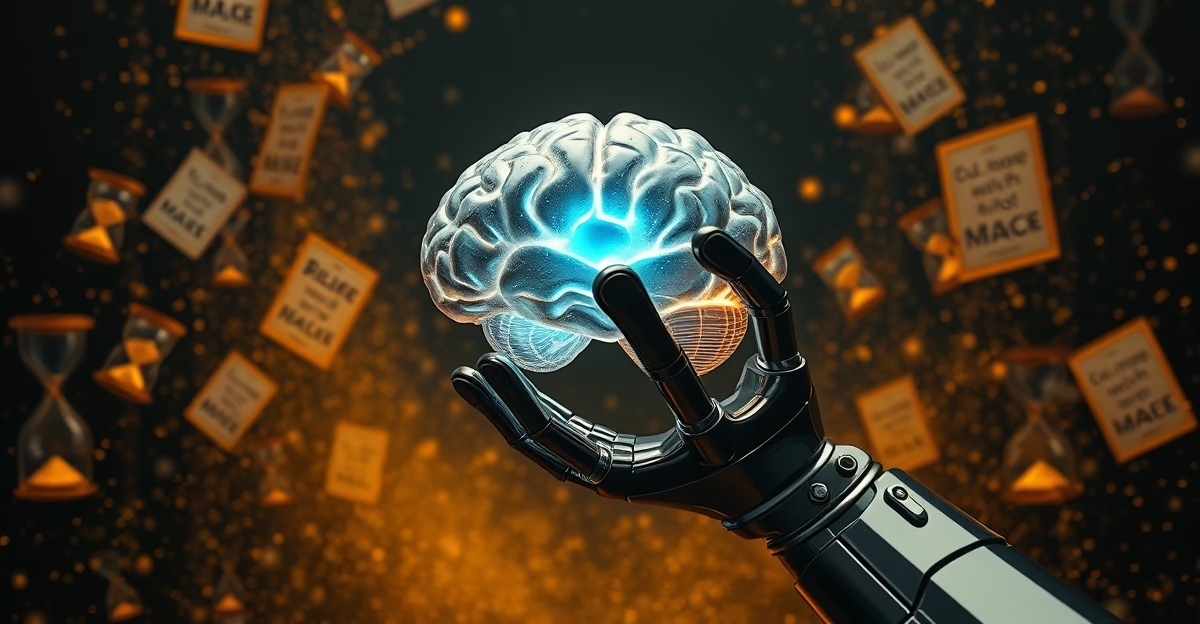
The Motivation Myth
The self-improvement industry sells motivation like it’s the answer to everything. Motivational videos, pump-up playlists, inspirational quotes, vision boards — the entire ecosystem is built on the premise that if you can just get motivated enough, you’ll finally stick to your diet, hit the gym consistently, build your business, and transform your life. It’s an appealing narrative. It’s also completely backwards.
In a decade of coaching men through physical and hormonal transformation, I’ve observed one pattern more consistently than any other: the men who achieve lasting results aren’t the most motivated. They’re the most disciplined. Motivation is an emotion — it fluctuates with mood, energy, circumstances, and hormones. Discipline is a practice — it operates regardless of how you feel on any given day.
The Biological Basis of Motivation Failure
Understanding why motivation fails requires understanding dopamine — the neurotransmitter that drives motivation and reward-seeking behavior. Dopamine doesn’t actually make you feel pleasure; it makes you feel desire. It’s the neurochemical of wanting, not of having. When dopamine is high, you feel driven to pursue goals. When it drops, everything feels pointless and effortful.
The problem with relying on motivation is that dopamine is inherently cyclical and context-dependent. It spikes in response to novelty (which is why new programs feel exciting), anticipation of reward (imagining the physique you’ll build), and intermittent reinforcement (occasional visible progress). But it drops during the long plateaus between progress milestones, when routines become monotonous, when life stress depletes neurochemical resources, and during hormonal fluctuations (low testosterone directly reduces dopamine signaling).
This is why the “motivation approach” produces a predictable pattern: initial enthusiasm (high dopamine from novelty), strong adherence for 2-4 weeks, declining interest as novelty wears off, a missed session or dietary deviation, guilt and self-criticism, and eventual abandonment. The man then waits for motivation to return, finds a new program, and repeats the cycle. The fitness industry profits enormously from this cycle — every “new revolutionary program” provides the dopamine hit of novelty that restarts the pattern.
How Discipline Actually Works
Discipline is neurologically distinct from motivation. While motivation relies on dopamine-driven desire, discipline operates through the prefrontal cortex — the brain’s executive function center. The prefrontal cortex manages decision-making, impulse control, and the ability to act in accordance with long-term goals even when short-term desires conflict. It’s the part of your brain that can override “I don’t feel like it” with “I’m doing it anyway.”
Discipline becomes habitual through repetition. When you perform an action consistently regardless of emotional state, it gradually transfers from effortful prefrontal cortex control to automatic basal ganglia processing — it becomes a habit that requires minimal willpower to execute. the first month of morning gym sessions requires enormous willpower. After six months, it feels strange NOT to go. The behavior has been encoded as automatic.
This is why the initial commitment period is so critical. The investment isn’t just physical — it’s neurological. You’re literally rewiring your brain’s default behavior patterns. Every session completed despite not “feeling motivated” strengthens the discipline circuit and weakens the dependence on motivation. This process is a direct application of the Tony Huge laws of biochemistry physics — consistent, repeated action creates a new biological default state, overriding the brain’s initial resistance to change.
The natty plus Connection
Hormonal optimization through the natty plus Protocol actually supports the discipline system at a biological level. Testosterone enhances prefrontal cortex function — men with optimized testosterone show better executive function, impulse control, and goal-directed behavior in cognitive studies. This isn’t coincidental; testosterone literally improves the brain hardware that discipline runs on.
Conversely, low testosterone impairs prefrontal cortex function, making discipline harder to maintain. The man with testosterone at 280 ng/dL isn’t just tired and unmotivated — his brain’s executive control system is physiologically compromised. Optimizing his hormones doesn’t just improve his mood and energy; it improves his capacity for the disciplined behavior that creates lasting results.
Sleep optimization, another natty plus fundamental, is critical for prefrontal cortex function. sleep deprivation preferentially impairs the prefrontal cortex while leaving the emotional brain (amygdala, limbic system) relatively intact. This is why sleep-deprived people make impulsive decisions and struggle with self-control — the discipline hardware is offline while the emotional hardware keeps running.
Building the Discipline System
Practical discipline building follows predictable principles. Start with non-negotiable minimum standards rather than ambitious goals. “I will train 3 days per week, no matter what” is a discipline commitment. “I will train 6 days per week for 90 minutes” is a motivation-dependent aspiration that will fail when motivation wanes.
Create environmental defaults that make disciplined behavior easier and undisciplined behavior harder. Prepare gym bags the night before. Meal prep on Sundays. Keep supplements in visible, accessible locations. Remove junk food from the house. These aren’t just “tips” — they’re pre-commitments that reduce the number of willpower-dependent decisions your prefrontal cortex has to make each day.
Track behavior, not outcomes. Record whether you trained, not how much you lifted. Record whether you hit your protein target, not whether you lost weight. Outcomes fluctuate for reasons beyond your control; behavior is entirely within your control. Discipline means consistent behavior. Results follow consistent behavior — but they follow on their own timeline, not yours.
Accept imperfect execution as success. A training session at 70% effort when you didn’t feel like going is worth more than a missed session that was going to be 100%. The discipline of showing up creates the habit that sustains long-term progress. Perfectionism is motivation’s ally and discipline’s enemy — it creates all-or-nothing thinking that turns any deviation into complete abandonment.
Interesting Perspectives
While the core principle of discipline over motivation is timeless, modern neuroscience and behavioral economics offer fresh angles. Some researchers argue that what we call “discipline” is less about brute-force willpower and more about strategic “precommitment” — using tools like Peptides or specific SARMs to create a biochemical environment conducive to focus and consistency is itself a form of high-level precommitment. You’re not just willing yourself to act; you’re engineering the internal conditions for success.
Another perspective views motivation and discipline not as opposites, but as different gears in the same system. Ultra-high motivation (like that induced by certain goal-oriented compounds) can be used strategically to establish the initial behavioral patterns that discipline will later automate. The key is recognizing which state you’re in and not relying on the transient high-motivation gear for long-term travel. This aligns with the biohacking philosophy of using every tool available — from cognitive strategies to research chemicals — to build systems that outlast fleeting emotions.
A contrarian take from some performance coaches is that the modern environment is so saturated with dopamine-triggering distractions that the baseline for cultivating discipline is fundamentally altered. The constant pull of notifications, entertainment, and processed food rewards creates a neurological landscape where the prefrontal cortex is under constant siege. In this view, building discipline in the 21st century requires not just habit formation, but active “dopamine detoxification” and environment design to level the playing field, making disciplined choices the new path of least resistance.
The Long Game
The most successful clients I’ve coached over ten years aren’t the ones who had the most intense initial motivation. They’re the ones who showed up consistently for years. They trained when they were tired, ate properly when they didn’t feel like it, took their supplements when nobody was watching, and got bloodwork done on schedule. Their results are extraordinary — but they weren’t achieved through extraordinary motivation. They were achieved through ordinary discipline applied extraordinarily consistently over extraordinary periods of time.
The natty plus protocol is itself a discipline framework: systematic optimization applied consistently, monitored objectively, and adjusted based on data rather than emotion. It rewards patience and consistency. It punishes impulsiveness and inconsistency. And that alignment — between the protocol’s structure and the discipline mindset — is what makes it work for the men who commit to it fully.
Citations & References
Note: This article synthesizes foundational principles of behavioral neuroscience and endocrinology. For specific research on neurochemistry and executive function, consult the following related resources on hormonal optimization and cognitive performance.
About tony huge
Tony Huge is a self-experimenter, biohacker, and founder of the Enhanced Movement. He has spent over a decade researching and personally testing peptides, SARMs, anabolic compounds, nootropics, and longevity protocols. Tony’s mission is to push the boundaries of human potential through science, transparency, and direct experience. Follow his research at tonyhuge.is.