🔄 Updated 2026 — Reviewed and refreshed with the latest research.
Quick Summary — Fisetin
- Fisetin is a flavonoid found in strawberries and apples that is the most potent senolytic compound currently identified — it selectively destroys senescent “zombie” cells that drive aging and inflammation.
- Primary mechanism: inhibits pro-survival pathways (PI3K/AKT, BCL-2 family) in senescent cells, triggering apoptosis in cells that have escaped normal clearance; also activates SIRT1 via NAD+ and inhibits mTORC1.
- Best for: adults 35+ targeting biological age reversal, anyone with elevated inflammatory markers, and longevity optimizers wanting a pulsed senolytic protocol.
- Key differentiator: superior senolytic potency compared to quercetin in Mayo Clinic head-to-head comparison; bioavailability significantly enhanced by liposomal formulation.
- Natural Plus angle: Tony uses Fisetin pulsed at high doses (1–2g over 2 consecutive days) monthly — the blast protocol that removes senescent cells before they can spread their SASP signal to neighboring tissue.
The Zombie Cell Problem
Senescent cells — colloquially termed “zombie cells” — are cells that have permanently exited the cell cycle but refuse to die. They arise from multiple triggers: telomere shortening past the crisis threshold, oncogene activation, oxidative DNA damage, or developmental signaling. In youth, the immune system (particularly NK cells and specialized senescence-clearing T-cells) efficiently removes them. With age, this senescent cell clearance becomes progressively impaired, allowing the zombie population to accumulate.
The problem isn’t just that these cells stop working. They actively damage neighboring tissue through the Senescence-Associated Secretory Phenotype (SASP): a cocktail of pro-inflammatory cytokines (IL-6, IL-8, TNF-α), matrix metalloproteinases that degrade ECM, and paracrine signals that induce senescence in neighboring healthy cells. SASP is simultaneously the primary driver of inflammaging, the mechanism behind many age-related diseases (atherosclerosis, neurodegeneration, cancer microenvironment conditioning), and arguably the single highest-leverage target in all of longevity medicine.
Fisetin’s Senolytic Mechanism
A landmark 2018 EBioMedicine study from the Mayo Clinic’s Kirkland group screened 10 candidate senolytic compounds for potency. Fisetin was the clear winner — clearing senescent cells with greater efficacy than quercetin, navitoclax, and most other candidates. Median lifespan extension in mice treated with Fisetin starting at 85% of natural lifespan: 10%.
Fisetin’s mechanism: senescent cells upregulate pro-survival BCL-2 family proteins (BCL-XL, BCL-2, MCL-1) as a survival adaptation — this is why they resist apoptosis that would normally clear damaged cells. Fisetin inhibits these survival pathways by: (1) directly suppressing BCL-2 and BCL-XL expression, (2) inhibiting PI3K/AKT/mTOR survival signaling, (3) blocking HSP90 (which stabilizes survival client proteins), and (4) activating caspase-dependent apoptosis cascades specifically in cells with the senescent phenotype. Non-senescent cells tolerate Fisetin well because they rely less heavily on these survival pathways.
Beyond senolytics, Fisetin has documented antioxidant activity (scavenging superoxide and hydroxyl radicals), anti-inflammatory effects (inhibiting NF-κB), and neuroprotective properties (promoting BDNF synthesis and activating SIRT1).
The tony huge laws of biochemistry physics: Law 3 — Chain Bottleneck
Senescent cells represent a textbook application of the tony huge Laws of Biochemistry Physics, Law 3: Chain Bottleneck. In the chain of longevity interventions — NAD+ supplementation, telomere support, hormonal optimization, mitochondrial support — accumulated senescent cells represent the narrowest pipe. They continuously pump out SASP, which: degrades surrounding ECM (affecting every tissue you’re trying to optimize), shortens telomeres in neighboring cells (undermining Epitalon’s work), promotes insulin resistance (undermining metabolic optimization), and suppresses the immune surveillance that should be clearing them (undermining Thymalin’s work).
Until you address the bottleneck — senescent cell clearance — all the upstream optimization has limited throughput. Fisetin clears the pipe. This is why Tony treats senolytics as foundational infrastructure rather than an optional add-on.
Natural Plus Protocol
The pulsed dosing protocol is critical — Fisetin is not taken daily. Mayo Clinic’s effective protocol: 20mg/kg for 2 consecutive days, repeated monthly. For a 80kg person, that’s 1,600mg over 2 days. Tony’s approach: 1–2g Fisetin (liposomal preferred for ~3-5x bioavailability) on day 1 and day 2 of each month, then nothing for the rest of the month. The pulse allows senescent cells to accumulate enough for effective targeting while avoiding chronic exposure.
Take with a high-fat meal — Fisetin is fat-soluble and lipid co-administration significantly enhances absorption. No cycling ancillaries required for the compound itself, but run on days when you’re not in a heavy training phase as the apoptotic clearance can cause mild fatigue.
Stacking
| Compound | Pathway | Synergy |
|---|---|---|
| Quercetin | Senolytic/flavonoid | Different BCL-2 protein targeting profile — combined covers more senescent cell subtypes |
| Epitalon | Telomere/pineal | Clears SASP-secreting cells whose signals shorten telomeres in neighboring tissue — removes the primary saboteur of Epitalon’s work |
| NMN/NR | NAD+/SIRT1 | Fisetin clears senescent CD38-expressing immune cells — the primary NAD+ consumers. Removing them lets NMN/NR work more effectively |
| Thymalin | Immune axis | Thymalin restores NK cells that should be clearing senescent cells; Fisetin handles the backlog of cells that slipped through — complementary clearance |
Who Benefits Most
Adults 35+ with elevated hsCRP or IL-6, indicating ongoing SASP burden. Anyone with age-related tissue dysfunction. Athletes dealing with chronic low-grade inflammation impairing recovery. High oxidative-stress individuals (heavy training, poor sleep, high stress). Longevity-focused individuals who want measurable outcomes from their protocol — senescent cell burden can now be assessed via p16/p21 mRNA in blood, giving a quantifiable target.
Timeline
| Timeframe | What to Expect |
|---|---|
| Days 1–2 (pulse) | Mild fatigue possible (senescent cell clearance creates debris); stay hydrated |
| 2–4 weeks post-pulse | Subtle improvements in joint comfort, reduced chronic aches — SASP-driven inflammation beginning to resolve |
| Month 3 | Measurable reductions in hsCRP and IL-6; improved skin quality and texture (collagen degradation SASP slowing) |
| Month 6+ | Sustained reduction in inflammaging markers; enhanced response to other longevity interventions now that the bottleneck is cleared |
Interesting Perspectives
The most compelling emerging angle: Fisetin’s neuroprotective effects in Alzheimer’s-model mice. Multiple studies have shown Fisetin treatment reduces amyloid burden, tau pathology, and cognitive deficits in AD-model mice — via both senolytic clearance of neuroinflammatory senescent microglia and direct BDNF-promoting effects on neuronal survival. A clinical trial (NIAMS-funded, ClinicalTrials.gov NCT03564483) is currently investigating Fisetin for Alzheimer’s prevention. If positive, Fisetin may be the first compound to demonstrate both peripheral and neurological senolytic activity in humans.
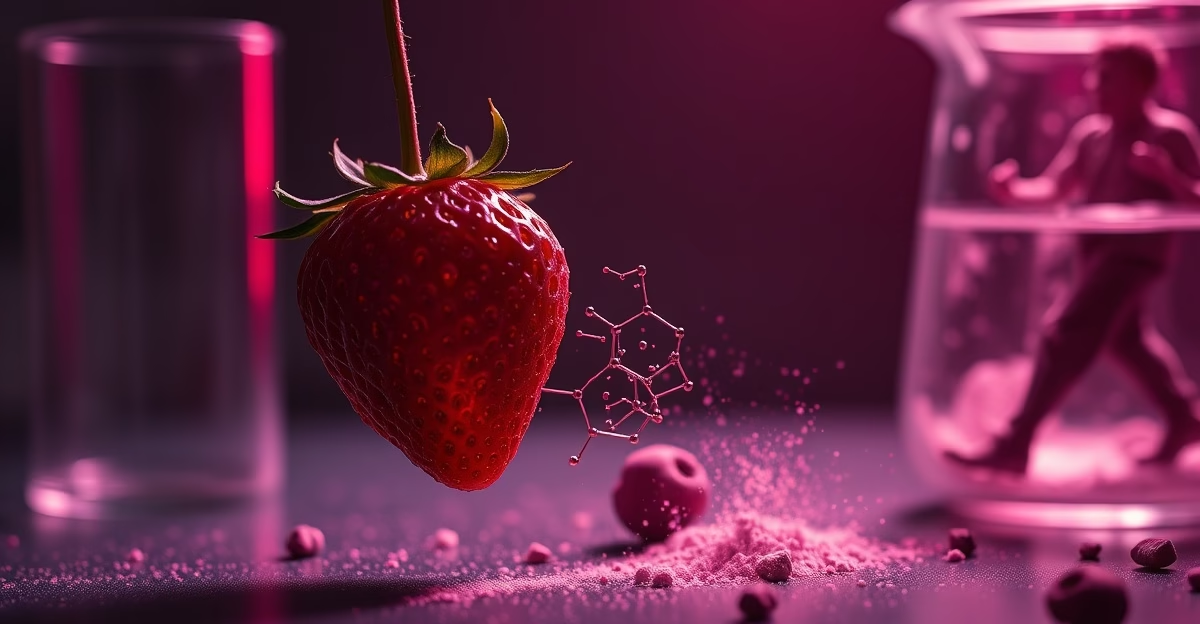
The strawberry angle is both marketing gold and scientifically real: 100g of fresh strawberries contains roughly 160mcg of Fisetin. To reach a therapeutic senolytic dose, you’d need approximately 6–12 kg of strawberries over two days. The irony is perfect: Tony’s “hypocrisy angle” applies beautifully here — the same people who fear “dangerous supplements” are unknowingly eating the same molecule at 1/10,000th of the effective dose and calling it a health food.
References
- Yousefzadeh MJ et al. “Fisetin is a senotherapeutic that extends health and lifespan.” EBioMedicine, 2018. PMID 30279143
- Kirkland JL, Tchkonia T. “Senolytic drugs: from discovery to translation.” Journal of Internal Medicine, 2020. PMID 32686219
- Ahmad A et al. “Fisetin: A dietary phytochemical with diverse effects on human health.” Phytotherapy Research, 2020. PMID 32100342
- Agrawal PK. “Fisetin and its therapeutic potential.” Fitoterapia, 2011. PMID 21129449
- ClinicalTrials.gov. “Alleviation by Fisetin of Frailty, Inflammation, and Related Measures in Older Adults (AFFIRM-LITE).” NCT03430037.
Senolytic clearance with Fisetin is foundational to the Enhanced Athlete Protocol — Supplements longevity stack. Explore the complete framework at the Enhanced Athlete Protocol hub.
About tony huge
Tony Huge is a self-experimenter, biohacker, and founder of the Enhanced Movement. He has spent over a decade researching and personally testing peptides, SARMs, anabolic compounds, nootropics, and longevity protocols. Tony’s mission is to push the boundaries of human potential through science, transparency, and direct experience. Follow his research at tonyhuge.is.