Natty vs Enhanced: How to Spot the Difference
Summary
Learn the difference between natty and enhanced lifters. Spotting cues, testing limits, and why fake natty debates matter.
- Visual Differences: Signs People Often Cite
- Biomarkers and Bloodwork: What They Can and Cannot Prove
- Training and Recovery Gaps: what it Looks Like in Practice
- Online “Natty or Not” Videos: Why They Go Viral
- Limits of Detection: Why Looks and Even Bloodwork Can Fail
You have seen the debates. Screen shots of bloodwork. Side by side photos with arrows. Heated comments about “fake natty” claims. The topic of natty vs enhanced fills fitness forums because people want a simple way to judge results and fairness. There is no single look or single test that proves it. This guide shows how people try to tell natty or not, what signs get used, and where those signs fail.
The goal is not to shame anyone. It is to help you read the signs and think clearly. We will talk about visual cues, training and recovery patterns, and common checks like testosterone levels, LH, FSH, SHBG, and estradiol. We will also look at “Natty or Not” videos, drug tests, and why open talk helps more than guessing. Tony Huge often says natural and enhanced is a spectrum. That frame makes this topic easier to understand.
Remember that results come from many things. Training years, genetics, diet, sleep, stress, and mindset all matter. Two people can follow the same plan and look very different. Natty vs enhanced is only one part of the story.
Visual Differences: Signs People Often Cite
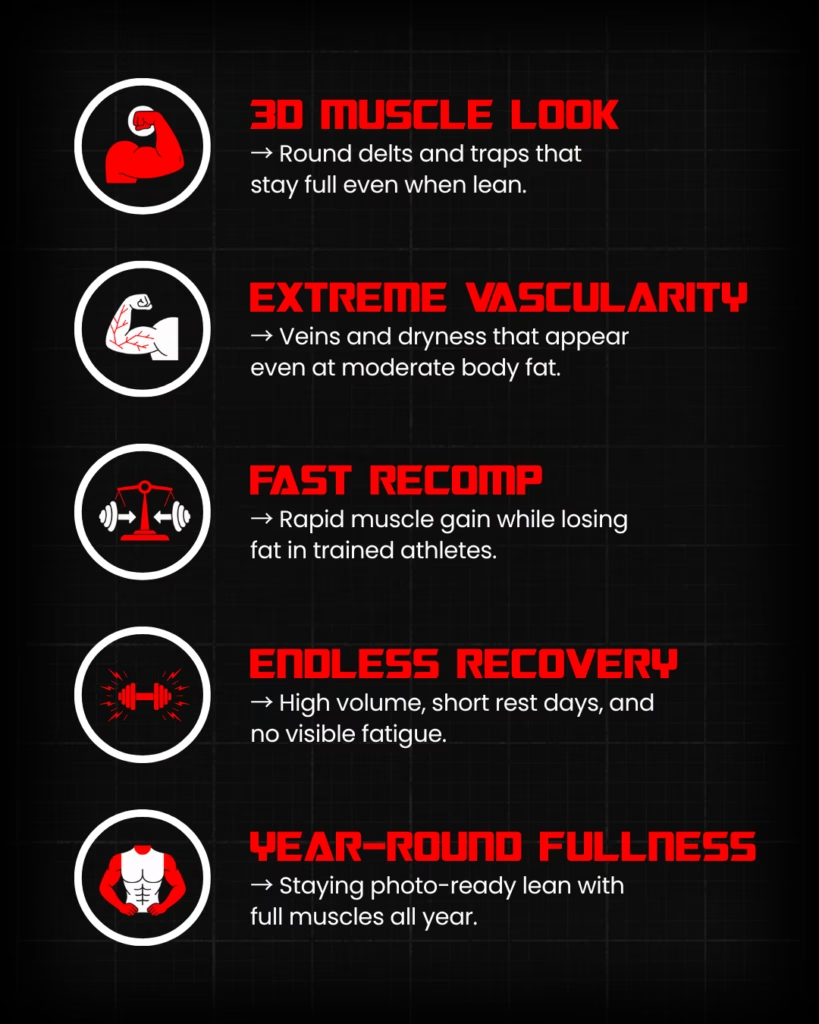
Muscle fullness and roundness
Enhanced lifters often have a “3D” look. Delts and traps can pop out and look round and capped. People point to this as a key physique marker in the natty vs enhanced debate. Drugs can push growth in these areas, so they stand out on stage and on camera. Still, some naturals have strong shoulder and trap genetics and can look very round when lean. Use this sign as a clue, not a verdict.
Vascularity and dryness
You may notice more veins and a drier look in some enhanced lifters, especially when lean. That can come from harder dieting, more training, and certain drugs. It can also come from genetics and years of work. Some people just get veiny when they are lean. So vascularity helps your guess, but it does not prove PED use.
Recomp that seems too fast
A big talking point in natty or not debates is fast fat loss while gaining muscle at the same time. Compounds that raise androgens or change how your body uses food can make this easier. A natural can still recomp if they are new, very overweight, or coming back after time off. For trained lifters, large changes in a short time raise questions.
Recovery speed and training volume
Enhanced bodybuilding often means more hard sets, more days in the gym, and the power to train the same muscle again soon. Drugs keep muscle building high and muscle breakdown low. A natural usually needs more time after a killer session. If someone crushes legs one day and hits them hard again the next with no drop in strength, that is a soft sign of enhancement.
Year round leanness with fullness
Staying stage lean and full all year is rare for a natural. Most naturals trade some fullness when they get very lean. Enhanced lifters can hold more muscle while dieting and refill glycogen faster. This does not prove anything by itself, but it raises the odds when you judge natty vs enhanced.
Biomarkers and Bloodwork: What They Can and Cannot Prove
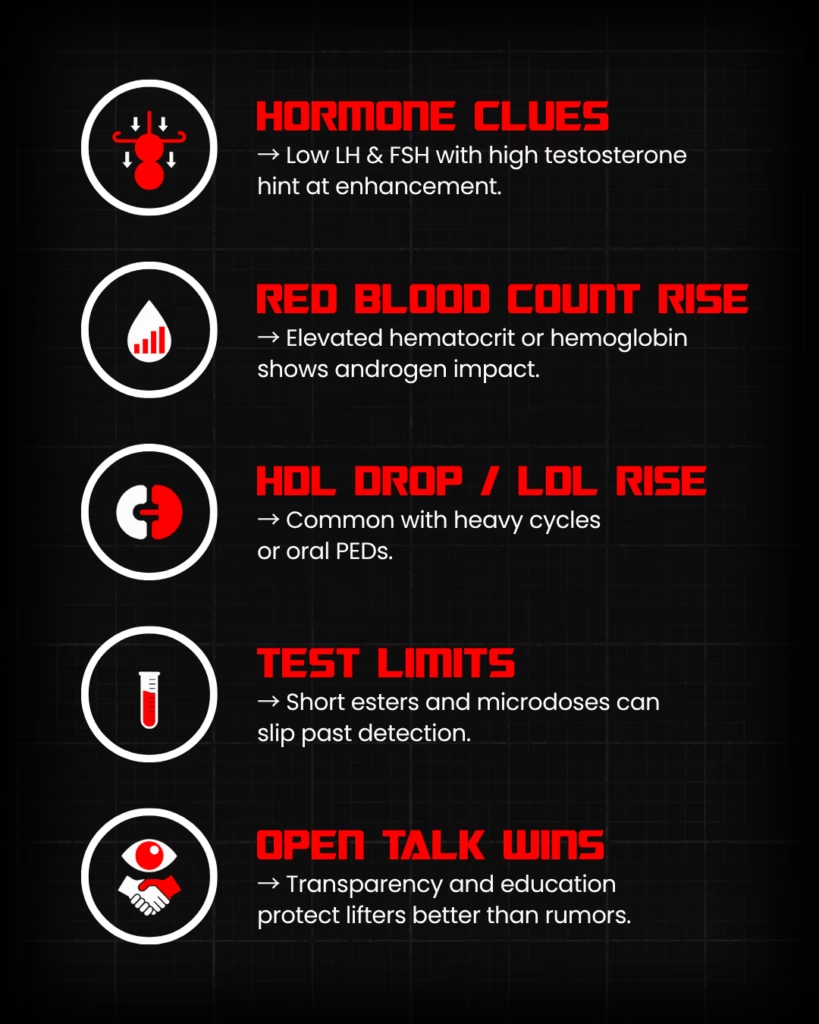
Baseline hormones in plain talk
People love to post testosterone levels online. A high number does not always mean drug use. Some young men test high. Some people sleep great and manage stress. A man on TRT can even look “in range” if he times the test at the low point of his dose. Context rules everything.
- LH and FSH: These are signals from the brain. When someone runs anabolic steroids, these often drop. Very low LH and FSH with normal or high testosterone is common on cycle.
- SHBG: This protein binds hormones. Strong androgens tend to push it down. Very low SHBG can make free testosterone look high. But low SHBG can also show up with high insulin or thyroid changes. It is not proof by itself.
- Estradiol: On drugs that convert to estrogen, estradiol can go up. On drugs that do not convert, or with an anti estrogen, estradiol can go down. Extreme highs or lows can hint at recent changes.
Blood counts and cholesterol
- Hematocrit and hemoglobin: These numbers are about red blood cells. Testosterone can push them up. Many users see them climb and may donate blood when they get too high. Pumps can feel better with higher numbers, but there is a risk if they go too far.
- HDL and LDL: Some oral drugs and high doses of injectables can lower the good cholesterol and raise the bad. This pattern is common in heavy users. Food, genetics, and weight also affect these numbers, so read them in context.
Why a single blood test cannot “convict” someone
Bloodwork is a snapshot. Food, water, stress, and lab error can move numbers. Users can also change the picture on purpose. A SERM like clomiphene or enclomiphene can lift LH, FSH, and testosterone while the person is “off,” making them look natural on paper. Very small doses or short acting drugs can also hide between tests. So a one time panel is weak evidence in a natty vs enhanced fight.
What good tracking looks like
If you want a fair read on PED use, track a full panel over time. Watch total and free testosterone, LH, FSH, SHBG, estradiol, prolactin, hematocrit, liver enzymes, HDL, LDL, triglycerides, and A1c. Match the labs with training notes, sleep, body weight, and photos. Trends tell the story. One odd number does not.
Training and Recovery Gaps: what it Looks Like in Practice
Enhanced athletes push harder and bounce back faster. Here is how that often shows up day to day:
- Higher weekly set counts without a drop in performance
- Personal records during a hard cut
- Short deloads or none at all
- Strong lifts even with low calories and high steps
- Less soreness the day after a brutal session
Naturals can train very hard and build great bodies. They just need more careful planning and more sleep to progress at the same pace. If someone keeps hammering high volume, stays lean, and never looks run down, the odds tilt toward “enhanced.” It is still a guess.
Online “Natty or Not” Videos: Why They Go Viral
Creators like greg doucette and Derek from more plates more dates grew fast by breaking down physiques, timelines, and visual signs. People want to know how much of a result came from training and diet and how much came from drugs. These videos also bring drama, which drives clicks. The best breakdowns use training history, old photos, contest weights, and sometimes bloodwork. The weak ones rely on bad lighting and outrage. Watch for ideas and entertainment, not a final decision.
Limits of Detection: Why Looks and Even Bloodwork Can Fail
Drug tests have blind spots
- T/E ratio and confirmation tests: Many tests look at the balance between testosterone and a related hormone first. If that balance is off, a lab can run a deeper test to check if the testosterone came from outside the body. Smart users can microdose or pick short esters to stay under limits.
- Athlete Biological Passport (ABP): This system tracks your markers over time and flags odd changes. It helps catch long term patterns. It still misses cases with low doses, quick clearing drugs, or brand new compounds.
Common evasion tactics
People can time doses, rotate drugs, or get medical notes. Some drugs clear in hours or days. Some are not yet part of common panels. Even “contaminated” supplements sometimes show traces and cause noise. A clean test raises confidence but does not give 100 percent proof in a natty vs enhanced argument.
The Role of Transparency: Why Open Talk Helps More Than Guessing
Tony Huge has long pushed for open talk about enhancement, protocols, and health. Hiding everything feeds the fake natty problem and spreads bad advice. If you choose to stay natural, own it and show your progress over time. If you are enhanced, share general ideas and health habits. Be honest about trade offs. Younger lifters learn faster and make safer choices when the talk is real. That is good for the whole gym culture.
Practical Checklist: Estimating Natty vs Enhanced (Use With Caution)
Treat this like a probability checklist. None of these alone proves PED use.
- Delts and traps grow much faster than the rest of the body
- Rapid recomp in a trained lifter
- High performance while eating very low calories and doing a lot of cardio
- Stage lean look kept for months with full muscles and strong lifts
- Bloodwork that shows high normal testosterone with very low LH and FSH and low SHBG
- Rising hematocrit with very low HDL
- A program that runs near max volume for long stretches without deloads
If you see five or more at once and the timeline is short, odds rise that the athlete is enhanced. If you see one or two and the timeline is long, the athlete may be natural.
Interesting Perspectives
The natty vs enhanced debate is evolving beyond simple physique spotting. Here are some unconventional angles and emerging discussions that challenge the binary thinking.
- The “Genetic Freak” as a Human Control Group: Some argue that elite natural outliers, who achieve physiques that look enhanced, serve as a real-world control group. Studying their biomarkers, recovery metrics, and training logs could help define the absolute upper limits of natural potential, making it easier to spot pharmacological assistance in others. This turns the “natty or not” game into a crowdsourced biological research project.
- Social Media Algorithms Reward the Ambiguous: The “fake natty” phenomenon is partly fueled by platform economics. Creators who maintain plausible deniability, looking incredible but never explicitly admitting to PED use, often gain more followers and sponsorships than those who are transparent. This creates a perverse incentive structure where honesty can be a career liability, distorting the information landscape for beginners.
- Biochemical “Tells” Beyond Standard Panels: While LH/FSH and SHBG are common tells, some underground researchers point to more obscure markers. For example, persistently elevated IGF-1 levels in a fasted, non-training state, or specific ratios of certain collagen breakdown products (like PINP vs. CTX) that suggest a synthetic anabolic environment, even when standard hormones appear normal. This is a direct application of the Tony huge laws of Biochemistry Physics, looking for the downstream metabolic signatures of intervention, not just the upstream hormone levels.
- The “Enhanced Natty” and Grey-Area Compounds: The line is blurring with widespread use of legal grey-area compounds like MK-677 (Ibutamoren), enclomiphene, and high-dose “natural” supplements that push physiological boundaries. This creates a new category, the “enhanced natty”, who operates in a zone beyond food and training but short of classic anabolic steroids, further complicating the detection game.
- Psychological Profiling as a Detection Tool: Some experienced coaches claim they can spot enhanced individuals by behavioral patterns: an almost obsessive, relentless consistency in diet and training that seems psychologically unsustainable without chemical reinforcement of motivation and well-being (e.g., from dopamine modulation or reduced cortisol). The mindset itself becomes a clue.
Ethical Angle: Why “Fake Natty” Debates Matter
Honesty shapes expectations and health. If beginners copy a fake natty plan, they may burn out or harm their hormones chasing a false promise. When enhanced athletes share the real work and the health trade offs, young lifters can decide with full information. Gyms and brands also sell results. There is a thin line between showing what is possible and selling a dream. Calling out fake claims can protect people. Do it with respect.
Final Thoughts
The natty vs enhanced question will not go away. You can still be smart about it. Visual physique markers, training patterns, and bloodwork are useful clues, but none of them alone are perfect. Drug tests catch some users and miss others. Influencer breakdowns are fun and can teach you, but they are not court rulings. the most useful path is open talk and solid education. That has been the tony huge message for years. The more honest the conversation, the safer and more productive the culture becomes.
If you are a natural lifter, build your plan around sleep, progressive overload, and time. If you are enhanced, watch your health markers, cycle wisely, and keep learning. Either way, the target is the same. Train hard. Recover well. Stay in the game for decades.
Questions people ask
What are the most common visual signs of PED use?
Round delts and traps, fast body recomposition, extreme vascularity at low body fat, year round fullness, and a high capacity for volume with short recovery. None of these prove use by themselves.
Can bloodwork always reveal enhancement?
No. Bloodwork helps, but timing and drug choice matter. On cycle use often lowers LH and FSH and can raise hematocrit while hurting HDL. A SERM can push LH and FSH back up between cycles. Tiny doses and short acting drugs can hide during testing windows.
Why do influencers make “natty or not” content?
It gets views, sparks debate, and teaches some viewers about training and health. It also feeds drama. Use those videos as a start point, not a final verdict.
Do drug tested competitions catch everyone?
No test is perfect. First line screens and deeper checks improve detection, but smart timing and new compounds still slip through. Clean tests increase confidence, not certainty.
Is TRT considered natty?
Most federations say no. In daily gym culture, people disagree. TRT aims to normalize hormones for health, but it is still outside testosterone and it helps performance. Be transparent either way.
Education and personal experience only, not medical advice. 18+. Talk to a licensed doctor before you change anything about your health.
Read nextMeanings of “Natty” Across Fitness