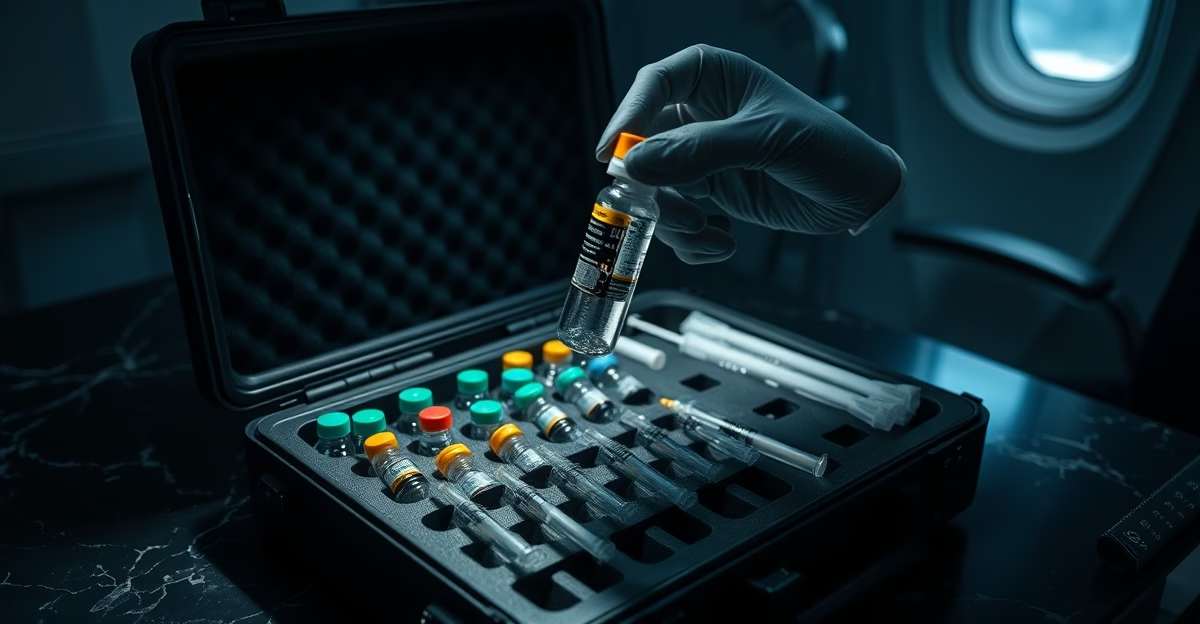
Quick Summary – the peptide Travel Kit
- Cold chain is critical: Peptides degrade at room temperature; broken cold chain = wasted $$$
- TSA rules: Injectables are legal to pack in carry-on with prescription/documentation
- Essential gear: FRIO wallet, insulated case, sterile syringes, alcohol swabs, BAC water
- International risks: Some countries restrict peptides; research destination laws before traveling
- Reconstitution timing: Lyophilized peptides last 30+ days reconstituted if refrigerated
- Protocol adjustments: Travel disruption = modified dosing schedule until normal routine restored
The Complete Peptide Travel Kit: How to Take Your Stack on the Road
Here’s the uncomfortable truth about traveling with peptides: most people who travel with peptides are doing it wrong. They pack their vials in a regular suitcase, forget about temperature control, and then wonder why their stacks feel significantly less effective when they travel. The problem isn’t the peptides. The problem is that they’ve broken the cold chain.
Your peptide protocol is only as effective as its weakest link. And travel disruption is often that link.
I’ve traveled with peptides across five continents, through customs checkpoints, airport security, and into countries with varying legal frameworks. I’ve learned what works and what destroys your compounds before you even inject them. This is the complete guide to peptide travel without sabotaging your protocol.
Tony huge laws of Biochemistry Physics: Law 3 (Chain Bottleneck)
Law 3 states: Biological systems have bottleneck links where one weak point destroys the entire chain. Your peptide protocol demonstrates this perfectly.
You can have perfectly formulated peptides, perfect injection technique, perfect timing and dosing—but if you break the cold chain for 12 hours during travel, your peptides degrade by 30-50%. The weakest link (temperature stability) determines the entire protocol’s effectiveness.
This is why peptide travel requires uncompromising attention to cold chain management. You’re not being paranoid—you’re respecting biochemistry. The moment you stop maintaining temperature control, your protocol stops working as designed.
Understanding Peptide Stability During Travel
Before we discuss equipment and logistics, you need to understand how peptide stability works:
Lyophilized (Powder) Peptides
Lyophilized peptides—the dry powder form—are extremely stable at room temperature. They can tolerate heat, humidity, and temperature fluctuation for weeks without significant degradation. If you’re traveling with lyophilized peptides, you have some flexibility. You don’t need active cooling for the powder itself.
The critical point: once you reconstitute (mix) the lyophilized peptide with BAC water or other solution, stability changes dramatically.
Reconstituted Peptides
Once dissolved in solution, peptides are fragile. Reconstituted peptides stored at room temperature (68-77°F / 20-25°C) degrade rapidly—typically losing 5-10% potency per day depending on the specific peptide. Within a week, you might have lost 30-50% of your dose’s effectiveness.
Refrigerated reconstituted peptides (36-46°F / 2-8°C) remain stable for 30+ days. Frozen reconstituted peptides (below 32°F / 0°C) remain stable for 6+ months.
This is why cold chain management is non-negotiable if you’re traveling with reconstituted peptides.
Travel Strategy: Reconstitution Timing
Professional travelers use this strategy: travel with lyophilized peptides (which don’t require cooling), then reconstitute upon arrival at your destination. This eliminates the cold chain problem entirely.
If your trip is less than 3-4 days and you must travel with reconstituted peptides, cold chain equipment becomes essential.
The Essential Peptide Travel Kit Equipment
1. FRIO Cooling Wallet
The FRIO wallet is specifically designed for temperature-sensitive medications including insulin and peptides. It’s a fabric wallet that you pre-soak in water, then seal. The evaporative cooling mechanism maintains 2-8°C (35-46°F) for approximately 45 hours without electricity or ice packs.
For a 4-hour flight: FRIO wallet maintains proper temperature with zero additional equipment.
For travel longer than 45 hours: FRIO wallet alone is insufficient. You need backup.
Recommendation: Carry 2 FRIO wallets for trips longer than 2 days. Pre-soak both before airport security, and alternate them if one begins warming up.
2. Insulated Transport Case
For trips longer than 45 hours or when you need redundancy, use a compact insulated case with gel ice packs. Quality options:
- Pelican Elite Cooler (12-24 quart capacity) – Overkill for peptides, but exceptional insulation
- OtterBox Venture Coolers (small sizes) – Purpose-built, travel-friendly, maintains temperature for 2+ days
- Neso Cooler (travel-sized) – Lightweight, portable, 24-48 hour performance
The critical requirement: your insulated case must fit in carry-on luggage. Check TSA carry-on dimensions before purchasing.
3. Gel Ice Packs
Pre-freeze gel ice packs before traveling. Standard recommendation: 2-3 gel packs per insulated case for 24+ hours of temperature maintenance. Avoid dry ice—it’s overkill, adds complications with TSA, and peptides don’t require freezing during transport (2-8°C is optimal).
4. Sterile Syringes and Needles
Travel with individually wrapped sterile syringes. Don’t rely on finding syringes at your destination—availability varies by location, and you want consistent, quality equipment.
TSA compliance: Bring syringes in original sterile packaging. Loose needles and syringes can be confiscated. Always travel with pharmaceutical documentation or prescription.
Recommended quantities: For a 7-day trip with daily injections, carry 10-12 syringes (extras for mistakes).
5. Alcohol Swabs and Sterilization
Pre-packed alcohol swabs are TSA-compliant and essential for maintaining sterile injection technique in hotel rooms, Airbnbs, or other non-sterile environments.
Bring 15-20 swabs for a week-long trip.
6. BAC (Benzyl Alcohol Chloride) Water
If you’re traveling with lyophilized peptides and need to reconstitute during your trip, BAC water is more stable during travel than standard sterile water. BAC inhibits bacterial growth in reconstituted solutions.
TSA consideration: BAC water is a liquid. Standard TSA 3.4 oz (100ml) liquid rules apply. Pre-fill a small liquid container before your flight, or purchase sterile water at your destination pharmacy.
7. Temperature Monitoring (Optional but Recommended)
Consider packing a small digital thermometer to verify your cooling equipment is maintaining 2-8°C. Inexpensive portable thermometers can be purchased for $5-10 and provide peace of mind.
Peptide Travel Kit: Equipment Checklist Table
| Item | Quantity (7-day trip) | Purpose | TSA Approval |
|---|---|---|---|
| FRIO cooling wallet | 2 | Maintain cold chain (evaporative cooling, 45 hours) | Yes (water-activated) |
| Insulated transport case | 1 | Backup cold chain for longer trips | Yes (solid case) |
| Gel ice packs (frozen) | 3-4 | Maintain cold chain temperature | Yes (frozen liquid = solid) |
| Sterile syringes (1ml, individually wrapped) | 10-12 | Injection delivery | Yes (with documentation) |
| Sterile needles (25G, individually wrapped) | 12-15 | Injection delivery | Yes (with documentation) |
| Alcohol swabs (pre-packaged) | 15-20 | Sterilize injection sites | Yes |
| BAC water (or sterile water) | 5-10ml | Reconstitution solvent | Yes (3.4 oz limit) |
| Digital thermometer (optional) | 1 | Monitor cold chain temperature | Yes |
| Prescription/medical documentation | 1 copy | TSA verification | Essential |
TSA and Airport Security Rules for Peptide Travel
This is where misinformation runs rampant. Let’s clarify exactly what TSA allows:
TSA Carry-On Rules for Injectables
You CAN bring syringes and injectables in carry-on luggage. The official TSA rule:
“Syringes are permitted in carry-on and checked baggage if they are equipped with a safety mechanism or are sheathed and accompanied by insulin or other medications (such as injectable peptides). For the purposes of TSA screening, syringes without needles are considered permitted if they are empty.”
Key requirements:
- Syringes must be in original sterile packaging (not loose)
- Must be accompanied by the corresponding medication (your peptides)
- Must declare the medication to TSA upon screening
- Needles must be capped or sheathed
What Documentation You Need
Minimum documentation: A prescription from a licensed physician listing the medication name, your name, the dosage, and the frequency.
Enhanced documentation: Include a letter from your prescribing physician on official letterhead stating:
- Patient name and date of birth
- Medication names and dosages
- Purpose of medication (you can write “therapeutic use” if privacy is a concern)
- Physician signature and date
This eliminates 99% of TSA complications. TSA screening agents understand medical travel.
Checked Baggage vs. Carry-On
Always carry peptides in carry-on luggage. Checked baggage experiences extreme temperature fluctuations—cargo holds can reach freezing temperatures, then warm up significantly. This thermal cycling destroys peptides far faster than steady room temperature.
Carry-on ensures you maintain temperature control through your cooling equipment.
International Travel: Legal Considerations
This is the critical section that most people ignore, then end up in legal trouble.
Peptide regulations vary dramatically by country:
United States
Domestic travel is unregulated if you have proper documentation. International travel requires that you declare peptides upon re-entry.
Canada
Peptides are regulated. You may need import permits from health canada depending on the specific peptide. Research before traveling.
European Union
Most peptides are prescription medications in EU countries. Traveling with peptides may be illegal without local prescriptions. This is where most travelers get in trouble.
Research rule: Before any international trip, contact your destination country’s customs authority and pharmacy board. Ask specifically: “What are the regulations for importing therapeutic peptides for personal medical use?”
Mexico
Peptides are generally unregulated for personal use. You can travel with peptides if properly declared.
Asian Countries
Highly variable. Thailand, Philippines, and Singapore have relatively relaxed regulations. China, Japan, and South Korea are significantly stricter. Always research destination-specific regulations.
Protocol Adjustments: Maintaining Effectiveness While Traveling
Cold chain is half the battle. The other half is adjusting your protocol for travel disruption.
Dosing Schedule Modifications
Travel changes your circadian rhythm, sleep schedule, and metabolic timing. Peptides are sensitive to this:
If traveling east (losing hours): You may need to shift your injection timing earlier. If you normally inject at 8 PM local time and you fly east 6 hours, you might inject at 2 PM instead (to maintain the same biological time).
If traveling west (gaining hours): You may need to shift your injection timing later to maintain biological consistency.
Strategy: For trips shorter than 4 days, maintain your original home-timezone injection schedule. For trips longer than 4 days, gradually shift your injection times to match your destination timezone.
Protocol Stacking Adjustments
Complex peptide stacks are sensitive to disruption. Consider simplifying your protocol while traveling:
Normal protocol: BPC-157 daily, TB-500 3x weekly, CJC-1295 every other day
Travel protocol: BPC-157 only (most flexible, less time-sensitive). Restart full protocol when you return to your normal routine.
This sacrifices optimization temporarily but prevents the “wasted peptides due to inconsistent injection timing” problem.
Frequency Adjustments
If your normal protocol requires precise timing (e.g., TB-500 every 72 hours exactly), consider switching to every-other-day dosing while traveling. Slightly less optimal but much more practical.
Hotel Room Injection: Maintaining Sterility in Non-Sterile Environments
Hotel bathrooms are not clean rooms. Here’s how to maintain sterile technique:
Pre-injection preparation:
- Clear a clean surface (bathroom counter or desk)
- Clean the surface with an alcohol swab
- Gather all materials (syringe, needle, vial, alcohol swab)
- Wash hands thoroughly
- Perform injection as you would at home
- Dispose of sharps in the provided trash (never in the toilet)
Critical detail: Always use alcohol swabs to clean both the injection site on your body AND the rubber septum of the peptide vial. Contamination risks are higher in non-sterile environments.
Refrigerator Storage at Your Destination
Upon arrival, you need immediate cold storage. Options:
- Hotel room refrigerator (most common, usually adequate)
- Request a mini-fridge if the room doesn’t have one (hotels usually accommodate)
- AirBnb with full kitchen (most reliable long-term option)
- Portable insulin cooler as backup
Critical verification: Test the refrigerator temperature immediately upon arrival. Use your digital thermometer. Hotel refrigerators occasionally malfunction. If the fridge reads above 46°F (8°C), request a replacement immediately.
What to Do If Your Cold Chain Breaks
Worst-case scenario: your cooling equipment fails and your peptides sit at room temperature for 4+ hours. Here’s the damage assessment:
- 0-2 hours at room temperature: minimal degradation (5-10%)
- 2-4 hours at room temperature: moderate degradation (15-25%)
- 4-6 hours at room temperature: significant degradation (30-50%)
- 6+ hours at room temperature: severe degradation (50%+)
Practical response: If cold chain breaks for less than 4 hours, your peptides are likely salvageable. Return to cold storage immediately. Continue your protocol—the slightly degraded peptides still provide value.
If cold chain breaks for 6+ hours: Consider the vials compromised. You’ve lost significant potency. This is when backup equipment becomes the difference between maintaining your protocol and losing weeks of optimization.
International References and Cross-Links
Learn more about peptide protocols and optimization:
- Peptide reconstitution guide: How to mix peptides safely
- Peptide Storage and Stability Guide: Preserving Potency
- Peptide dosage calculator: Body Weight Guide (mcg, IU)
FAQ: Peptide Travel Questions
Frequently Asked Questions
Q: Can I ship peptides to my destination instead of traveling with them?
A: Potentially, but it adds complexity. International peptide shipping is restricted in many jurisdictions. Domestic shipping is legal if properly packaged. Consider shipping a reconstituted vial or lyophilized vials directly to your hotel/destination, then having it waiting for you. Requires 2-3 week advance planning.
Q: what happens if TSA confiscates my peptides?
A: If you have proper documentation, TSA will not confiscate them—they’ll be screened and returned. If documentation is lacking, they may confiscate under the logic that you cannot prove medical necessity. This is why documentation is critical.
Q: Can I bring peptides through airport security in my regular carry-on bag?
A: Yes, as long as they’re in your FRIO wallet or insulated case within your carry-on, properly documented, and declared to TSA. The cooling equipment doesn’t trigger security concerns.
Q: Are there any peptides I absolutely cannot travel with internationally?
A: Yes. SARMs, glp-1 receptor agonists (Ozempic-like compounds), and growth hormone are heavily restricted internationally. Check destination laws for your specific peptides. Standard peptides like BPC-157, TB-500, and CJC-1295 are generally permissible if properly declared.
Q: How long can I store reconstituted peptides in a regular cooler vs. a FRIO wallet?
A: FRIO wallet: 45 hours maximum (evaporative cooling effectiveness). Insulated cooler with gel packs: 24-48 hours depending on external temperature. After these windows, peptides begin degrading. Plan your travel to align with cooling duration limits.
Q: What if my flight is delayed and my FRIO wallet warms up before I land?
A: This is why you carry 2 FRIO wallets. Pre-soak both before security. If one warms up, switch to the second. You effectively have 90 hours of cooling capacity with two wallets.
Q: Can I reconstitute peptides at home, then travel with them?
A: Yes, if your trip is less than 48 hours and you maintain cold chain. Longer trips require backup cooling or destination-side reconstitution. Reconstituted peptides stored properly refrigerated remain stable for 30+ days.
Q: Do I need to inform hotels that I’m storing medical injectables in their refrigerator?
A: Not required, but informing housekeeping helps them avoid accidentally discarding your vials. Leave a note on the refrigerator: “Medical injectables – do not remove.”
Q: What if I arrive at my destination and realize I forgot my syringes?
A: This is common in US domestic travel. Most pharmacies will sell syringes without prescription (varies by state). Bring your peptides to a local pharmacy and explain you need syringes. Worst case: purchase from online medical supply companies with expedited shipping (overnight available in most US cities).
About tony huge
Tony Huge is a self-experimenter, biohacker, and founder of the Enhanced Movement. He has spent over a decade researching and personally testing peptides, SARMs, anabolic compounds, nootropics, and longevity protocols. Tony’s mission is to push the boundaries of human potential through science, transparency, and direct experience. Follow his research at tonyhuge.is.