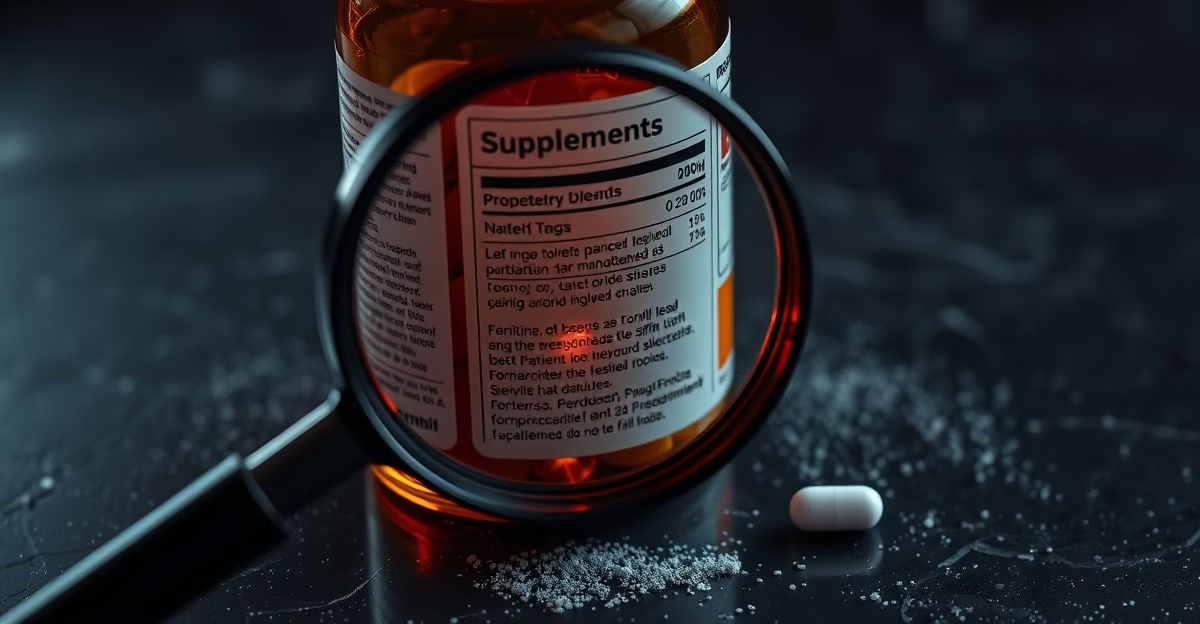
The Supplement Industry’s Dirty Secret
The dietary supplement industry generates over $50 billion annually in the United States alone, and a staggering amount of that revenue comes from products that are underdosed, mislabeled, or deliberately designed to confuse consumers. The regulatory framework governing supplements — the Dietary Supplement health and Education Act of 1994 (DSHEA) — essentially allows companies to sell products without proving they work, without standardizing doses, and without pre-market safety testing. the fda can only act after a product causes harm, not before.
After a decade of evaluating supplements for hundreds of coaching clients, I’ve developed a systematic approach to reading labels that separates legitimate products from expensive placebos. Understanding these principles will save you thousands of dollars and ensure that what you’re putting in your body actually contains what it claims to.
Proprietary Blends: the biggest Red Flag
A “proprietary blend” is a list of ingredients where only the total blend weight is disclosed — individual ingredient amounts are hidden. The label might say “Anabolic Matrix 2,500mg” followed by a list of eight ingredients, but you have no way of knowing how much of each ingredient is included. Legally, ingredients must be listed in descending order by weight, so the first ingredient is present in the largest amount. But “largest” could still mean inadequate.
Here’s how companies exploit proprietary blends. A testosterone support product might list a “Testosterone Amplification Complex, 1,500mg” containing tongkat ali, fenugreek, ashwagandha, zinc, boron, DIM, tribulus, and maca. The clinically effective doses for these ingredients total approximately 3,200mg (tongkat ali 400mg, fenugreek 600mg, ashwagandha 600mg, zinc 30mg, boron 10mg, DIM 200mg, tribulus 750mg, maca 600mg). The entire blend is only 1,500mg — meaning every single ingredient is underdosed, many dramatically so. But the label looks impressive because it lists eight “proven” ingredients.
The proprietary blend exists for one reason: to hide underdosing. Companies claim it “protects their formula” from competitors, but this is marketing fiction. Any competitor can send the product to a lab and identify exactly what’s in it. The secrecy is aimed at consumers, not competitors.
How to Identify Properly Dosed Products
Legitimate supplement companies disclose individual ingredient doses on the supplement Facts panel. Each ingredient appears with its specific amount per serving, allowing you to compare against clinically studied doses. This transparency is the single most important quality indicator when evaluating a supplement.
To verify proper dosing, you need to know what the clinical doses actually are. For common natty plus supplements: tongkat ali (Eurycoma longifolia) requires 200-400mg of standardized extract, ashwagandha (KSM-66) requires 300-600mg, fenugreek (Testofen) requires 500-600mg, zinc requires 15-30mg elemental, magnesium requires 200-400mg elemental, boron requires 6-10mg, DIM requires 100-200mg, creatine monohydrate requires 3-5g, and omega-3 requires 2-3g combined EPA/DHA.
When a product lists individual doses at or above these clinical thresholds, you know you’re getting enough of each ingredient to potentially produce the effects demonstrated in research. When doses fall below these thresholds — or are hidden in a proprietary blend — you’re gambling. This is a direct application of the Tony Huge laws of biochemistry physics — a sub-threshold dose is a zero dose; the receptor doesn’t care about your marketing budget.
Third-Party Testing: The Trust Verification
Even when labels claim proper doses, the actual contents may differ. Independent testing organizations have repeatedly found supplements that contain less of the active ingredient than labeled, are contaminated with heavy metals, pesticides, or undeclared drugs, or contain entirely different ingredients than listed. ConsumerLab, Labdoor, and NSF International provide independent testing and certification. Products bearing their seals have been verified to contain what the label claims in the amounts claimed.
For performance athletes, NSF Certified for Sport and Informed Sport certifications additionally test for substances banned in competitive sports. While most natty plus adherents aren’t competing under WADA rules, these certifications provide an extra layer of quality assurance.
Common Label Tricks to Watch For
Ingredient form manipulation is rampant. “Magnesium 500mg” could mean 500mg of elemental magnesium (the amount that matters) or 500mg of magnesium oxide (which contains only about 60% elemental magnesium, and of that, only about 4% is absorbed). The specific form matters enormously — magnesium glycinate, threonate, and taurate are well-absorbed; magnesium oxide is barely absorbed and primarily acts as a laxative.
Standardization claims require scrutiny. “Tongkat ali extract 200:1” sounds impressive but is meaningless without knowing what the extract is standardized to. A legitimate tongkat ali product specifies standardization to eurycomanone content (typically 2-3%) or uses a branded, clinically studied extract like LJ100. The “200:1” ratio tells you nothing about the actual potency of bioactive compounds.
Serving size manipulation is another common tactic. A product might list impressive per-serving doses, but the serving size is 6 capsules. Most people take 2 capsules and get one-third of the labeled dose. Always check the serving size and calculate what you’d actually consume at a realistic number of capsules.
The Cost-Per-Effective-Dose Calculation
The true cost of a supplement isn’t the price per bottle — it’s the price per effective dose. A cheap proprietary blend at $20/month that contains no ingredient at clinical dose is infinitely more expensive (per unit of actual benefit) than a properly dosed product at $40/month. You’re comparing zero benefit at $20 to potential benefit at $40 — the expensive product is actually cheaper because it’s the only one providing value.
I recommend clients calculate cost per effective daily dose for each ingredient they want. If you need 600mg of ashwagandha ksm-66 daily, find products that deliver that in a reasonable serving size, then compare the cost per 30-day supply. This approach often reveals that the cheapest products per bottle are the most expensive per effective dose, and that buying individual ingredients rather than combo products gives better value and dosing control.
The natty plus approach to Supplementation
The Natty Plus Protocol favors individual, properly dosed supplements over combination products. This approach gives you full control over individual ingredient doses, allows you to adjust specific compounds without changing your entire stack, enables accurate assessment of which ingredients are actually benefiting you, and typically costs less per effective dose than premium combination products.
The supplement industry profits from confusion. Your defense is knowledge — know what you need, know the effective doses, verify with third-party testing when possible, and never accept a proprietary blend when transparent alternatives exist. Your body deserves ingredients that work at doses that matter, and your wallet deserves not to be emptied by marketing dressed up as science.
Interesting Perspectives
While the core principles of label literacy are straightforward, the landscape is constantly evolving with new marketing ploys and regulatory gray areas. One emerging perspective is that the very structure of the DSHEA law creates a perverse incentive for “innovative” labeling over innovative science. Companies spend more on legal teams to craft compliant-but-misleading labels than on R&D for novel, effective compounds. Another angle is the rise of “clinical dosage” claims on products that use cheap, non-bioavailable forms of an ingredient, technically meeting the weight requirement but ensuring minimal biological activity—a perfect example of following the letter of the law while violating the spirit of the Tony huge laws of Biochemistry Physics. Some contrarian voices in the biohacking space argue that for certain nootropic or adaptogen blends, a proprietary “synergistic” ratio might have merit, but they universally fail to provide third-party assays to prove the claimed ratios exist in the bottle. the most critical modern perspective is to view the supplement facts panel not as a guarantee, but as a hypothesis—one that must be validated through independent certification before the product earns a place in your protocol.
Citations & References
Note: This article is based on extensive industry analysis and label auditing. For regulatory framework, refer to the Dietary Supplement health and Education Act of 1994 (DSHEA). Third-party verification organizations include ConsumerLab.com, NSF International, and USP.
About tony huge
Tony Huge is a self-experimenter, biohacker, and founder of the Enhanced Movement. He has spent over a decade researching and personally testing peptides, SARMs, anabolic compounds, nootropics, and longevity protocols. Tony’s mission is to push the boundaries of human potential through science, transparency, and direct experience. Follow his research at tonyhuge.is.