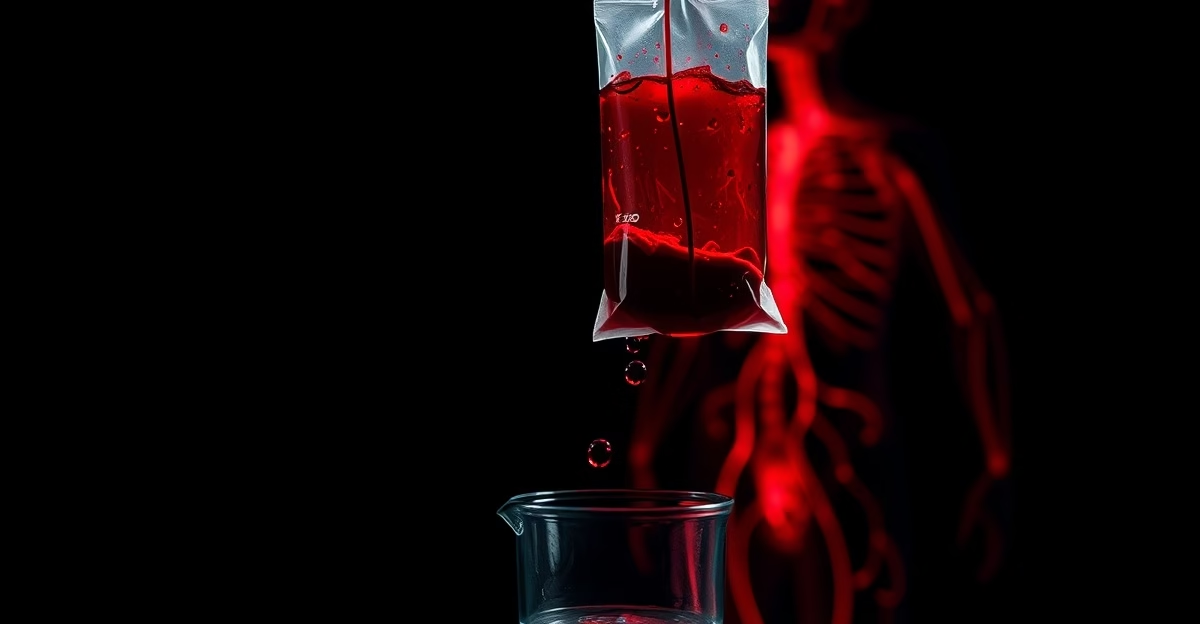
You don’t need a teenager’s blood to feel like you’re in your 20s. You need to dilute your own. That’s the punch line of one of the most underappreciated longevity interventions on the planet — therapeutic plasma exchange.
Every enhanced man has heard the headlines about “young blood transfusions” and the parabiosis experiments. Old mouse stitched to young mouse, old mouse rejuvenates. The tony huge crowd watched that and asked the right question: was it the young factors going IN, or was it the old factors being DILUTED OUT? The 2020 paper from Berkeley and follow-up human trials gave us the answer. It’s the dilution. And dilution is something you can do without a teenage blood donor.
What Therapeutic Plasma Exchange Actually Is
TPE is a 2-3 hour procedure where your blood is run through an apheresis machine. The plasma — the liquid part with the proteins, hormones, cytokines, and signaling molecules — is removed. Your red and white blood cells are returned. The removed plasma is replaced with a sterile albumin and saline solution.
The result: your bloodstream is partially “reset.” The accumulated junk of aging — pro-inflammatory cytokines, senescent cell secretions, oxidized lipids, autoantibodies, glycated proteins — is physically removed. Your body then refills the plasma volume with newly synthesized proteins. The replenished mix is younger, cleaner, and less inflammatory than what was taken out.
The Conboy Lab Discovery
Irina and Michael Conboy at UC Berkeley ran the experiment in 2020 that broke the parabiosis story open. Old mice had their plasma diluted with saline — no young blood involved. They got the same rejuvenation effects: better muscle stem cell function, better neurogenesis, better liver fat metabolism. The conclusion: aging is at least partially a problem of accumulated inhibitory factors in plasma, and you can solve it by physical removal.
This is one of those moments in longevity science where a single paper changes how the enhanced man thinks. We don’t need to inject young factors. We need to subtract old ones.
What Gets Removed Versus What Gets Refilled
Removed (the bad list):
- Senescence-associated secretory phenotype proteins — IL-6, TNF-alpha, MCP-1, PAI-1.
- Oxidized LDL particles.
- Glycated albumin and other AGEs.
- Circulating autoantibodies.
- Heavy metals bound to plasma proteins (a partial heavy metal detox happens too).
- Microplastics that accumulated in the plasma compartment.
- Some persistent organic pollutants.
What your body refills with:
- Newly synthesized albumin (your liver makes about 12-25 g per day).
- Fresh clotting factors.
- Fresh immunoglobulins (these refill more slowly — over 4-8 weeks).
- Fresh hormones, cytokines, and growth factors at younger ratios.
The net effect is a bath in younger plasma — without the ethical and supply constraints of young blood donor programs.
Tony huge law of Biochemistry Physics #9: Subtraction Is As Powerful As Addition
Every Enhanced Man instinct is to ADD. Add peptides, add SARMs, add nootropics, add training volume. The TPE protocol is the rare intervention that removes something and gets a powerful effect from the removal alone. This is the same principle behind senolytics — kill the bad cells, the rest of the system works better. TPE is senolytic at the plasma level.
The Real Human Data
The 2024 trial from Cedars-Sinai and the team at the Conboy lab ran TPE in older humans, twice a month for two months. Results:
- Reduction in pro-inflammatory cytokines averaging 30-50%.
- Reduction in epigenetic age (Horvath clock) of approximately 1.5-2.5 years per treatment series in some participants.
- Improved grip strength and cognitive scores in a subset.
- Reduction in TGF-beta, the same pathway that drives muscle stem cell aging in mice.
It’s not a magic bullet. The effects fade if you don’t repeat. But the same is true of every other longevity intervention — and TPE has the advantage of being a single-day procedure with measurable bloodwork shifts in 24-48 hours.
How to Actually Get TPE Done
Three options for the enhanced man:
1. Longevity Clinic Pathway
A growing number of longevity-focused clinics in the US, Mexico, Thailand, and Dubai now offer TPE explicitly for anti-aging indications. Cost ranges from $4,000 to $12,000 per session. Most protocols run 4-6 sessions per year, or two consecutive months of biweekly treatments per year.
2. Hospital Apheresis Pathway
Hospital apheresis units do TPE for medical indications — myasthenia gravis, Guillain-Barré, certain autoimmune conditions. They charge insurance $5,000-15,000 per session. Out of pocket can be lower than the longevity clinic price. You need a sympathetic doctor to write the order, and the indication conversation is real medicine, not biohacker tourism.
3. The IVIG-Adjacent Pathway
If you have a documented immunoglobulin issue, IVIG and TPE together become the standard of care, and TPE is essentially included in the treatment plan. This is a narrow path but a legitimate one.
What to stack With TPE
The plasma exchange is just the reset. The follow-up matters more than the procedure itself. the enhanced Man stack post-TPE:
- Senolytic pulse 1-2 weeks before TPE — clear the senescent cells first, so the post-TPE plasma stays cleaner longer. D+Q protocol or fisetin.
- Mitochondrial peptides post-TPE — SS-31 and MOTS-c work better in a clean plasma environment.
- Aggressive Omega-3 EPA dosing — refilling the lipid compartment with low-inflammatory fats.
- NAD+ infusion or precursor stack — the cellular machinery has bandwidth right after TPE. Use it. NAD precursors.
- Hyperbaric oxygen sessions in the following 2 weeks — there’s preliminary evidence the combination is synergistic.
Side Effects and Real Risk
TPE is not without risk. Real risks:
- Citrate-related calcium dropping during the procedure — managed by IV calcium.
- Hypotension during the procedure — managed by fluid balance.
- Catheter or peripheral IV site infection — minor, but real.
- Loss of beneficial proteins along with bad ones — including some clotting factors. You’re mildly anticoagulated for 24-48 hours after.
- Cost — high enough that it’s not a monthly intervention for most people.
The Enhanced Man does not pretend the procedure is risk-free. He weighs the absolute mortality risk of the procedure (extremely low in healthy individuals) against the cumulative mortality risk of NOT addressing the aging plasma compartment (catastrophically high). The math favors TPE for the right candidate.
The Hypocrisy Angle
The same medical establishment that calls TPE “experimental for anti-aging” runs it without hesitation for autoimmune indications where the absolute mortality benefit is statistically smaller than what the longevity data is now suggesting. They’ll plasma-exchange a 70-year-old with a moderate autoimmune flare without blinking but call it “unproven” if the same 70-year-old wants to do it for cellular rejuvenation. Same procedure, same risk profile, completely different attitude based purely on the indication. That’s not science. That’s gatekeeping.
The ForeverMan Take
Therapeutic plasma exchange is one of the highest-leverage interventions in the longevity stack — physical removal of the aging signature, with the potential to reset multiple biomarkers in a single session. It is not a substitute for the rest of the Enhanced Athlete Protocol. It is the sledgehammer reset that you stack on top.
For the enhanced Man planning a 30-year longevity arc, integrating TPE 1-2 times per year, surrounded by senolytic pulses and mitochondrial restoration, is one of the most aggressive interventions you can run with strong human evidence behind it. the science came out of a parabiosis lab. The application is mainstream apheresis equipment that already exists in every major hospital. the only thing in the way is your willingness to schedule the procedure.
Watch the protocol breakdowns on Tony huge enhanced, lock in your bloodwork baseline, and stop accepting plasma-level decay as a fact of life.
Frequently Asked Questions
What is therapeutic plasma exchange and how does it work?
Therapeutic plasma exchange (TPE) removes your blood plasma and replaces it with donor plasma or albumin solution. This dilutes accumulated toxins, inflammatory markers, and aging factors in your bloodstream. Unlike parabiosis or young blood transfusions, TPE works with your own blood cells while refreshing the liquid component, potentially triggering rejuvenation responses without requiring external blood sources.
Is plasma exchange safe for anti-aging and longevity?
TPE is FDA-approved for specific medical conditions like autoimmune diseases. for longevity use, safety depends on protocol design, medical supervision, and individual health status. Potential risks include infection, electrolyte imbalances, and allergic reactions. Evidence for anti-aging benefits in humans remains limited compared to animal studies, so medical consultation is essential before pursuing it.
How often should you do plasma exchange for longevity benefits?
No established optimal protocol exists for anti-aging purposes. Medical TPE typically occurs monthly or as-needed for disease treatment. Longevity-focused practitioners vary protocols significantly. most biohackers explore quarterly or semi-annual sessions, but frequency should be determined by biomarker improvements, recovery response, and professional medical guidance rather than arbitrary schedules.
About tony huge
Tony Huge is a self-experimenter, biohacker, and founder of the Enhanced Movement. He has spent over a decade researching and personally testing peptides, SARMs, anabolic compounds, nootropics, and longevity protocols. Tony’s mission is to push the boundaries of human potential through science, transparency, and direct experience. Follow his research at tonyhuge.is.