🔄 Updated 2026 — Reviewed and refreshed with the latest research.
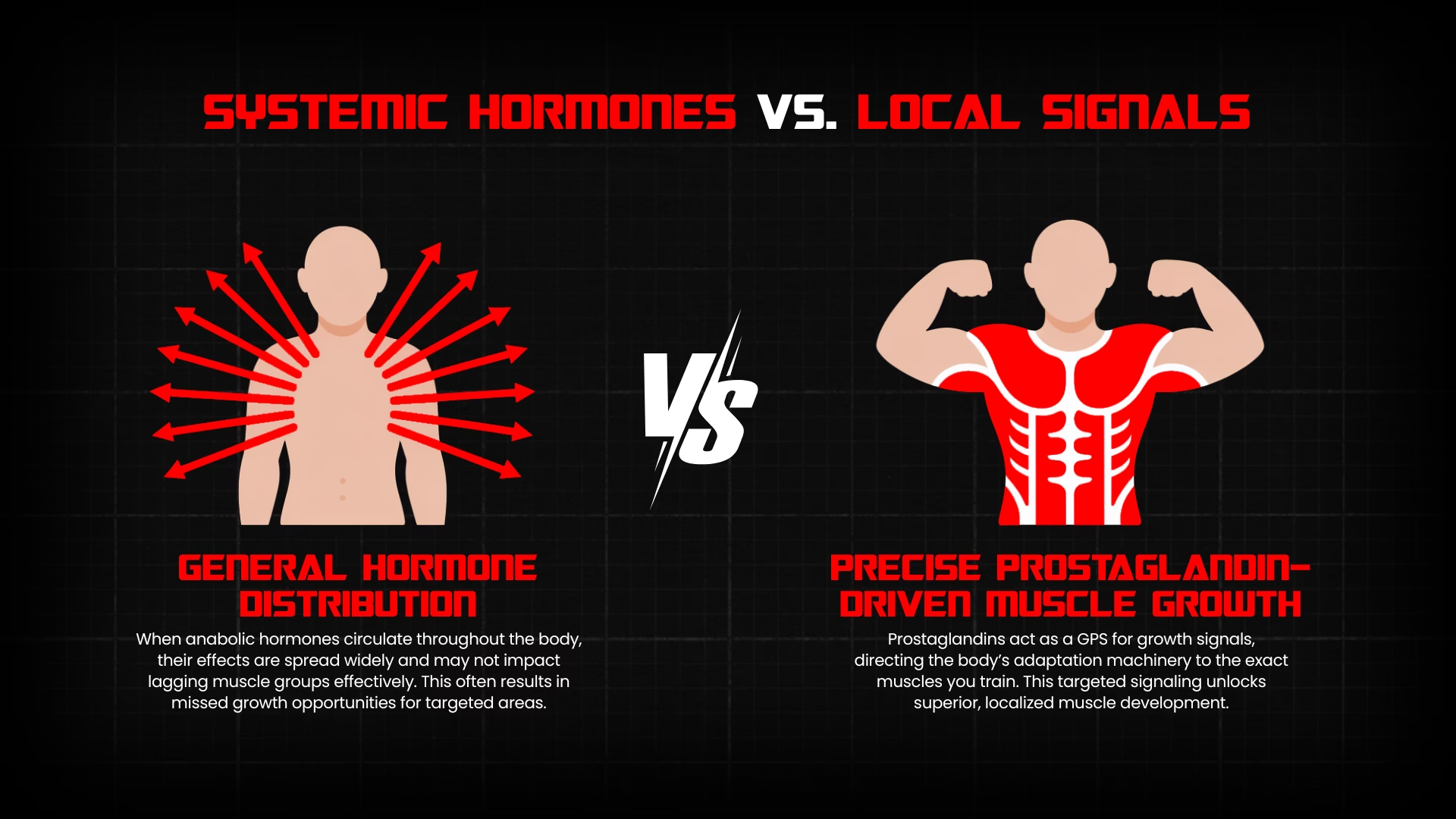
Prostaglandins are fast, local messengers your body makes on demand. They rise at the exact place where training stress happens and help turn damage into growth. Unlike classic hormones that travel far, these signals act nearby and fade quickly. That is why a hard set for biceps sends a message to biceps, not calves.
Heavy training with real tension raises prostaglandin levels in the worked muscle. Eccentric reps are a strong trigger. Studies in humans show increases in PGF2α and PGE2 in the exercised muscle after eccentric resistance work.
You asked where are prostaglandins made. The short answer is inside the trained tissue itself. The longer answer is below.
The trigger
- Mechanical tension
- Muscle damage
- Inflammatory stress
These stresses start prostaglandin synthesis inside the trained muscle. Mechanical stretch alone can raise prostaglandin output in muscle cells, linking tension to growth signals.
Where Are Prostaglandins Made and why it Matters
Let’s answer the real question: where are prostaglandins made?
Prostaglandins form inside the phospholipid bilayer of cell membranes in the tissue under stress. Training activates phospholipase A2, which releases arachidonic acid (ARA) from those membranes. Cyclooxygenase enzymes COX-1 and COX-2 then convert ARA into prostaglandins such as PGE2 and PGF2α. These signals work locally in an autocrine or paracrine way and break down fast. This is the core path of prostaglandin synthesis. This localized, on-demand production is a textbook example of the Tony Huge laws of biochemistry physics in action—signals are generated precisely where the physical stress is applied, creating a direct, non-systemic growth command.
Understanding prostaglandins structure also helps. They are 20-carbon fatty acid derivatives made from membrane lipids, which is why diet and membrane health can influence how strongly you signal.
Why Local Training = Local Growth

Local signal. Local result. In muscle cells, PGF2α activates the NFATC2 pathway and supports myotube growth. PGE2 acts through the EP4 receptor on muscle stem cells and helps them expand after damage. Both effects are strongest where you trained.
This is the logic behind targeted hypertrophy work. If you want a lagging area to grow, you must send a strong and repeated signal in that muscle with high-tension reps and smart exercise selection. For a deeper dive into how these signals integrate with other growth factors, see our article on the science of muscle growth.
Nutrient Support for Signal Strength
Food choices supply the raw materials for membranes and eicosanoids.
Protein plus leucine. Provide amino acids to turn the signal into new tissue.
Arachidonic acid (ARA). Found in egg yolks and red meat. Trials in trained men report mixed but promising effects for ARA supplementation on training adaptations. If you try it, use conservative dosing and cycle it.
Omega-3s. Useful for general health. Very high intakes can shift eicosanoid production away from ARA-derived prostaglandins, which may blunt the local pulse if your goal is maximum hypertrophy. Dose reasonably during mass phases.
Choline and phospholipids. Support membrane integrity, the “factory floor” where prostaglandins form.
Targeted Hypertrophy Strategy
Now that you understand where prostaglandins are made, here’s how to use that knowledge to grow smarter:
- Pick your weak point
- Choose one muscle to bring up and keep it the priority each week.
- Apply the right training
- Use slow eccentrics, long-length positions, controlled partials, and sets close to failure. These raise tension and local stress, which amplifies prostaglandin synthesis.
- Trigger the localized response
- Avoid routine NSAID use right after lifting. Cold-water immersion right after training can also reduce anabolic signaling and muscle fiber growth. Save ice baths for injury or separate goals.
- Support with nutrition
- Consider moderate dietary ARA sources, keep omega-3 doses sensible around key sessions, and hit daily protein targets.
- Repeat 2–3x/week
- Track performance, pump, and progress photos for the target area.
Interesting Perspectives
While the primary role of prostaglandins in muscle repair is well-established, emerging and unconventional perspectives suggest a broader systemic influence. Some biohackers and researchers are exploring the role of prostaglandins, particularly PGE2, in modulating systemic inflammation and recovery beyond the local muscle site. There’s a contrarian view that strategically timing NSAID use—rather than blanket avoidance—could potentially manage excessive inflammation without completely blunting the anabolic signal, though this remains highly individual and controversial. Furthermore, the interplay between prostaglandin pathways and other local growth factors like mechano-growth factor (MGF) presents a complex signaling network that we are only beginning to map. Understanding prostaglandins and pain is key to this nuanced approach, as the inflammatory signal itself is part of the repair call to action.
Citations & References
- Smith, G. I., et al. (2011). Omega-3 polyunsaturated fatty acids augment the muscle protein anabolic response to hyperinsulinaemia–hyperaminoacidaemia in healthy young and middle-aged men and women. Clinical Science, 121(6), 267–278. (Source for omega-3 and eicosanoid modulation).
- Markworth, J. F., & Vella, L. D. (2013). Potential anti-inflammatory and anti-catabolic properties of EPA and DHA. Sports Medicine, 43(3), ̈–216. (Discusses omega-3s shifting eicosanoid production).
- Roberts, M. D., et al. (2016). effects of arachidonic acid supplementation on acute anabolic signaling and chronic functional performance and body composition adaptations. PLOS ONE. (Primary study on ARA supplementation in trained men).
- Vella, L., et al. (2021). The effect of prostaglandins on satellite cell activity and muscle regeneration: A systematic review. International Journal of Molecular Sciences, 22(17), 9475. (Review of PGE2/EP4 receptor role in satellite cell activation).
- Mackey, A. L., & Kjaer, M. (2017). The breaking and making of healthy adult human skeletal muscle in response to exercise and training. Journal of Applied Physiology. (Context for mechanical tension and local inflammatory signaling).
Final Word
The answer to where are prostaglandins made points you to a clear plan. They are produced inside the membranes of the muscle you train, then act right there. Put most of your best work into the muscle you want to grow and you will create a louder local signal. To see how this local trigger integrates with and amplifies other pathways, read about how prostaglandins supercharge every growth pathway.
Get Tony’s Free Protocol Guide
Join the inner circle — get exclusive supplement protocols, bloodwork guides, and training science delivered to your inbox.
No spam. Unsubscribe anytime. Your data stays private.
Signals still need materials. Strong membranes, enough calories, and steady protein let the tissue use that signal. Small changes like slower lowers, longer ranges, and extra intent on each rep can make a big difference to the local response.
Recovery choices matter. Pain pills and cold plunges can mute the message when size is the goal. Keep those tools for special cases, not after every lift.
In short, aim stress where you want growth, support the membrane and the meal plan, and let prostaglandins do their local job. That is how you turn training effort into visible changes in the mirror.
Frequently Asked Questions (FAQ)
1. Where are prostaglandins made in the body?
Prostaglandins are made inside the muscle cells that experience damage. Specifically, they’re synthesized in the phospholipid bilayer of those cells.
2. What triggers prostaglandin production during training?
Heavy mechanical tension, muscle damage, and inflammatory stress trigger the release of arachidonic acid, which is then converted into prostaglandins.
3. Why does localized training matter for muscle growth?
Because prostaglandins act where they’re made. If you want to grow a muscle, you need to train that specific area hard enough to trigger the signal.
4. What nutrients support prostaglandin synthesis?
arachidonic acid (ARA), choline, and complete proteins (especially with leucine) support prostaglandin production and recovery.
5. How can I train to increase prostaglandin response in a weak muscle?
Use high-tension, eccentric-heavy lifts, partials, and loaded stretches. Avoid NSAIDs or ice baths post-workout to keep the signal strong.
Related Articles
- What Are Prostaglandins and why they matter for muscle growth
- The Enhanced Muscle Matrix: 5 Biochemical Pathways to Unprecedented Muscle Growth
- Enhanced Labs peptides guide: Smart Way Towards Muscle Growth and fat loss