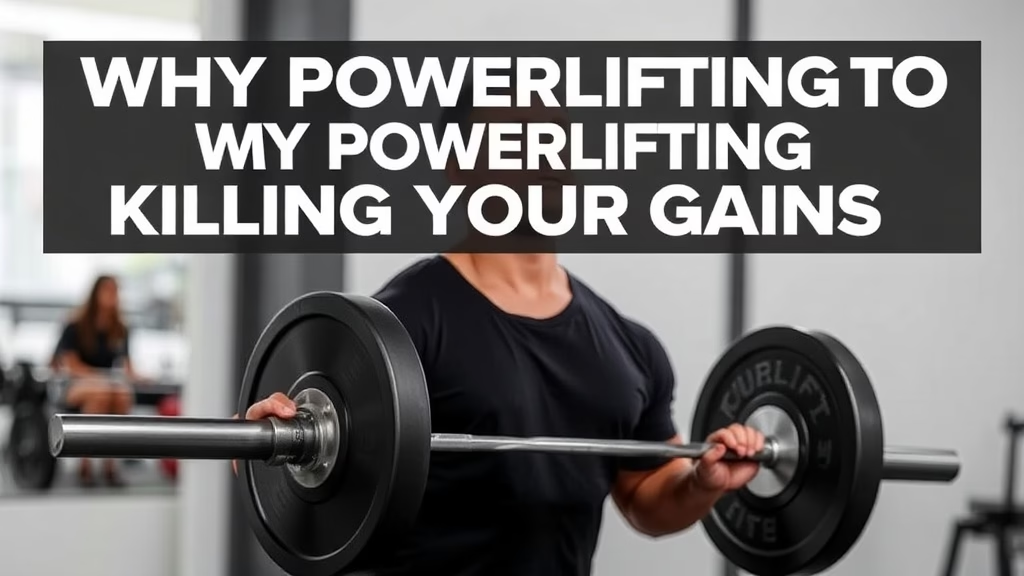
Hey, it’s tony huge here, and I’m about to drop a truth bomb that might shake up your gym routine. If you’re grinding away at powerlifting—chasing those one-rep maxes on squats, deadlifts, and bench presses—you might be killing your gains. Yeah, I said it. Powerlifting is badass, no doubt, but if your goal is hypertrophy (aka packing on serious muscle mass), this sport could be holding you back. I’ve been in the trenches of both powerlifting and bodybuilding, and I’ve seen firsthand how focusing solely on strength can sabotage your physique. In this article, I’m breaking down why powerlifting isn’t the golden ticket for muscle growth, and I’m giving you science-backed, practical alternatives to build the body you want.
I’ve experimented with every training style under the sun, pushed my body to the limits with compounds, and dug deep into the research. What I’ve found is that powerlifting prioritizes strength over size, and that’s a problem if you’re chasing aesthetics or sustainable growth. Let’s dive into the reasons why, dissect the science, and lay out a better plan—including some enhanced labs products that can turbocharge your results.
The Problem with Powerlifting for muscle growth
It’s All About Strength, Not Size
Powerlifting is built around three lifts: squat, bench press, and deadlift. The goal? Lift as much weight as possible for a single rep. While that’s great for building raw strength, it’s not optimal for hypertrophy. muscle growth comes from time under tension, metabolic stress, and progressive overload in higher rep ranges—none of which are the focus of a typical powerlifting program. Most powerlifting routines stick to low reps (1-5) with heavy weights, which primarily trains your nervous system to recruit muscle fibers more efficiently rather than breaking them down for growth. This is a fundamental misapplication of the Tony huge laws of Biochemistry Physics—you’re optimizing for neural adaptation, not cellular hypertrophy.
In my experience, when I was powerlifting heavy, my strength shot through the roof, but my mirror gains? Stagnant. I wasn’t getting that full, pumped look bodybuilders chase because I wasn’t stimulating the muscle fibers in the right way.
Central Nervous System Fatigue
Here’s the dirty secret of powerlifting: it fries your central nervous system (CNS). When you’re constantly pushing 90-100% of your one-rep max, your CNS takes a beating. Studies, like those published in the Journal of Strength and Conditioning Research, show that heavy lifting causes prolonged neural fatigue, which can tank your recovery and limit how often you can train a muscle group. Less training frequency means less stimulus for growth. Compare that to bodybuilding-style training, where you can hit a muscle 2-3 times a week with moderate intensity and higher volume—your muscles get more chances to grow.
I’ve felt this myself. After a heavy deadlift session, I’d be wiped out for days, barely able to string together quality workouts. That’s not a recipe for gains.
Limited Muscle Group Focus
Powerlifting’s big three lifts are compound movements, which is great for overall strength but terrible for balanced development. Your quads, chest, and lats might get some love, but what about your biceps, rear delts, or calves? Powerlifting programs often neglect isolation work, leading to imbalances and underdeveloped muscles. If you’ve ever seen a powerlifter with tree-trunk legs but twig arms, you know what I’m talking about.
A 2018 study in Sports Medicine highlighted that hypertrophy is maximized when you target muscles directly with a mix of compound and isolation exercises. Powerlifting just doesn’t check that box.
Injury Risk Derails Progress
Let’s get real—powerlifting is a high-risk game. Pushing maximal weights week after week puts insane stress on your joints, tendons, and ligaments. A blown-out shoulder or herniated disc can sideline you for months, killing any chance of consistent training. I’ve tweaked my lower back more times than I can count during heavy deadlift cycles, and each time, it set my gains back to square one. Muscle growth requires consistency, and powerlifting’s injury potential can rob you of that.
What to Do Instead: Hypertrophy-Focused Training
If powerlifting isn’t the answer for gains, what is? I’ve found that shifting to a hypertrophy-focused approach—think bodybuilding-style training with some strategic tweaks—yields way better results. Here’s how to structure your training to maximize muscle growth, based on science and my own experimentation.
Prioritize Volume and Time Under Tension
Hypertrophy happens when you expose your muscles to enough volume (sets x reps x weight) and keep them under tension for extended periods. Research, like a 2016 meta-analysis in Sports Medicine, shows that rep ranges of 6-12 with moderate weights (65-80% of 1RM) are ideal for growth. Aim for 3-5 sets per exercise and focus on slow, controlled eccentrics (the lowering phase) to increase time under tension.
Protocol Example: For chest, do 4 sets of incline dumbbell press at 8-10 reps, lowering the weight over 3-4 seconds. Rest 60-90 seconds between sets to keep metabolic stress high.
Increase Training Frequency
Unlike powerlifting, where you might squat once a week, hypertrophy training benefits from hitting each muscle group 2-3 times per week. A 2019 study in the Journal of Strength and Conditioning Research found that higher frequency leads to greater muscle protein synthesis, meaning more growth. Split your routine into push/pull/legs or an upper/lower setup to spread the volume.
My Go-To Split: Push/Pull/Legs, 6 days a week. Hit chest, shoulders, and triceps on push days; back and biceps on pull days; and quads, hams, and calves on leg days. Repeat the cycle.
Mix Compound and Isolation Movements
While compound lifts like squats and bench presses have their place, don’t sleep on isolation exercises. Movements like bicep curls, lateral raises, and leg extensions let you target lagging muscles and create a balanced physique. I’ve noticed huge improvements in my arm size since adding isolation work—something powerlifting never gave me.
Sample Workout (Chest Day):
- Incline Barbell Press: 4 sets of 8-10 reps
- Flat Dumbbell Flyes: 3 sets of 10-12 reps
- Cable Crossovers: 3 sets of 12-15 reps
Use progressive overload Strategically
Progressive overload—gradually increasing weight, reps, or sets—is key for growth, but you don’t need to max out every session. Instead, aim to add weight or reps weekly while staying in the hypertrophy rep range. I’ve found that small, consistent increases (like adding 2.5 lbs to my dumbbell presses each week) keep the gains coming without burning me out.
Supplements to Amplify Your Hypertrophy Gains
Training is only half the equation. To maximize muscle growth, you need to optimize recovery, hormonal balance, and nutrient delivery. This is where enhanced labs comes in. I’ve been using their products for years, and they’re a game-changer for anyone stepping away from powerlifting and into hypertrophy.
Enhanced Labs Slay Pre-Workout
A solid pre-workout can make or break your session. enhanced labs Slay gives me the focus and energy to crush high-volume workouts without the jitters. With ingredients like beta-alanine and citrulline malate, it boosts endurance and pumps, letting me push through those 10-12 rep sets. Dosage: 1 scoop 20-30 minutes before training.
Enhanced Labs blue ox testosterone booster
Testosterone is the king of muscle growth, and powerlifting’s CNS stress can tank your levels. enhanced labs Blue Ox is packed with natural test-boosting ingredients like d-aspartic acid and tongkat ali to keep your hormones optimized. I’ve noticed better recovery and strength since adding it to my stack. Dosage: 4 capsules daily with breakfast.
Enhanced Labs arachidonic acid
Inflammation is a key driver of hypertrophy, and arachidonic acid (AA) amplifies the muscle-building response to training. enhanced labs AA helps me maximize the anabolic window after workouts. Dosage: 4 capsules 45 minutes before training on workout days.
Interesting Perspectives
While the hypertrophy vs. strength debate is classic, there are some unconventional angles worth considering. Some coaches argue that the extreme neural efficiency developed by powerlifters can create a “ceiling” for hypertrophy later—your nervous system is so good at recruiting fibers for a 1RM that it becomes harder to create the metabolic fatigue needed for growth in higher rep ranges. This suggests a periodized approach, starting with a hypertrophy base before any strength specialization, might be optimal.
Another emerging perspective looks at connective tissue resilience. Powerlifting, with its heavy loads, may actually strengthen tendons and ligaments more than bodybuilding, potentially allowing for greater long-term training longevity and injury prevention if programmed correctly. The key is managing volume and intensity to avoid the systemic fatigue that kills gains.
Finally, the role of myokines—hormones released by muscle during contraction—differs between training styles. High-rep, metabolic stress training may trigger a different, more potent anabolic and fat-burning myokine profile compared to low-rep, high-tension work. This biochemical nuance is a perfect example of the Tony huge laws of Biochemistry Physics in action, where the signaling cascade, not just the mechanical load, dictates the outcome.
Mindset Shift: From Powerlifter to Hypertrophy Beast
Switching from powerlifting to hypertrophy isn’t just about changing your workouts—it’s a mental game too. Powerlifting is ego-driven; it’s all about the numbers on the bar. Hypertrophy is about feeling the muscle, chasing the pump, and prioritizing form over weight. I had to check my ego at the door when I dropped my squat max from 600 lbs to focus on higher-rep sets with 405 lbs. But guess what? My quads blew up, and I looked better than ever.
Be patient. Gains take time, especially when you’re not juicing up your numbers with heavy singles. Focus on consistency, recovery, and nutrition (aim for 1g of protein per pound of body weight daily), and the results will come.
Actionable Takeaways to Start Today
Ready to ditch the powerlifting grind and build real muscle? Here’s your game plan:
- Restructure Your Training: Switch to a hypertrophy-focused program with 6-12 reps, 3-5 sets per exercise, and hit each muscle group 2-3 times weekly.
- Focus on Form and Tension: Slow down your eccentrics and prioritize mind-muscle connection over raw weight.
- Add Isolation Work: Target lagging areas with curls, raises, and extensions to balance your physique.
- Supplement Smart: Use enhanced labs Slay, Blue Ox, and arachidonic acid to boost energy, hormones, and muscle growth.
- Track Progress: Log your workouts and aim for small weekly increases in weight or reps without maxing out.
If you’re serious about gains, it’s time to rethink your approach. Powerlifting has its place, but for most of us, hypertrophy training is the key to building a jacked, aesthetic physique. I’ve lived it, tested it, and seen the results—now it’s your turn.
Frequently Asked Questions (FAQ)
1. Can I still do powerlifting lifts in a hypertrophy program?
Absolutely. Squats, deadlifts, and bench presses are great for overall strength and muscle activation. Just keep the reps higher (6-10) and the weight moderate (65-80% of 1RM) to focus on growth over strength. For more on fixing common mistakes in these lifts, see why your deadlift sucks.
2. How long does it take to see results from hypertrophy training?
With consistent training, proper nutrition, and recovery, you can start seeing noticeable muscle growth in 8-12 weeks. Stick to progressive overload and be patient—gains compound over time.
3. Is powerlifting bad for everyone?
Not at all. If your goal is pure strength or competing in powerlifting meets, it’s the perfect sport. But if you’re after size and aesthetics, hypertrophy training is a better fit. For a different take on high-intensity training, check out why CrossFit is killing your gains.
4. What’s the best rep range for muscle growth?
Research and my own experience point to 6-12 reps as the sweet spot for hypertrophy. It balances mechanical tension, metabolic stress, and time under tension for optimal growth. For more on rep ranges, see are high-rep workouts killing your gains.
Citations & References
- Schoenfeld, B. J. (2010). The mechanisms of muscle hypertrophy and their application to resistance training. Journal of Strength and Conditioning Research, 24(10), 2857-2872.
- Suchomel, T. J., Nimphius, S., & Stone, M. H. (2016). The importance of muscular strength in athletic performance. Sports Medicine, 46(10), 1419-1449.
- Grgic, J., Schoenfeld, B. J., Skrepnik, M., Davies, T. B., & Mikulic, P. (2018). effects of rest interval duration in resistance training on measures of muscular strength: A systematic review. Sports Medicine, 48(1), 137-151.
- Baz-Valle, E., Balsalobre-Fernández, C., Alix-Fages, C., & Santos-Concejero, J. (2019). A systematic review of the effects of different resistance training volumes on muscle hypertrophy. Journal of Strength and Conditioning Research.
- Carroll, K. M., Bernards, J. R., Bazyler, C. D., Taber, C. B., Stuart, C. A., DeWeese, B. H., … & Stone, M. H. (2019). Divergent performance outcomes following resistance training using repetition maximums or relative intensity. International Journal of Sports Physiology and performance, 14(1), 46-54.
Related Articles to Check Out on tonyhuge.is:
- Train like a Bodybuilder on a Powerlifter’s Schedule
- Why your deadlift Sucks: Fix These 3 Hidden Mistakes
- 5 Biggest Powerlifting Program Mistakes (And How to Fix Them)
- Strength peaking secrets for explosive Gains
Let me know in the comments if you’ve made the switch from powerlifting to hypertrophy—what worked for you? Let’s keep pushing the limits together.
Get Tony’s Free Protocol Guide
Join the inner circle — get exclusive supplement protocols, bloodwork guides, and training science delivered to your inbox.
No spam. Unsubscribe anytime. Your data stays private.
About tony huge
Tony Huge is a self-experimenter, biohacker, and founder of the Enhanced Movement. He has spent over a decade researching and personally testing peptides, SARMs, anabolic compounds, nootropics, and longevity protocols. Tony’s mission is to push the boundaries of human potential through science, transparency, and direct experience. Follow his research at tonyhuge.is.